 Best
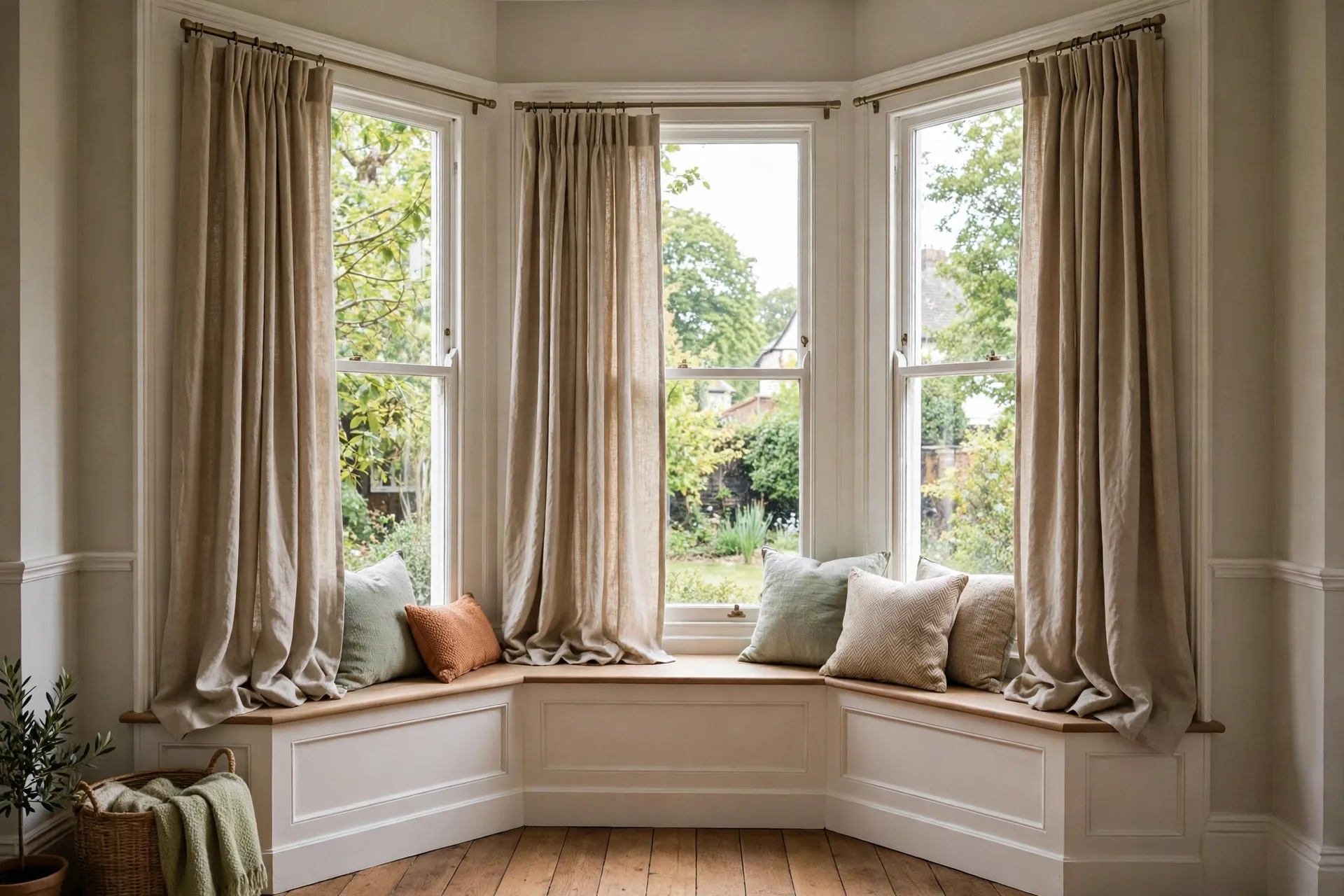
Best Curtains for Bay Windows
A bay window is three or more panes set at angles, and no single straight rod fits it. This guide sorts the hardware, the measuring, and the curtain types by bay size, room, and job.
The best curtains for a bay window are the ones that follow the angles of the bay instead of fighting them. A curved track or an angled bay rod with panels that draw around the corners beats a single straight rod every time, because a straight rod either cuts across the bay and wastes the nook, or stops short and leaves a gap at each angle. Choose the hardware first, then the panels to suit it.
A bay window pushes out from the wall of a room and turns a flat window into a small alcove with daylight from three directions. That shape is the appeal of a bay, and also the problem with dressing one. This guide sorts the hardware, the measuring, the length decisions for seats and radiators, and the curtain types by bay size and room, so the finished bay looks like one window, not three forced together.
Bay window picks by job
Sheer pinch-pleated panels suit a bright bay, blackout linen suits a bedroom bay that must stay dark, and short linen panels suit a bay with a seat or a radiator below. The picks are grouped by the bay job each one fits, not by brand. Check the heading, the lining, the finished length, and the care label on the listing.
As an Amazon Associate, we earn from qualifying purchases.
| Pick | Type | Mounting | Best for |
|---|---|---|---|
| 1 | Topfinel Pinch Pleated Sheer Curtains | Curved track | A bright bay that needs soft daylight and daytime privacy |
| 2 | MIULEE 100% Blackout Linen Curtains | Angled bay rod | A bedroom bay that must stay dark |
| 3 | Pickluc Burgundy Blackout Curtains | Bay rod or track | A cold bay that loses heat |
| 4 | MIULEE Sage Short Linen Curtains | One rod per section, or a bay rod | A bay with a built-in seat or a radiator below |
| 5 | Best Home Fashion uMIXm Mix and Match Tulle Sheer and Blackout Curtain Set | Double bay rod | A bay used day and night |
| 6 | Everyday Celebration Cordless Roman Shades | One shade per pane, side panels on a bay rod | A small bay where curtains would crowd the nook |
1. Topfinel Pinch Pleated Sheer Curtains: best for a bright bay that needs soft daylight and daytime privacy
- Best for: A living room bay where daylight matters most, with soft privacy from the street during the day.
- Key features: Lightweight semi-sheer panels, curved track that follows the bay angles, soft filtered light.
- Pros: Keeps the bay bright, follows the angles without gaps, gentle privacy by day, light fabric slides easily on a track.
- Cons: Little privacy at night once indoor lights are on, no real darkness alone, needs a track, not a straight rod.
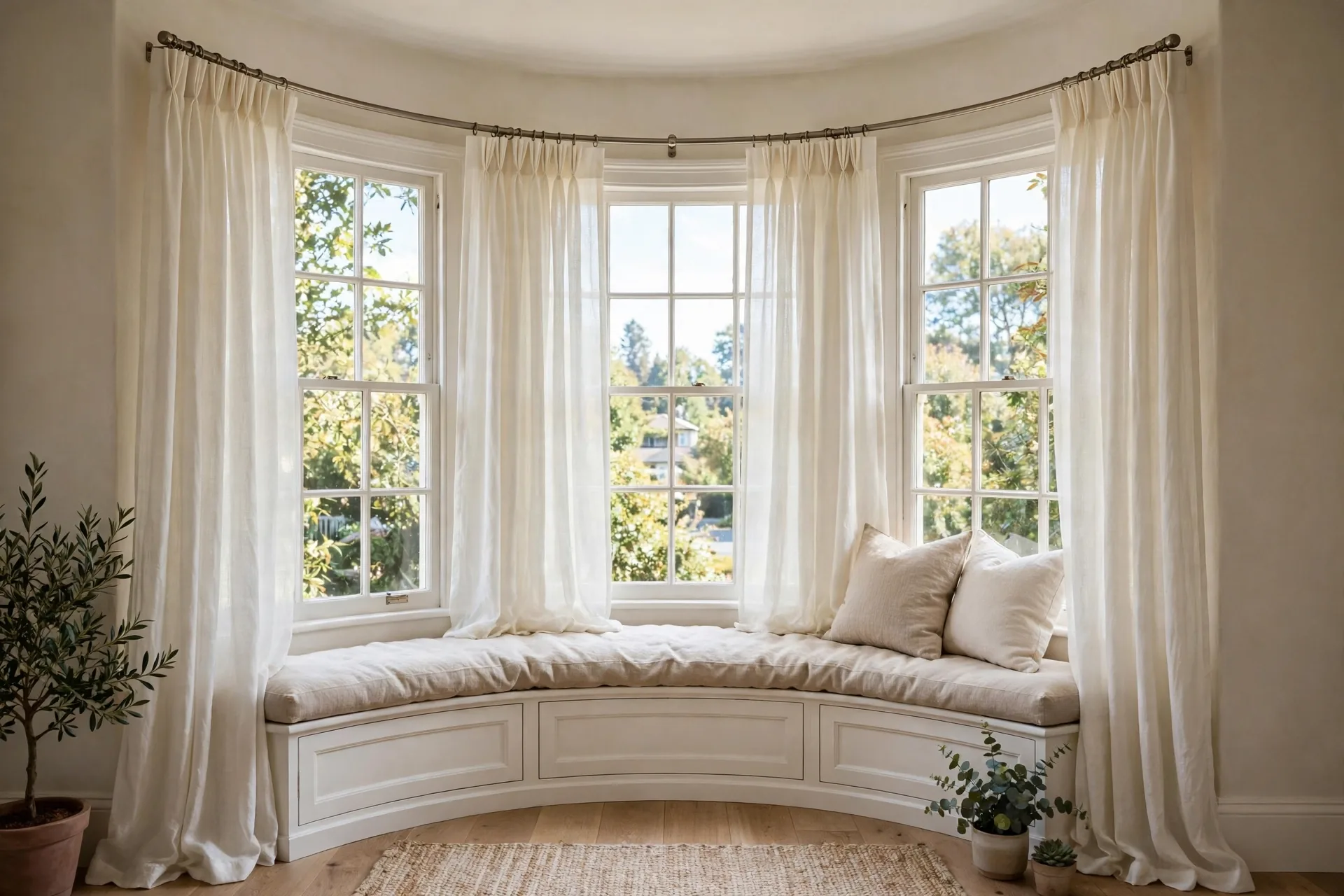
2. MIULEE 100% Blackout Linen Curtains: best for a bedroom bay that must stay dark
- Best for: A bedroom bay where sleep comes first, including rooms facing street light or morning sun.
- Key features: Blackout-lined panels, angled bay rod with corner joints, panels overlap the frame when closed.
- Pros: Strong darkness for sleep, covers the angles when drawn, plain panels suit a restful room.
- Cons: Heavier panels need firm brackets, the open stack takes rod space at each end, check the care label.
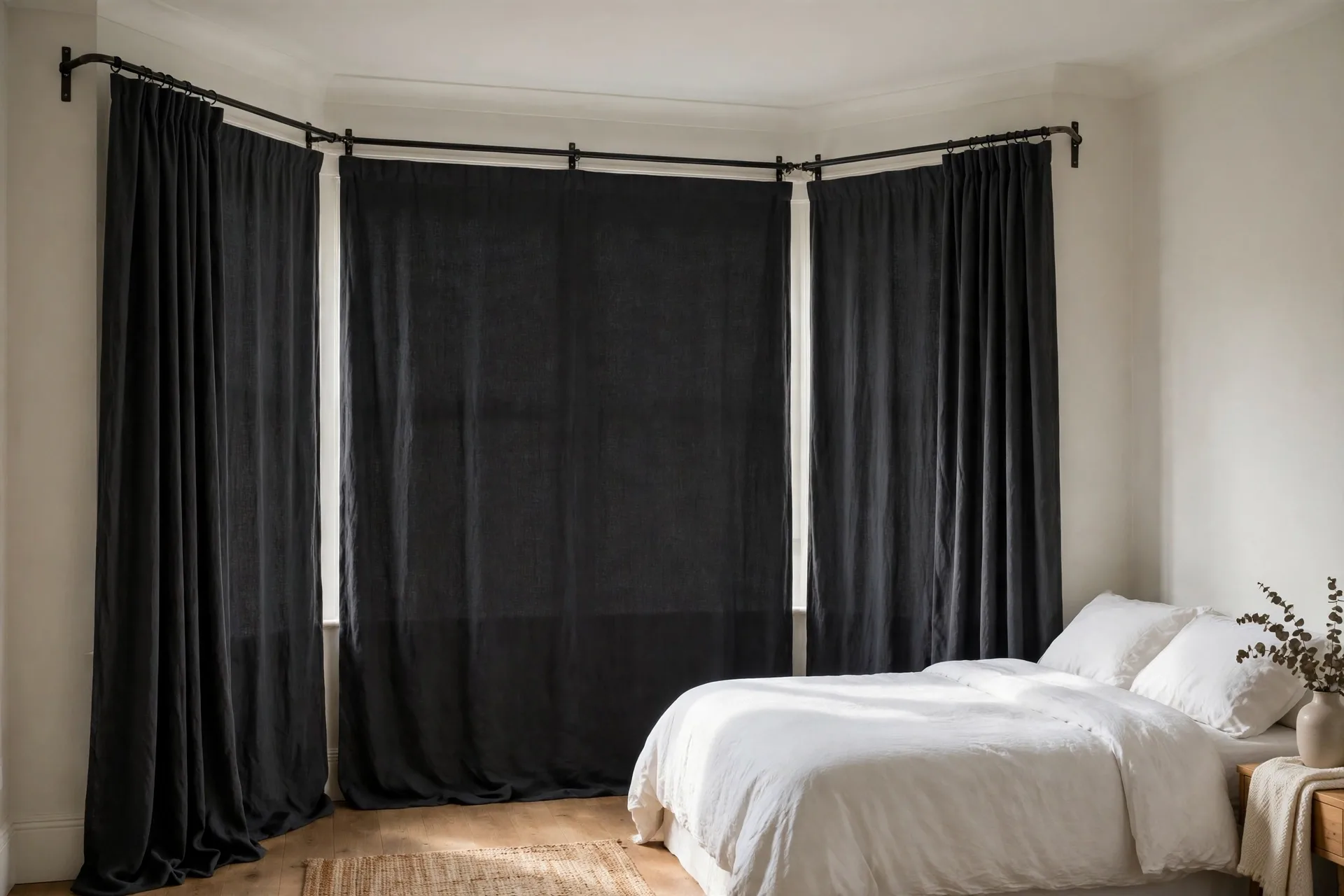
3. Pickluc Burgundy Blackout Curtains: best for a cold bay that loses heat
- Best for: A bay that feels cold in winter, where extra glass and old frames let cold air in.
- Key features: Thermal-insulated 230 GSM polyester fabric, bay rod or track, floor length to stop cold air at the sill, heavier fall.
- Pros: Softens cold air at the glass, fuller folds when closed.
- Cons: Heavier than unlined panels, so the rod and brackets must suit the weight, adds stack width when open.
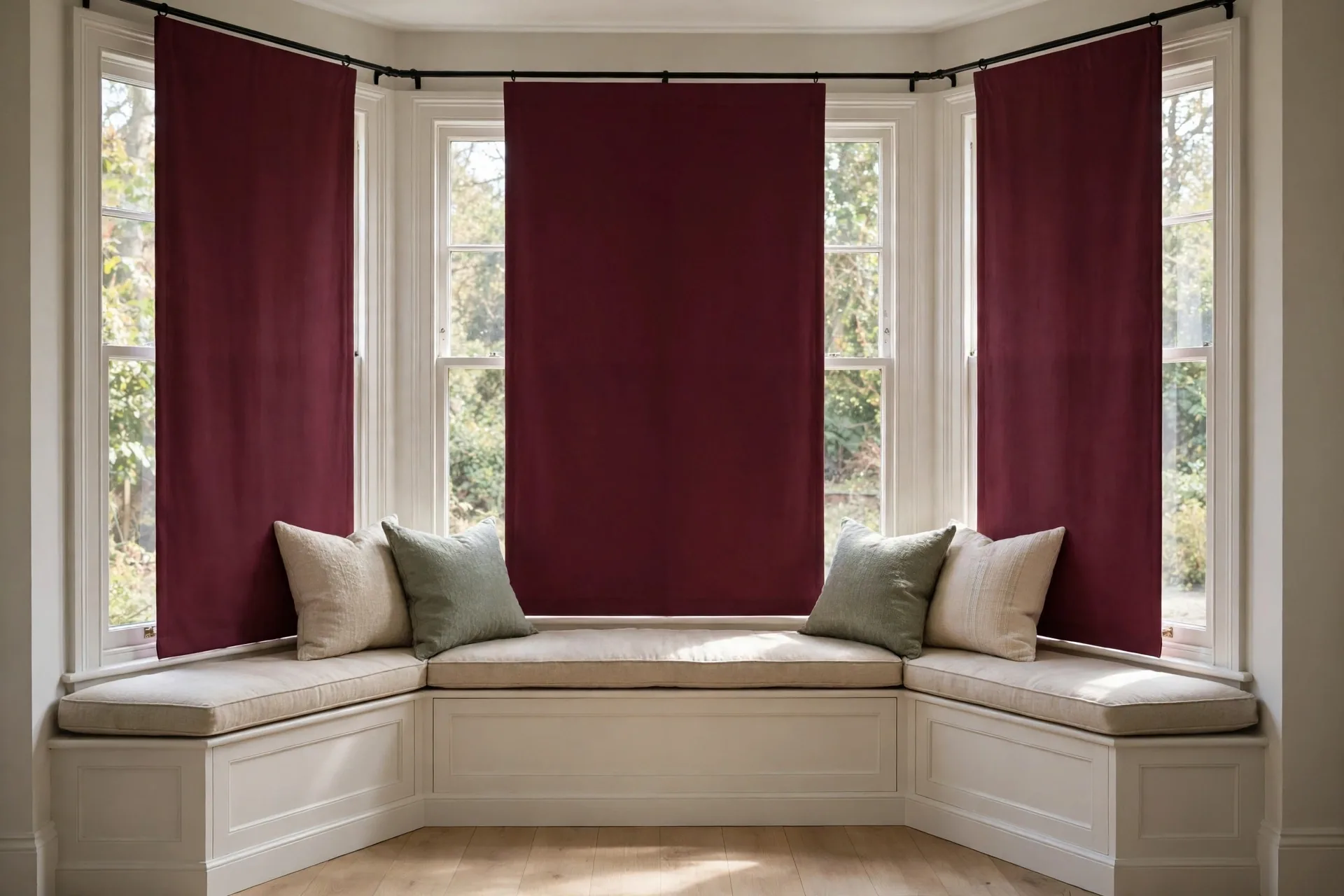
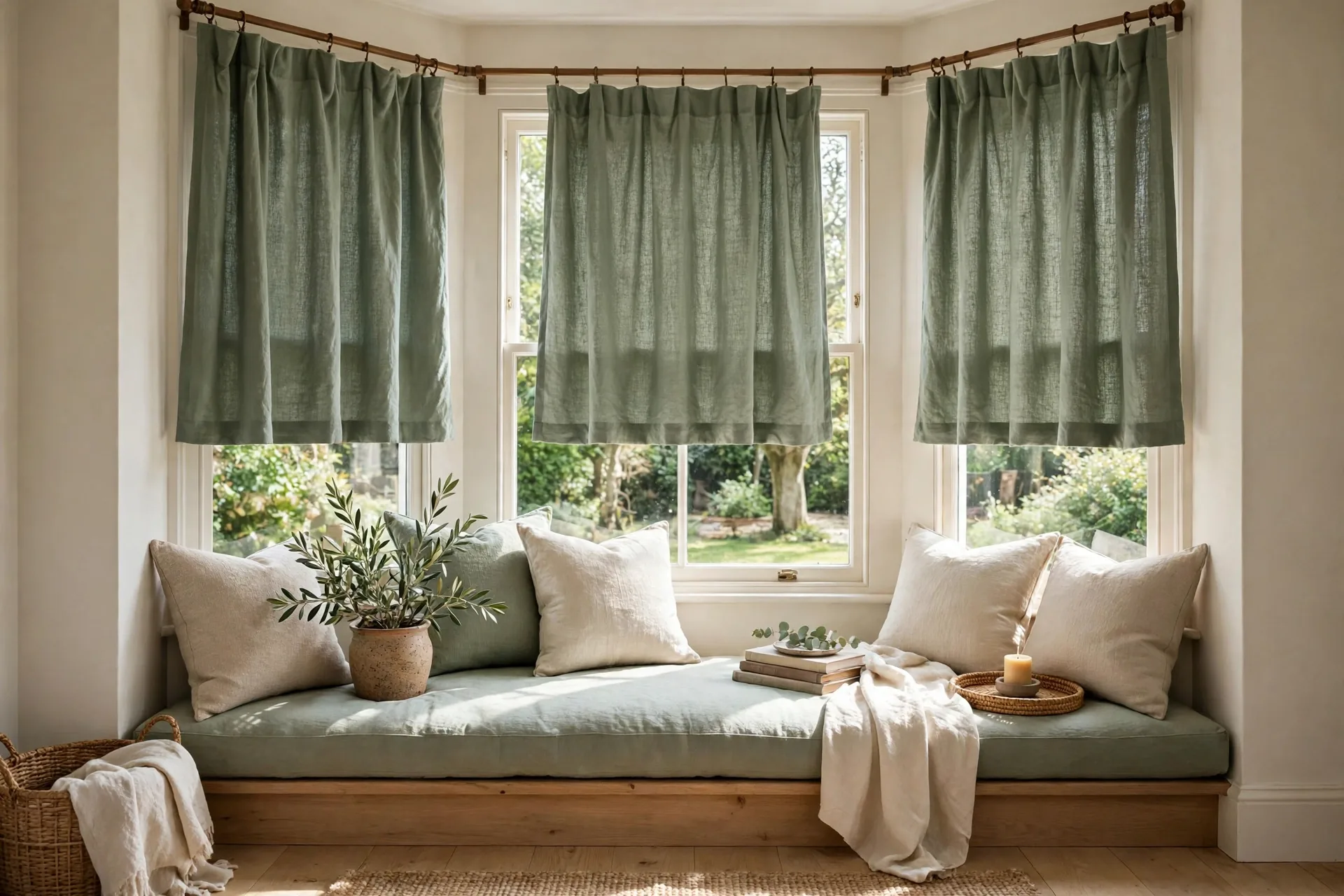
4. MIULEE Sage Short Linen Curtains: best for a bay with a built-in seat or a radiator below
- Best for: A kitchen or living room bay with a seat, a desk, or a radiator under the glass, where floor-length panels would sit on the seat or block heat.
- Key features: Short cafe length ending at or just below the sill, light washable fabric, one rod per section or a bay rod.
- Pros: Keeps the seat and the radiator usable, easy to wash, daylight above the panels stays bright.
- Cons: Limited privacy at night, no darkness alone, short panels suit casual rooms better than formal ones.
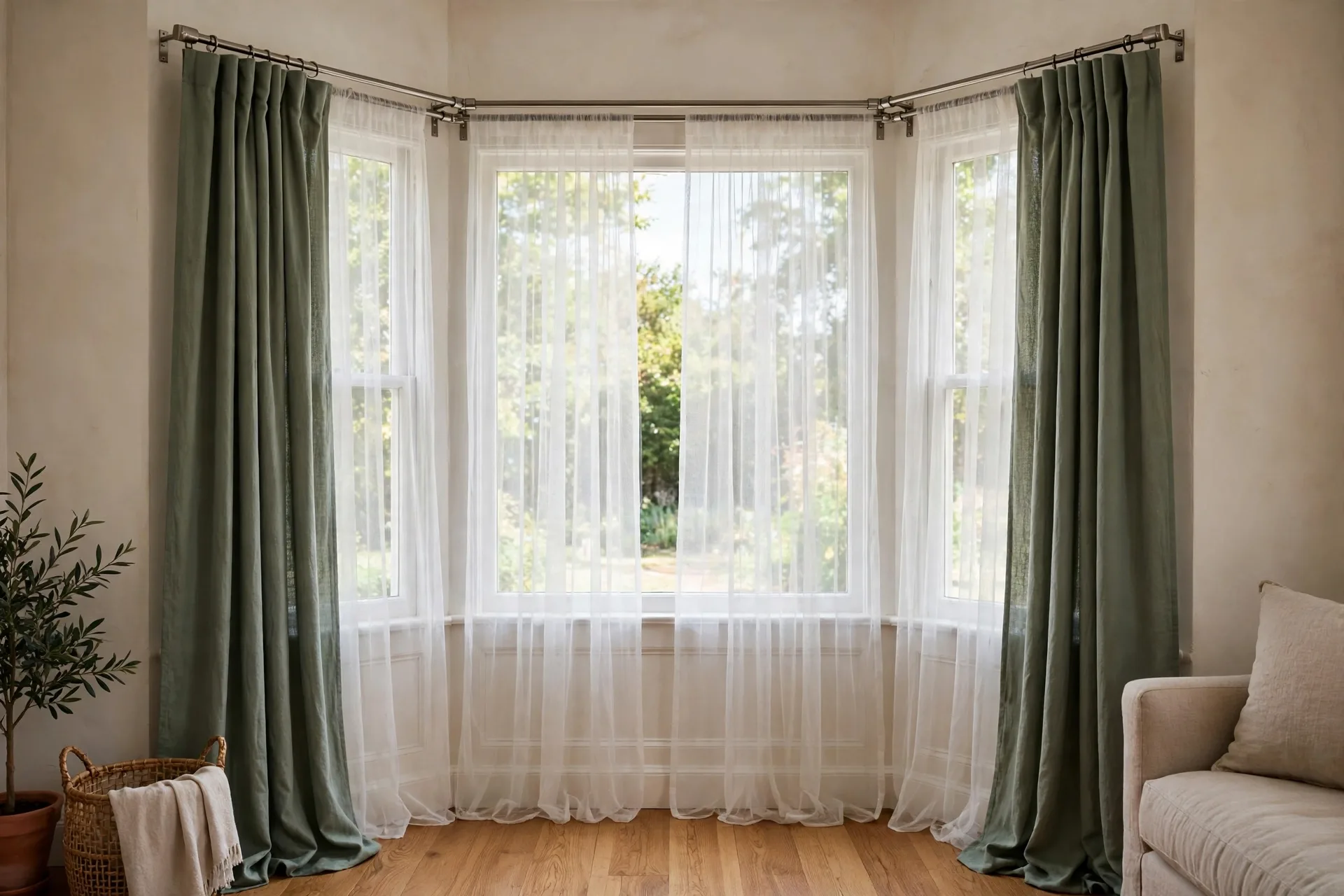
5. Best Home Fashion uMIXm Mix and Match Tulle Sheer and Blackout Curtain Set: best for a bay used day and night
- Best for: A bay that works as a living space by day and needs full cover at night, such as a bedroom bay or a street-facing living room bay.
- Key features: Sheer layer nearest the glass, blackout layer on the room side, double bay rod so each layer moves on its own, 2 tulle sheer panels and 2 blackout panels in one set, grommet top, 52 by 84 inches each
- Pros: Daylight through the sheer by day, full darkness and privacy at night, each layer draws on its own.
- Cons: Two layers stack wider when open, so leave stack space at each end, needs a double bay rod, grommet panels do not run on a track, heavier total load.
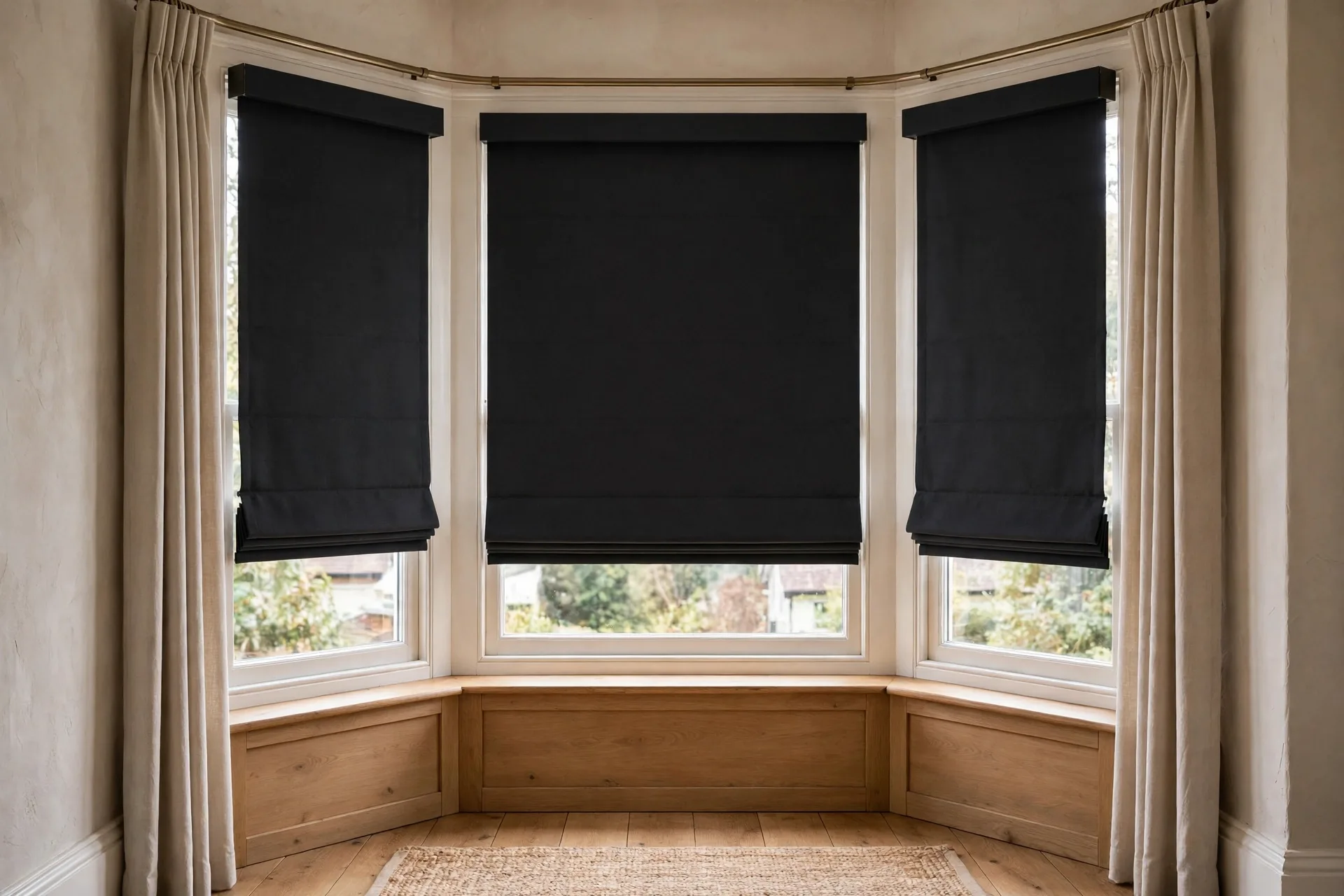
6. Everyday Celebration Cordless Roman Shades: best for a small bay where curtains would crowd the nook
- Best for: A small bay, a bay with a desk or a seat tight under the glass, or a bay where full curtains would fill the nook.
- Key features: One Roman shade per pane, stationary side panels on a bay rod for softness, compact header at each pane.
- Pros: Keeps the nook open and usable, per-pane control of light.
- Cons: Shades need a good fit per pane, so measuring matters more, side panels do not close.
A Roman shade is the practical answer for a bay with a shallow sill. It is not a curtain, but it solves the bay problem.
What a bay window is and why one rod never fits it
A bay window is a window that projects outward from the main wall of a room, usually in three sections: a wide front pane and two angled side panes. The projection turns a flat window into a shallow alcove, which is why bays suit a reading seat, a breakfast table, or a row of plants. A bow window, four or more panes in a gentle curve, is the close cousin.
One straight rod never fits a bay, because the glass does not sit in one plane.
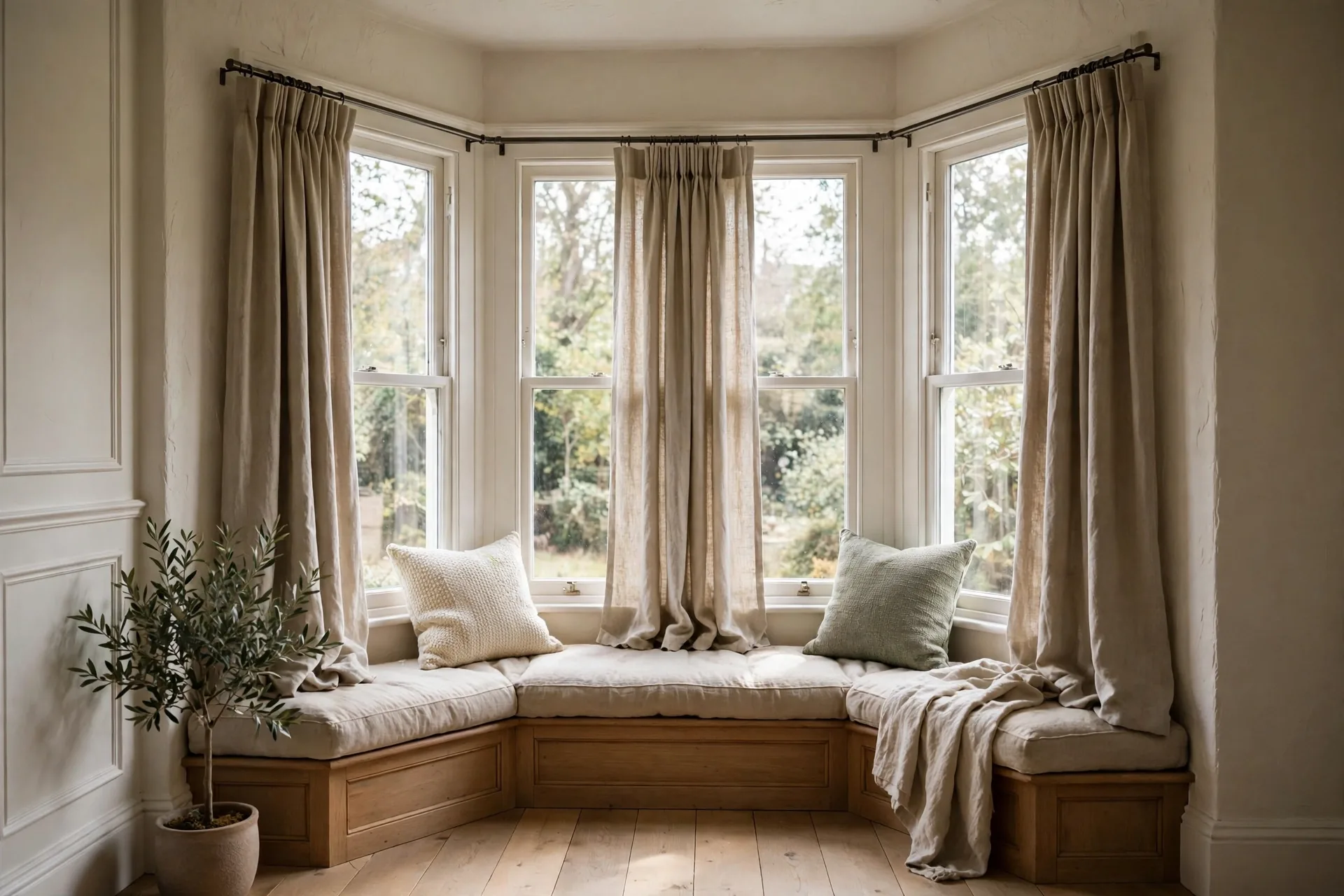
A rod fixed straight across the front cuts off the side panes, wastes the alcove, and leaves the side glass bare. A rod fixed inside the bay needs a joint at each angle, or it cannot follow the turn at all. The fix is hardware made for angles: an angled bay rod with hinged corner joints, a curved track bent to the bay, or separate rods, one per section, where the look allows it.
A canted bay is the third common type: its angled sides typically sit at 30 or 45 degrees, between the square sides of a box bay and the gentle curve of a bow window.
Bay hardware in plain words
An angled bay rod is a rod in sections joined at the bay angles, so panels draw around the corners. It suits most three-section bays, takes standard headings such as grommet, rod pocket, and back tab, and is the simplest choice where the angles are clean and the panels are not too heavy. A curved track is bent to follow the bay, including fully curved bow windows, and gives the smoothest draw around corners. It suits ripple-fold and pinch-pleat panels best, and can run on the wall or the ceiling.
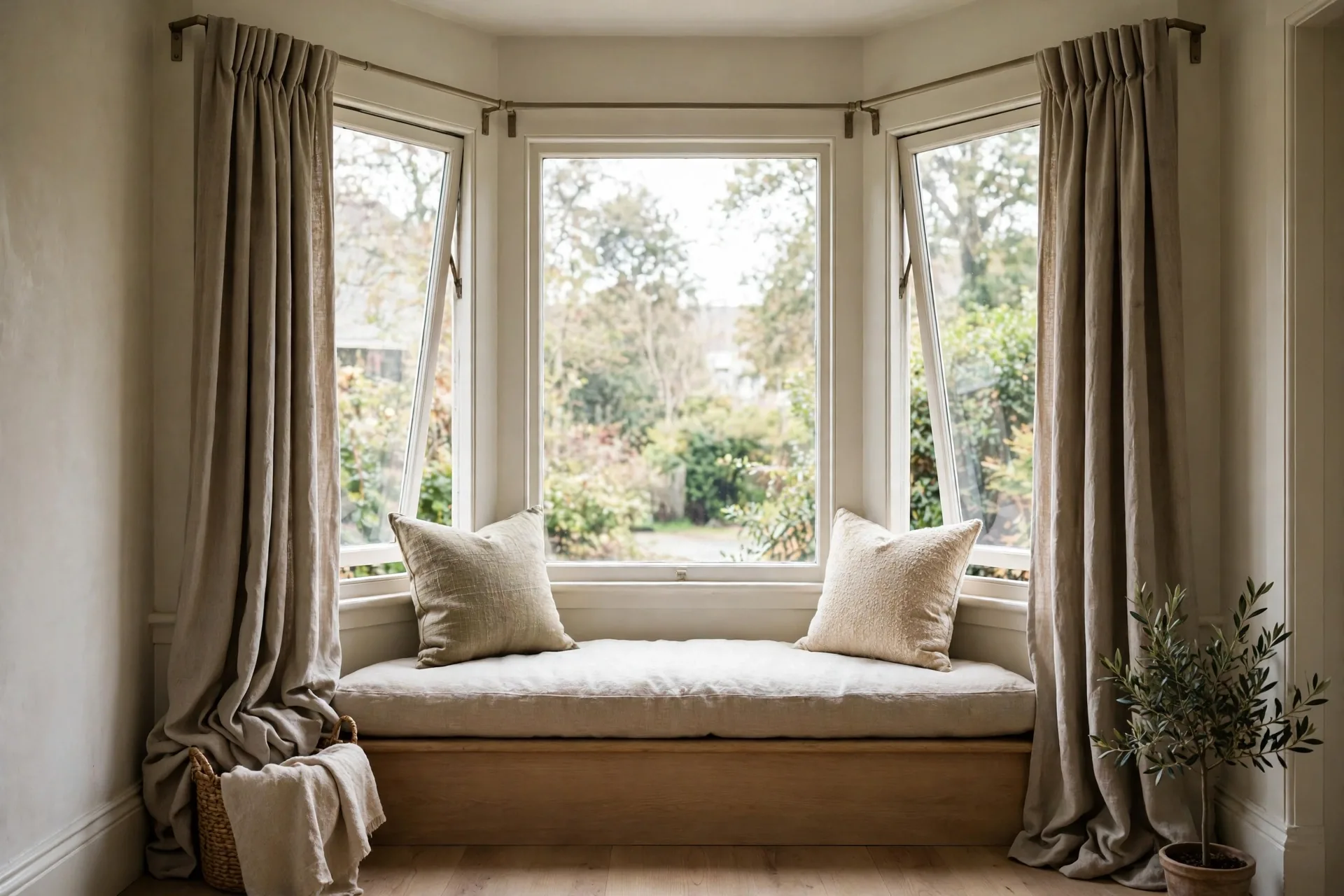
Separate rods, one per section, are the third choice, and suit bays where each pane is dressed on its own, such as cafe panels on a seating bay. They are simpler to fit and cheaper to replace, but the panels do not draw across the bay as one curtain, and the rod ends at each angle need care. A ceiling track suits tall bays and bays with little wall above the frame, because it lifts the eye and can run past the frame where a wall rod would stop short. Whichever hardware you choose, fix brackets into solid wall or proper anchors, and check the load rating, because a bay carries more fabric and more joints than a flat window. For rod and bracket detail, see How to Hang Curtains.
If the top of the window has no studs, blinds are the safer option, because bay walls can be thinner or differently built. Fix into solid material, and use specialist drywall anchors in drywall, not standard wall anchors.
Motorized bay curtains on flexible motorized tracks with smart-home schedules, closing at sunset and opening in the morning, suit bays where the track runs through tight angles and manual operation is a wrestle.
Hang from the center outward for even distribution, and use a spirit level, not the eye, because bays play tricks with perspective.
How to measure a bay window section by section
Measure a bay window section by section, never as one straight span, because each pane has its own width. Start with the front pane, measuring from angle to angle, then each side pane from the angle to the frame edge, and note which figure belongs to which pane. Measure the depth of the bay too, from the wall line to the front glass, because the depth decides whether a seat or a radiator will foul the panels.
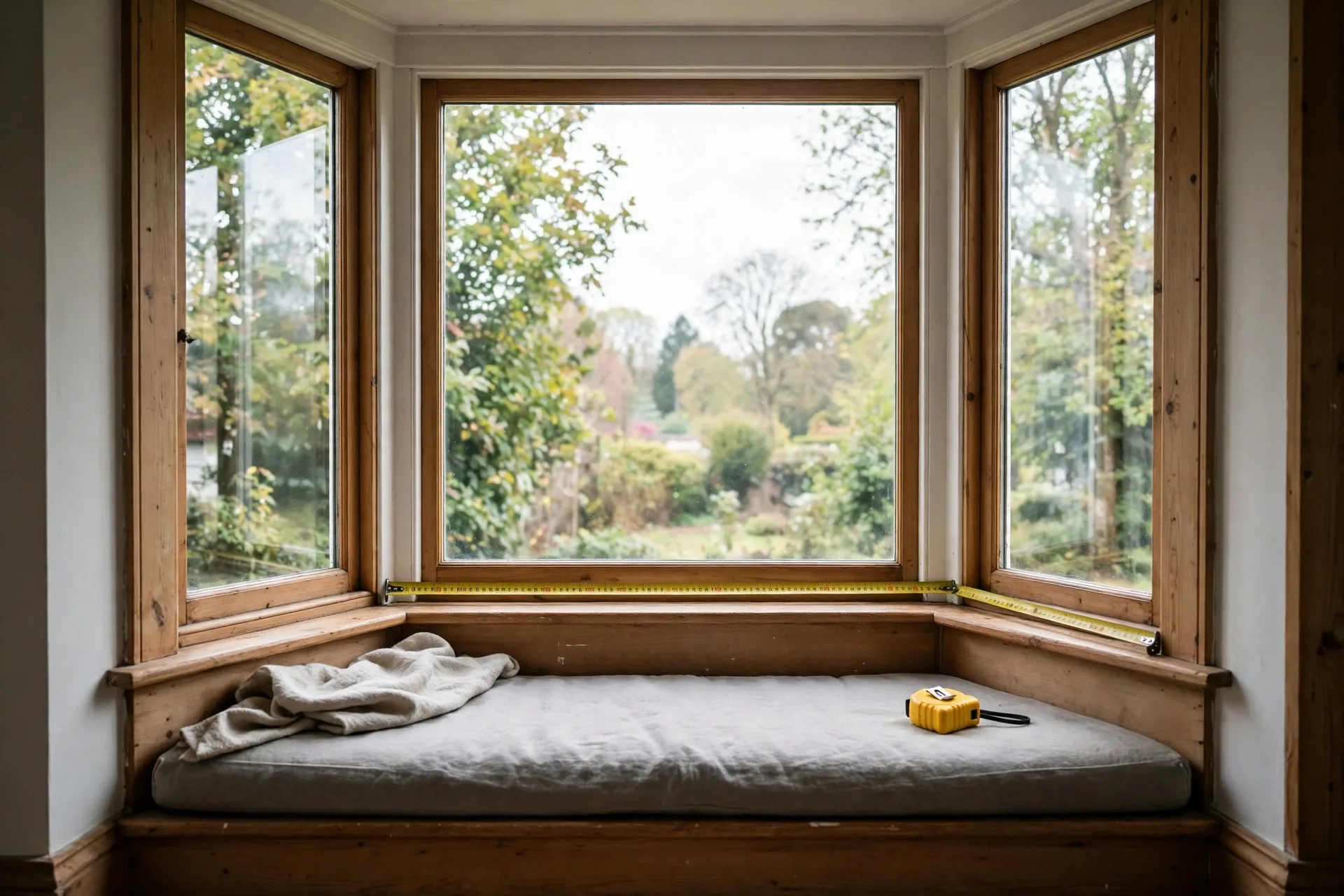
Next, note whether each joint is a shallow or a sharp turn, because the hardware is cut or bent to those angles and a wrong angle leaves a gap at the corner. Then decide the rod position: height above the frame, and how far past each outer frame edge the rod should run. Add that stack space to the section widths before you work out panel count, because panels bunched at the angles still cover glass. For the full measuring steps, see How to Measure for Curtains, and for length choices, see Curtain Sizes.
Add 12 to 24 inches to total width for overhang, so open curtains clear the glass instead of covering the outer panes.
Inside-mounted blinds or Roman shades need at least 2 inches of recess, or they protrude awkwardly past the frame.
Fullness on a bay runs 1.5 to 2 times the section width for a standard look, 2 to 2.5 times for a full look, 2.5 to 3 times for pinch pleat, and 2 to 2.5 times for sheer.
Seating, radiators, and the length decision
The length decision on a bay is set by what sits under the glass, not by habit. A bay with a built-in seat needs panels that stop at or just below the sill, so nobody sits on fabric and the seat stays usable. A bay with a radiator below needs the same short length: floor-length panels over a radiator trap heat behind the fabric and can scorch or discolor it, so keep panels clear of the radiator top.
A bay with nothing below it takes floor length, which suits the tall glass.
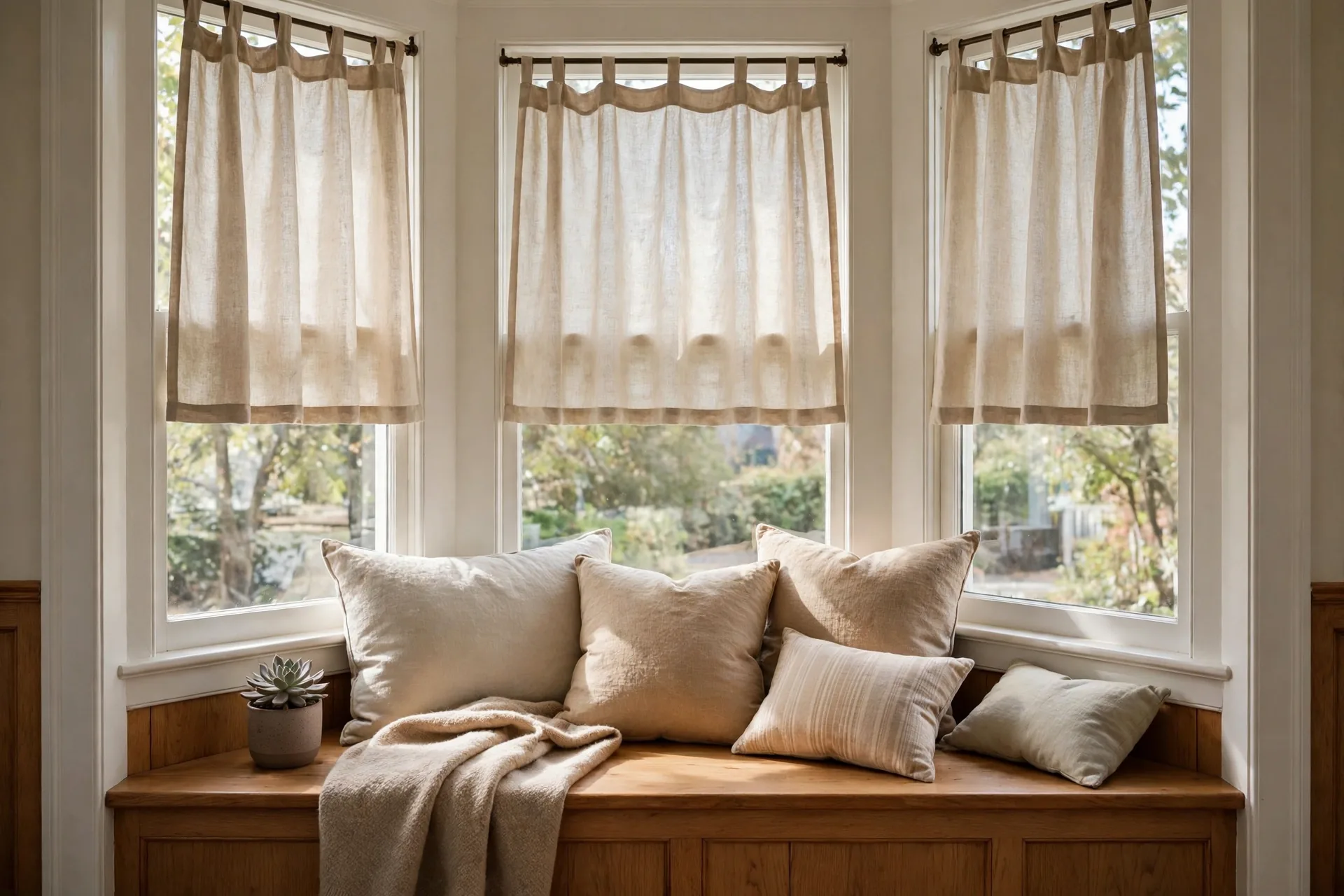
Floor length also helps with cold air at the sill, because a panel that reaches the floor closes the cold gap there. Where a bay is used as a dining nook or a desk bay, match the length to the furniture: panels should clear the table or desk edge when drawn. If the bay has both a seat and a radiator, the radiator rule wins, and short panels are the safe choice.
Light, privacy, and cold air across angled glass
Light on a bay comes from three directions at once, so a bay is brighter than a flat window of the same width, and harder to darken. Sheers suit a bay by day, because they soften glare from every pane without shutting out the daylight that makes a bay worth having. For the sheer job in full, see Best Sheer Curtains. For night privacy and darkness, the panels must close across the whole bay, including the angles, because a gap at one corner leaks light and sightlines. A blackout layer on a bay track, or blackout panels on an angled rod, gives the night job, and the panels must overlap the outer frame when closed, not just meet in the middle. For the full darkness job, see Best Blackout Curtains.
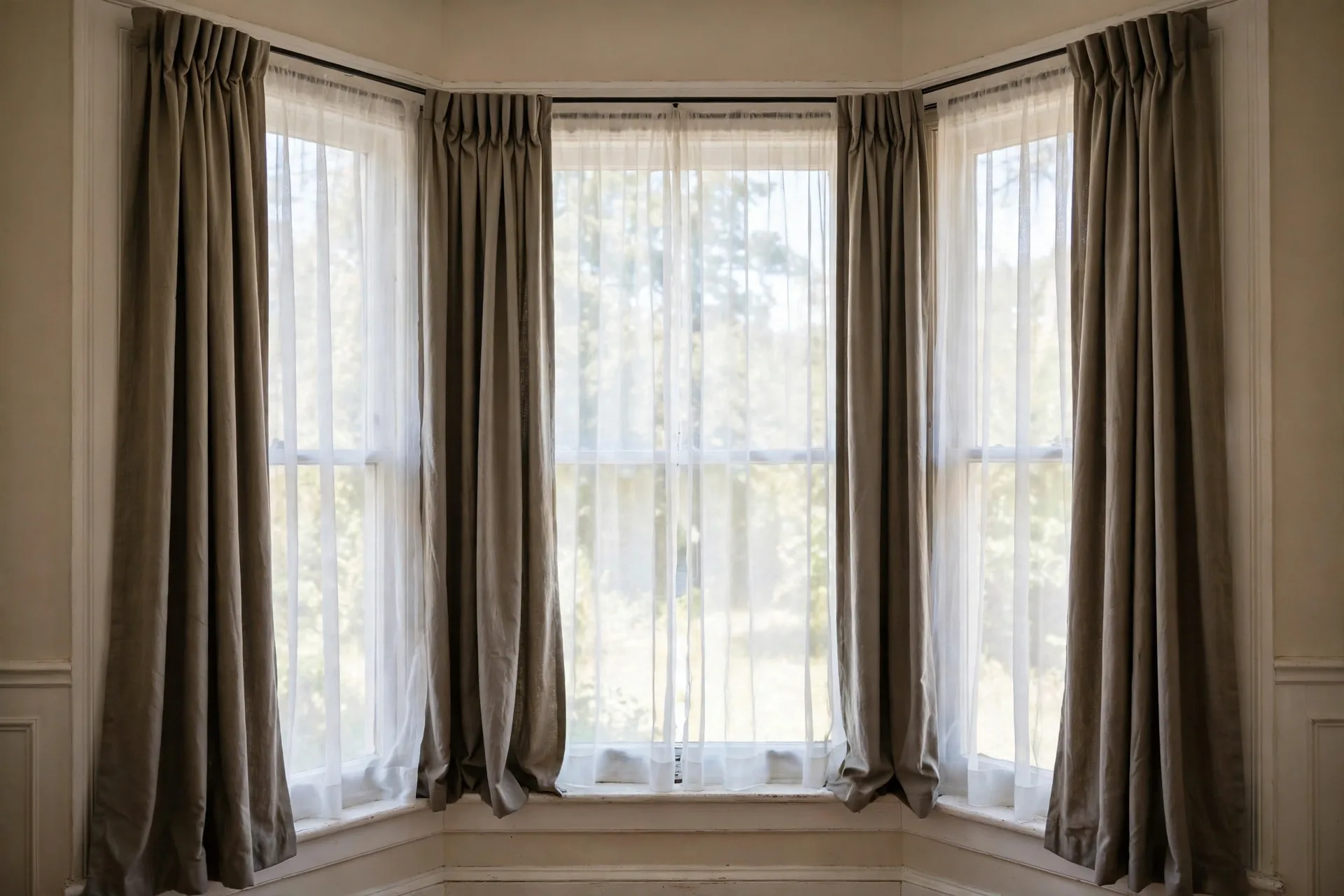
Cold air is the other bay problem, because a bay has more glass, more frame joints, and more outside wall than a flat window. A thermal lining behind the face fabric helps, and so does a floor-length close, which shuts the cold air at the sill instead of letting it spill into the room. For the full warmth job, see Best Thermal Insulated Curtains. A sheer alone will not fix a cold bay, and a heavy panel hung short over a radiator will not either.
Bay windows by room
A living room bay is usually the room's main feature, so it suits full-length panels on a curved track or an angled rod, with a sheer layer for day and a closing layer for evening. Keep the color plain where the room already has pattern, and let the bay shape carry the interest. For living room direction and color, see Best Curtains for Living Room. A bedroom bay needs darkness first, so a blackout layer that closes across the whole bay matters more than the face fabric. For room-wide bedroom advice, see Best Curtains for Bedroom.
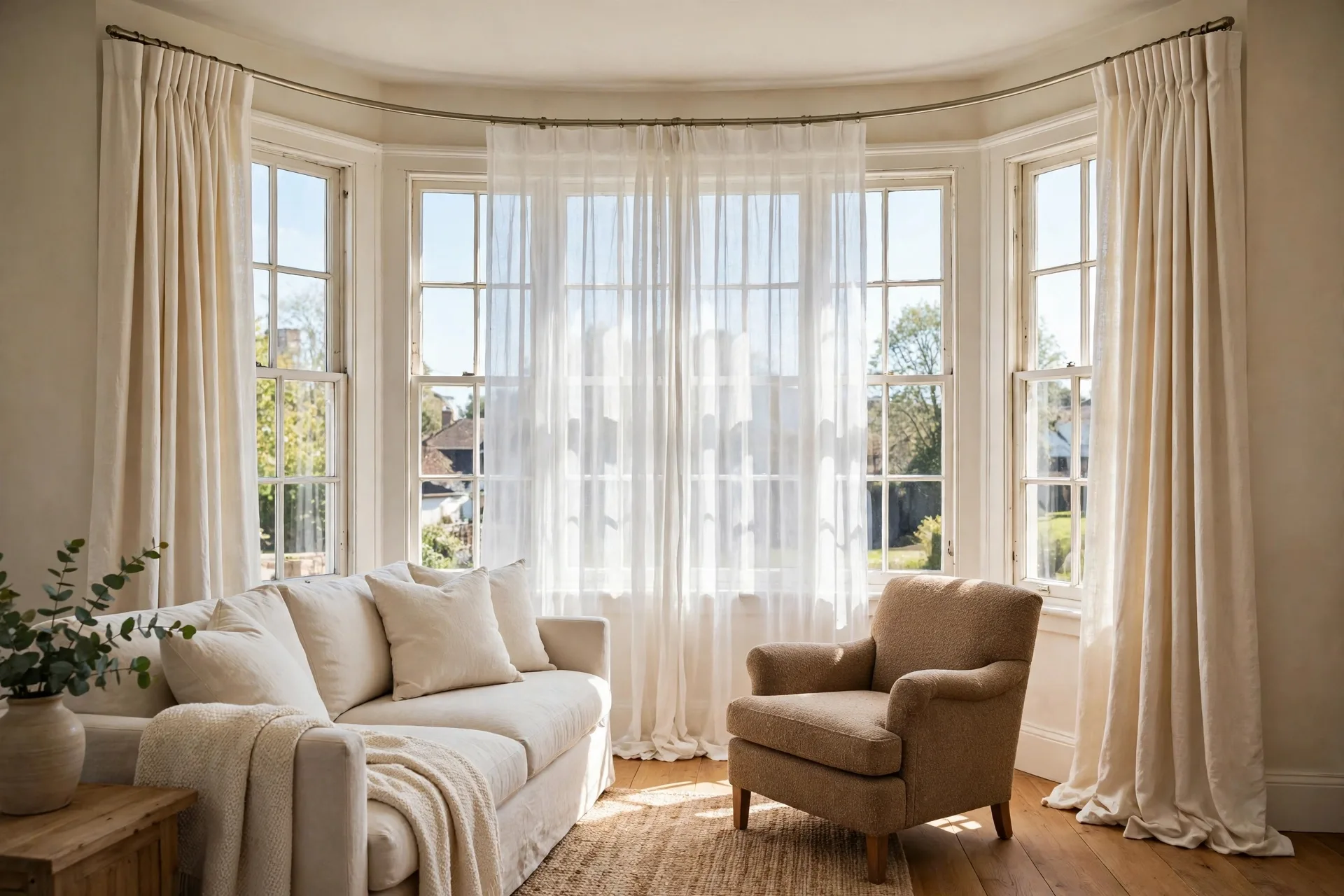
A kitchen bay suits short, washable panels, because steam, splashes, and cooking smells reach the fabric. A dining bay suits floor length and a calmer fabric, because meals feel better in soft, even light. A stairwell or hallway bay suits a simple sheer or a stationary panel, because the window is often out of reach and the job is softening light, not daily drawing.
Pattern scale should follow bay size: large-scale patterns suit bigger bays where the fabric has room to breathe, while small prints suit modest bays.
In a kitchen bay, outside mounts are easier to clean and less likely to get wet or dirty from cooking, and long drapes should stay away from food prep areas.
Small, wide, and curved bays
A small bay, where each pane is narrow, suits shades or short panels better than full curtains, because full panels bunched at the angles fill the nook and leave little room for a seat or a plant. One shade per pane keeps the glass usable pane by pane. A wide bay suits a curved track or a long angled rod with a center support, because a long unsupported rod sags under the panel weight.
A curved bow bay needs a curved track, not an angled rod, because the glass turns in a continuous curve with no clean joint.
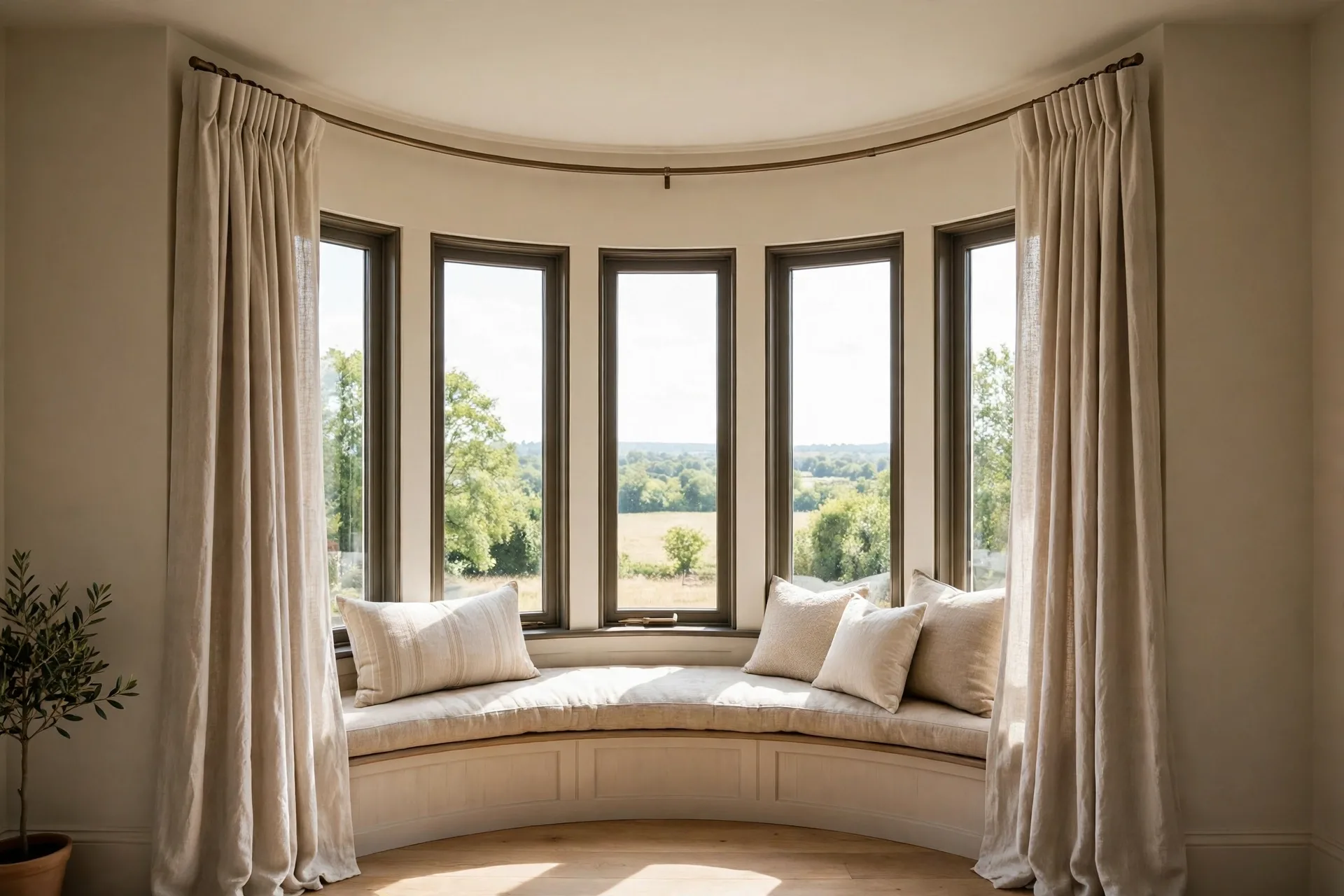
Lightweight panels suit a curved track best. A box bay, where the side panes sit at right angles to the wall, suits separate rods per section or a track with square corner bends. In every case, match the hardware to the bay shape before choosing fabric, because fabric cannot fix a rod that does not follow the turn.
Layers that work on a bay
Layers work on a bay when each layer has its own track or rod, so the layers move on their own and never fight at the angles. The most useful pair is a sheer nearest the glass and a closing panel on the room side. A second useful pair is a shade per pane with side panels on a bay rod: the shades give per-pane light control.
A third pair suits a cold bay: a thermal-lined closing panel over a sheer, closing at night for warmth and darkness together.
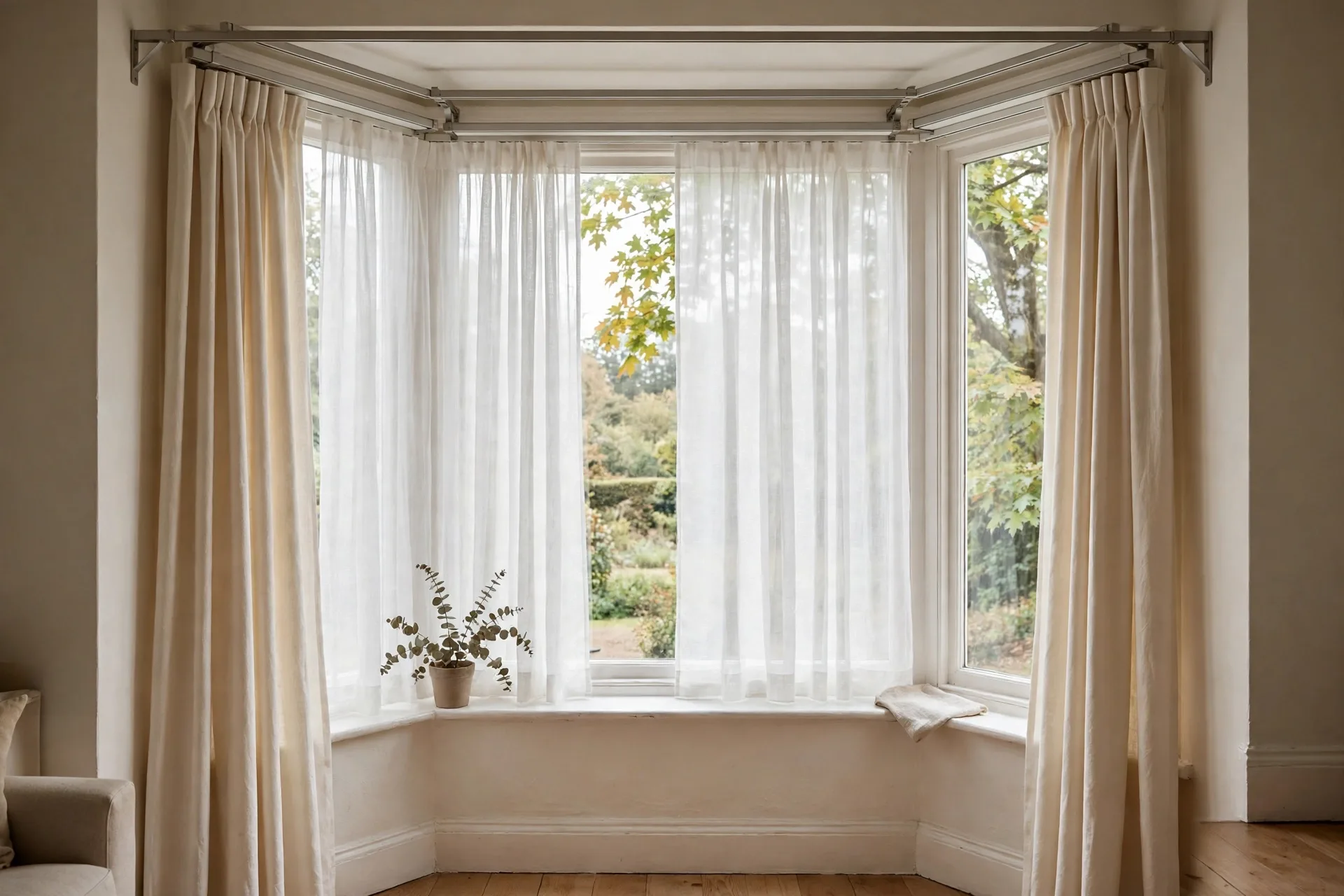
What fails on a bay is two layers on one rod, because the layers bunch at the angles and neither closes cleanly. If the bay has only one rod line, choose one layer that does the main job well.
Roman shades suit bay corners because their compact headers minimize light gaps and bulk at corners, where roller or honeycomb shades' larger headers overlap and interfere.
On a bay, each panel needs its own holdback, because one shared holdback does not hold bay panels that pull from different angles.
Bay window mistakes that waste the nook
The most common bay mistake is a straight rod across the front, which turns a bay into a flat window, hides the side panes, and wastes the alcove the bay was built to give. The second is panels that stop short of the outer frame, so the open stack covers glass and the closed panels leave light gaps at the angles. The third is measuring the bay as one span, which gives a panel count that fits no section, and leaves one pane short and one overfull.
Other mistakes follow from ignoring what sits below: floor-length panels over a radiator, panels that pool on a window seat, and heavy panels on a rod with no center support. A further mistake is a heavy, stiff fabric for a curved track, where the fabric fights the bend and draws in jerks.
Check curtains do not block window furniture: sash mechanisms, trickle vents, and opening casements must still move freely once panels are hung.
Checks to run before you order bay curtains
Start with the bay shape: count the panes, note each angle, and decide between an angled rod, a curved track, or separate rods per section. Next, check what sits below the glass, and let that set the length. Then check the mounting: solid wall or proper anchors at each bracket point, and a center support where the span is wide.
Then check the light job: day only, night only, or both. Confirm the heading suits the hardware, because a rod-pocket panel needs a rod and grips it, while a ripple-fold panel glides on its track.
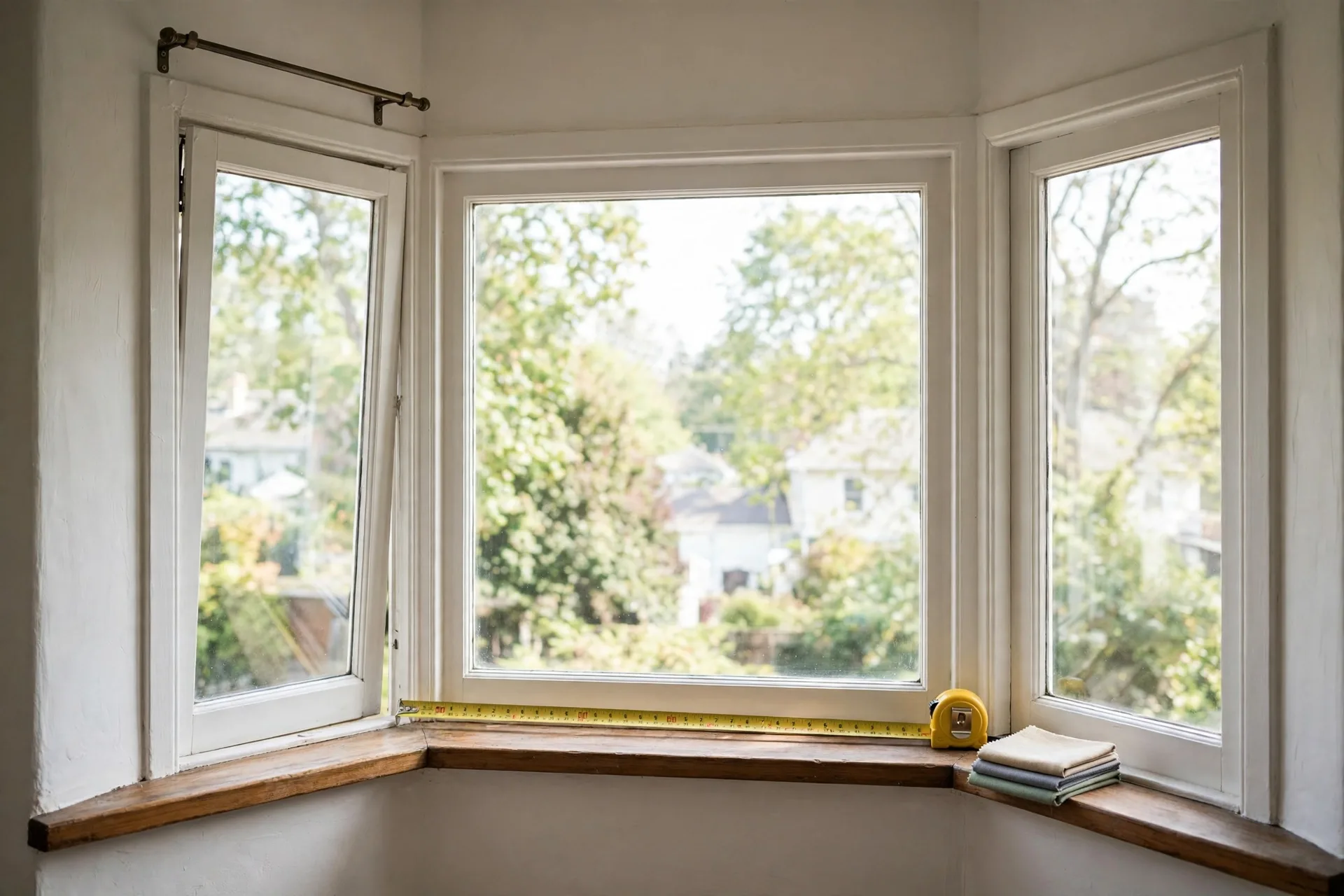
Order a swatch where one is offered, and look at it in daylight and at night. For measuring steps, see How to Measure for Curtains, and for hanging steps, see How to Hang Curtains.
Frequently asked questions about bay window curtains
Most bay window questions come down to hardware, measuring, and length, and to what sits below the glass.
What is the best way to hang curtains on a bay window?
The best way to hang curtains on a bay window is on hardware that follows the angles: an angled bay rod with corner joints, a curved track bent to the bay, or separate rods, one per section, where the look allows it. A single straight rod across the front wastes the nook.
Can you use a normal curtain rod on a bay window?
A normal straight rod does not suit a bay window, because the glass sits in more than one plane and a straight rod cannot turn the corners. Angled bay rods, curved tracks, and per-section rods let panels draw around the angles.
How do you measure a bay window for curtains?
Measure a bay window section by section: each pane from angle to angle, the depth of the bay, and the height above the frame for the rod position. Add stack space past each outer frame edge so the open panels clear the glass, and work out panel count from the section widths.
Should bay window curtains be floor length?
Bay window curtains should be floor length where nothing sits below the glass, because floor length suits the tall glass and helps with cold air at the sill. Where a seat, a desk, or a radiator sits below, short panels that stop at or just below the sill are the right choice.
What curtains are best for a bay window with a seat?
Short cafe panels suit a bay window with a seat, because they give privacy at eye level and leave the seat free.
Do bay window curtains need a curved track?
Bay window curtains need a curved track only where the bay itself curves, as in a bow window with four or more panes in a gentle curve. A three-section bay with clean angles suits an angled bay rod just as well, and separate rods per section suit bays dressed pane by pane.
How do you stop light leaking at bay window corners?
Light leaks at bay window corners stop when the panels close across the whole bay and overlap the outer frame, with no gap at the angles. A track or rod that follows the angles and panels wide enough to stay full when closed help more than a darker color.
Can you put Roman shades on a bay window?
Roman shades suit a bay window well, one shade per pane, especially where the bay is small or a seat sits tight under the glass. Keep the shade cords or chains in a child-safe setup.
Are thermal curtains worth it on a bay window?
Thermal-lined curtains are worth it on a bay window that feels cold, because a bay has more glass and more frame joints than a flat window.
For other curtain types, see Best Window Curtains.
This guide is research-based curation: we compared maker specifications, published reviews, and current prices. Read how we choose.