 Best
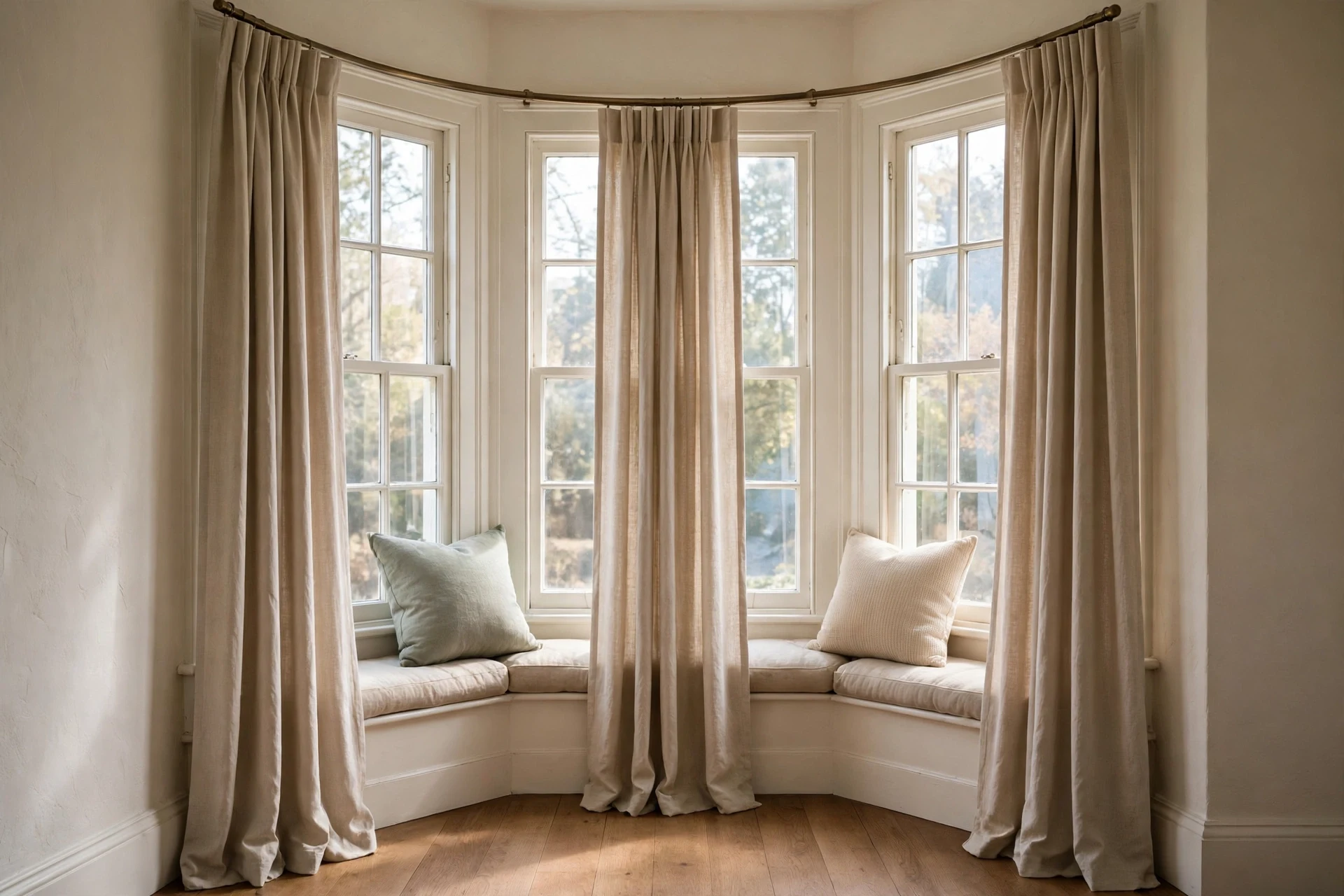
How to Measure for Bay Window Curtains
A bay window cannot be measured straight across the front. This guide measures each facet on its own, then works out the track, the stack, and the drop.
A bay window is measured facet by facet, along the shape of the bay, never straight across the front. Measure each flat section of glass on its own, note the angle at every corner, decide whether the curtains will sit inside the bay or outside it, and then measure the track or rods along the path the curtains will actually travel. A bay measured that way fits; a bay measured straight across ends up short at the corners and gaping at the sides.
A bay is a window that projects out from the wall, usually in three sections: a wide front facet and two angled side facets, though box bays have square corners and curved bays have a smooth bend instead of flat facets. The curtains have to travel around every angle or curve, so the measurement follows the full shape of the bay rather than the straight line across its front. This guide measures the bay facet by facet, then fits the track to it.
Inside the bay or outside it: the first decision
The first decision is where the curtains will sit: inside the bay, following its shape, or outside it, across the front of the bay on the room wall. The choice changes every measurement that follows, so settle it before you pick up the tape.
Curtains inside the bay follow the angles of the bay on a shaped track or on separate rods for each facet.
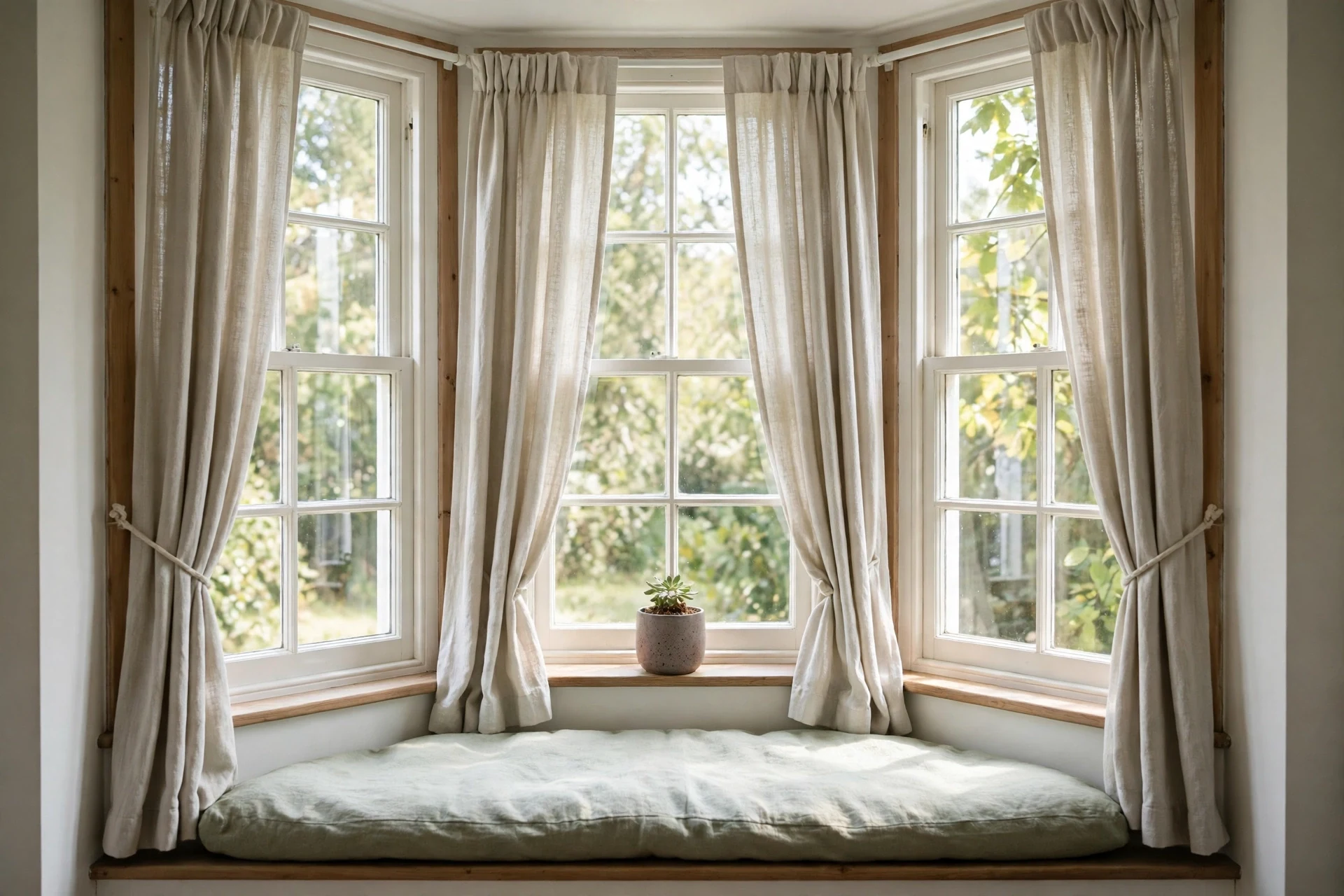
They keep the bay as a usable nook, so a window seat, a reading chair, or plants on the sill stay in the room rather than behind a curtain wall, and they suit a bay that is a feature of the room. The trade-off is that the panels stack inside the bay when open, so they cover part of the side glass, and the track has to bend around every corner, which costs more and needs accurate angles. Curtains outside the bay hang on a straight rod or track on the room wall, across the front of the whole bay. They close off the bay entirely when drawn, which suits a bedroom where darkness matters, and they are simpler and cheaper to fit, because the rod is straight. The trade-off is that the bay becomes a dead space behind the curtains when they are closed, and the rod has to be long enough to clear the full projection of the bay.
Measure for the choice you made, and do not mix the two. An inside measurement runs along the facets of the bay, while an outside measurement runs straight across the room wall, wider than the bay itself. For the general measuring steps that sit behind this guide, such as tools, fullness, and panel count, see How to Measure for Curtains.
As a starting point for the height and the run, install the rod or track about 4 to 6 inches (10 to 15 cm) above the window and extend it 6 to 12 inches beyond each side, toward the wide end of that range so the curtains clear the bay and stack off the glass when open.
Measuring each facet on its own
Each facet is measured on its own, in the order you will hang the curtains, and every figure is written down as you go, because a bay has too many numbers to hold in your head. Use a steel tape, not a fabric one, because a steel tape stays straight and gives an accurate figure across a long facet.
Start at one end of the bay and work across. Measure the width of the first side facet from the outer edge where the track will start to the corner where the facet meets the front.
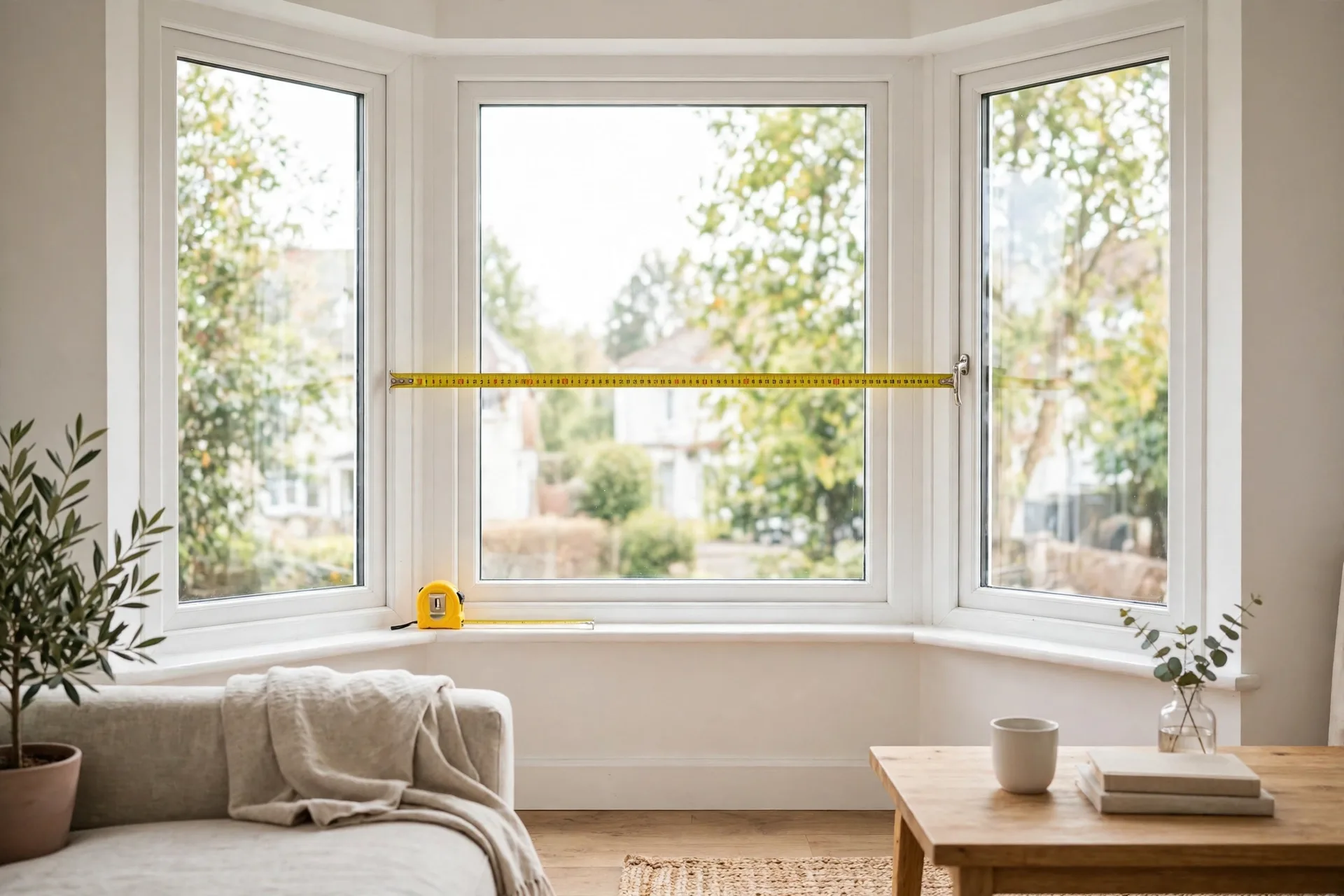
Then measure the front facet from corner to corner, and then the second side facet from its corner to the outer edge where the track will end. Measure along the line the track or rod will follow, keeping the tape flush against the window frames, and measure at the height the track will sit, not at the sill, because a bay can be wider at the top than at the bottom. Where cornices or coving run across the top of the bay, measure from the inside of the cornice, because the track sits below it.
Write each facet down with a label, left, center, and right, and a sketch of the bay with the figures on it, so the numbers cannot be mixed up later. Measure twice, and if the two readings differ, measure a third time and take the reading that repeats. Add the three facet widths together only after each one is certain, because the total is the track length, and a wrong facet makes the whole total wrong. For the standard lengths that follow from the drop, see Curtain Sizes.
Give the measurements in inches and give exact figures with no deductions, because the maker works from your numbers as given. Measure the drop from ceiling to floor on the left, in the middle, and on the right, so the shortest drop is caught on the facet where it falls.
Angles and offsets: what to note at every corner
The angles are what make a bay hard to measure, and they are the numbers most people skip, which is why bay curtains so often gap at the corners. Note the angle at every corner where two facets meet, and note any offset where the facets do not line up.
Most bays have corners of 45 degrees or 90 degrees. A box bay has square 90 degree corners, and a standard angled bay has 45 degree corners between the front and the sides.
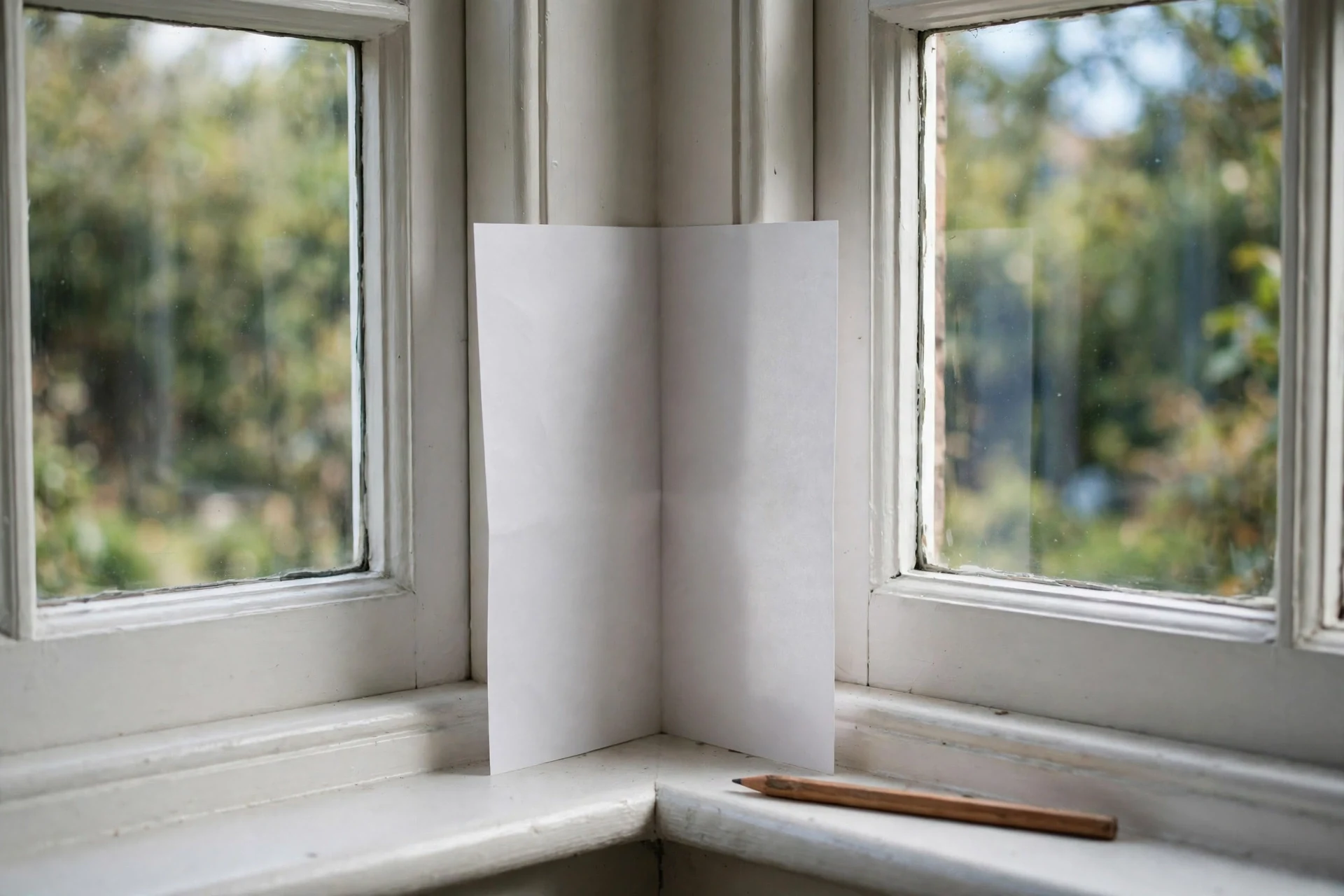
You can check the angle with a sheet of paper: fold one corner of an A4 sheet so the edges meet, and the folded edge gives you 45 degrees, while an unfolded sheet held into the corner gives you 90 degrees. If the paper sits flush against both sides of the corner, the angle matches, and if it does not, the angle is something else and the track maker needs to know. Note the angle on your sketch next to the corner it belongs to.
Also note the offset, which is how far each facet sits forward of the next one. A bay where the side facets sit at a different depth from the front, or where the window frames step in and out, needs the track to clear the deepest frame, so measure the projection of each facet from the room wall and write it down. Note anything that sticks out into the track path: a window handle, a lock, a deep sill, or a radiator below the bay. A handle that projects into the track path will catch the gliders or the rings every time the curtain passes, so the track must sit far enough from the wall to clear it, and that clearance has to be in the measurement.
Cafe curtains are measured per bay section, one short panel for each facet, and the bracket type follows the way the window opens. A niche bracket sits inside the recess and suits an outward-opening window, while a window-frame bracket fixes to the sash so the curtain moves with the window, which suits an inward-opening window. The bracket is 0.4 in wide, sits 1.2 in from the rod end, and leaves 3.1 in of rod uncovered.
Corner deductions matter where blinds share the bay with curtains. On a 135-degree bay, where the corners are 45 degrees, the center shade runs 0.8 to 1.2 in narrower, and on a 90-degree corner subtract 1.5 in (4 cm) per meeting side: the side blind loses it on one side and the center blind on both sides, 3.0 in (8 cm) in total. Ready-made 90-degree and 135-degree corner pieces exist for these joints, and anything else is made to order.
Track or separate rods: measuring for each one
A bay takes either one shaped track that follows the angles, or separate rods on each facet, and the measurement is different for each. Decide which one you are fitting before you measure, because the track and the rods are ordered differently.
A shaped track is the easiest option for most bays, because the curtains travel around every angle on one continuous run and meet in the middle without a gap.
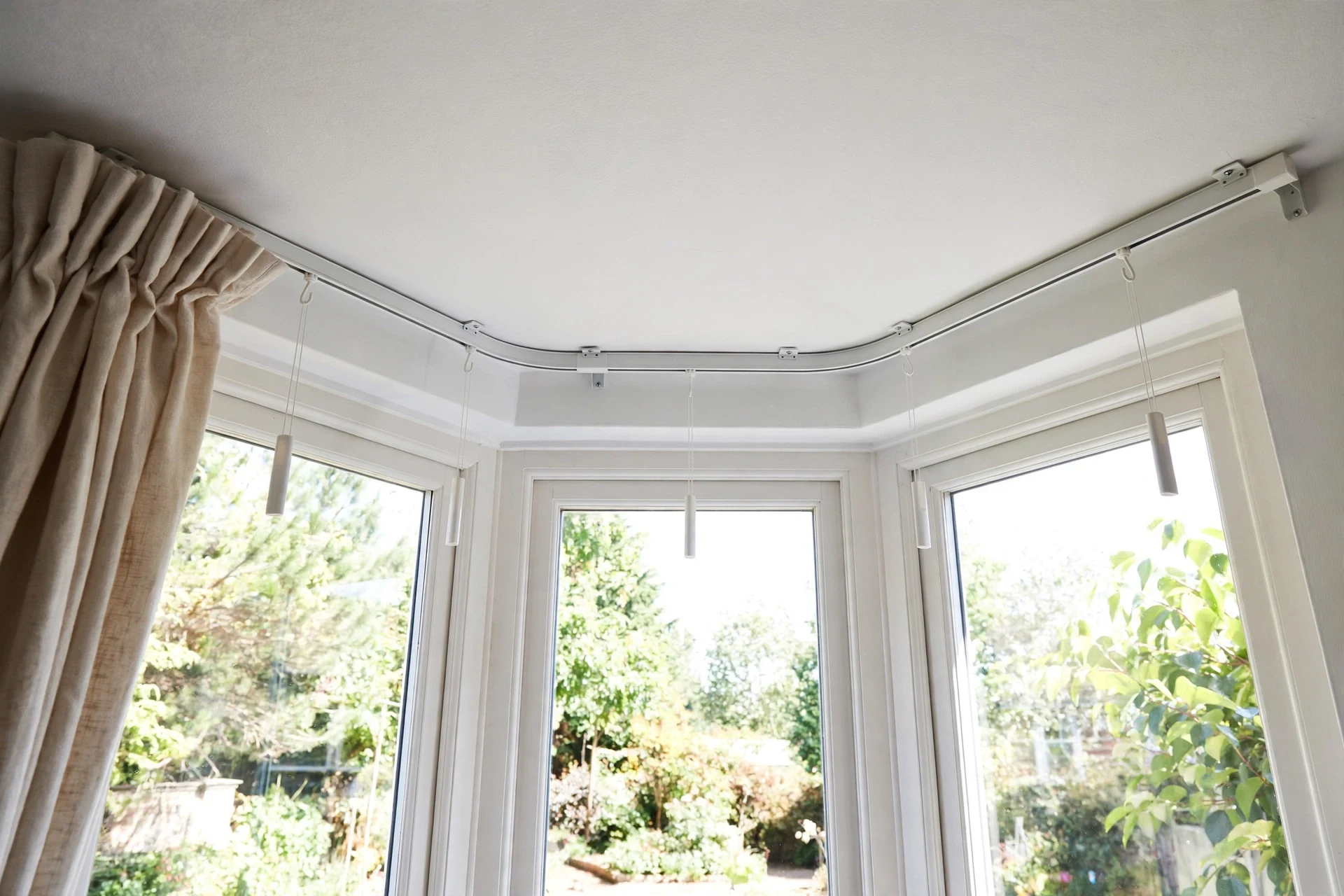
Measure the track along the full shape of the bay, end to end, following every facet and every corner, so the track length is the sum of the facet widths plus the bend allowances at the corners. Check the instructions for your chosen track for the exact allowances at each end, because different tracks need different amounts of straight run past the last bend. When the track is in place, measure the drop from the track, not from the window, and the width is the track length you just measured.
Separate rods give a more traditional look, with one rod on each facet, and each rod is measured on its own. Measure the width of each facet separately, and order each rod to fit its facet, with enough overhang at each end for the panels to stack clear of the glass. The panels on separate rods meet at the corners but do not travel around them, so each facet is dressed on its own, and the corners will always show a small break where the rods meet. Separate rods suit a bay where the curtains stay mostly closed or mostly open, and a track suits a bay where the curtains travel around the corners every day.
A specialist bay rod with passing rings and passing brackets lets the curtains glide around the corners instead of stopping at each one, which is the fix where standard brackets block the rings. A bendable track is the other answer, because it can be bent by hand to the shape of the bay. Eyelet curtains suit a bay rod less well: the brackets and joints stop the eyelets traveling freely around the corners, eyelets are about 1.6 in (40 mm) in internal diameter and suit a 35 mm rod (about 1.4 in) best, and eyelets are unsuitable for tracks. Wave curtains are a poor fit for most bay windows, and they suit straight runs better.
Where two tracks overlap, measure end to end and then add the overlap width. Without a rod or track in place, add about 8 to 12 in (200 to 300 mm) of overlap on each side and above.
The fitting itself has two more choices. A ceiling fit, also called a top mount, fixes to the ceiling, while a wall fit, or face mount, fixes to the wall, and a track can also fit inside a cornice. Fix to wall studs or ceiling battens, because a bay track carrying full panels needs solid wood behind it. On a bay track the heading choice is between an S-fold and a pleated heading, and a double track can layer a sheer with a blackout panel. A fixed-flow track runs the panels in set lanes and a free-flow track lets them move freely, and motorization is hard to fit on multiple openings or free-flow tracks, so check with the track maker before planning around it.
Stack space and handle clearance at the ends
Stack space is the room the open panels need at the ends of the bay, and it is the measurement most bay guides understate. When the curtains are open, the fabric stacks into a bundle at each end, and if there is no room for the bundle, the panels hang over the glass and block the light the bay was built to catch.
Leave room at each end of the bay for the stack.
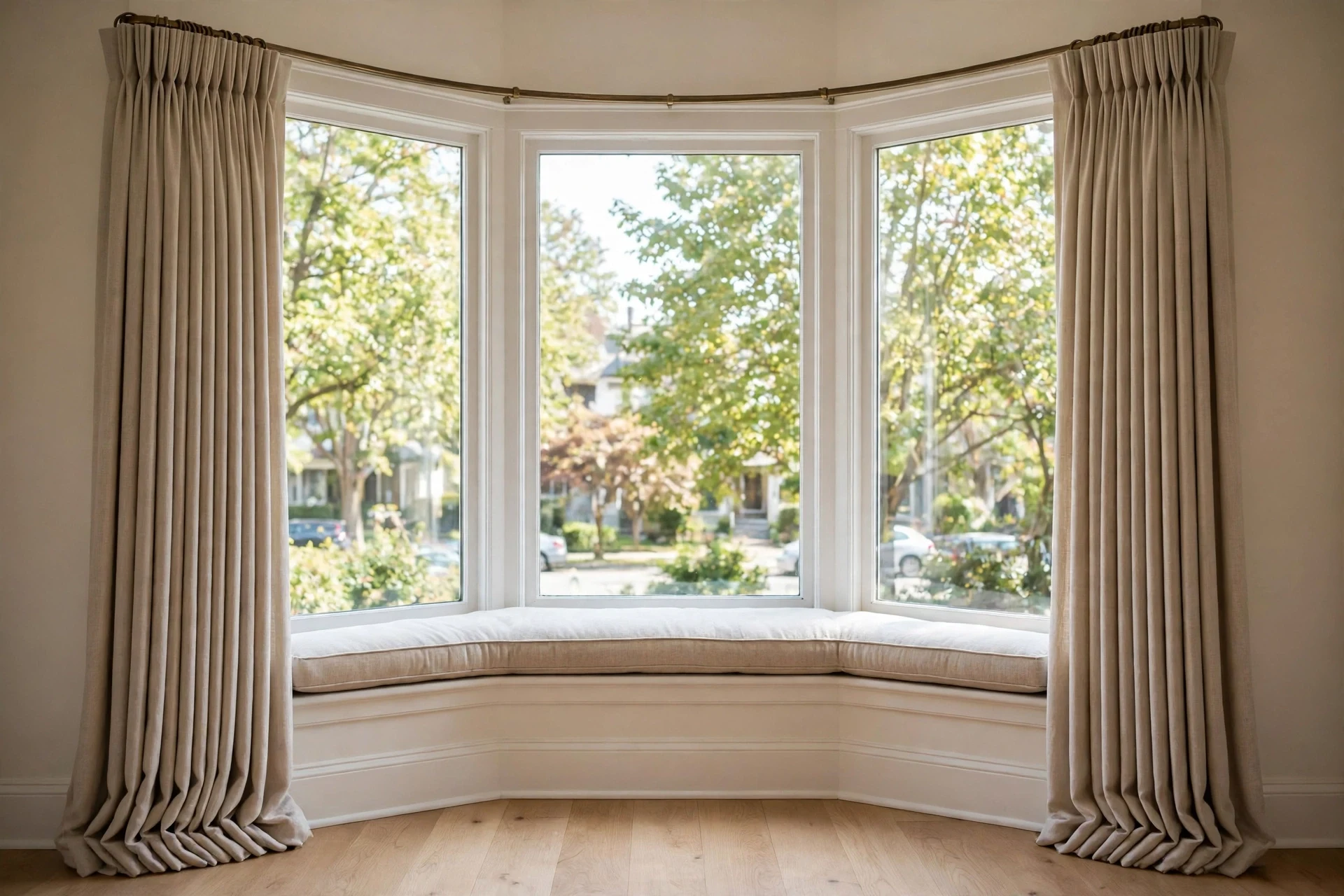
Allow about 8 to 12 in (20 to 30 cm) of stack room at each end, and more for fuller panels, because a full panel stacks wider than a slim one. Measure the stack room from the end of the glass to the end of the track, and check that the bundle, when the panels are fully open, sits clear of the glass and clear of the side wall. Where the bay is used as a reading nook or a seat, the stack should also clear the seat, so the panels do not drape over the cushions when they are open.
Handle clearance is the second end check. Open every window in the bay fully before you mark the track position, and check that the handles, cranks, and locks clear the track and the panels. A crank handle on a casement window needs room to swing without hitting the curtain fabric or the track every time the window opens, and that clearance only shows up with the sash open, not closed. If a handle fouls the track, move the track farther from the wall, or choose a rod with a longer projection, and re-measure the drop from the new track position. For the hanging steps once the track is in, see How to Hang Curtains.
For a luxurious look in a bay, aim for fullness of 2.5x, and work the panel count from the track length at that fullness. On a large bay use a 6-inch pinch pleat rather than a 3-inch one for balance, because a small pleat looks lost across a wide run, and tracks run more smoothly than rods on large windows. Use 3 to 4 panels instead of one big pair to cut bulky stacking, and frame the bay by adding at least 30 percent to the left and right window measurements so the stack sits off the window. The stack itself can sit left, right, in the center, or split across multiple openings, with custom splits of up to 2 for bi-fold or sliding doors.
Where blinds share the bay, let the blinds do the daily work and the curtains frame them. The blind chain control side must operate without obstacles, so check the chain run before the track position is fixed, and Perfect Fit blinds or shutters fit directly on uPVC frames with no drilling where the window suits them.
Roman shades need their own clearances in a bay. Allow at least 2.8 in above the trim for the cord lock, and 5.9 in where the shade is hung high for a ceiling illusion. A raised Roman stack stands 9.8 to 11.8 in (25 to 30 cm) tall, so the stack must clear the top of the bay when the shade is up.
The shortest drop rule for uneven sills
Bay sills are rarely level. The floor under a bay can slope, the sill can sit at a different height on each facet, and the track can sit slightly out of level across a long run, so a drop measured on one facet will be wrong on another. The rule for this is the shortest drop rule: measure the drop on every facet, and order the shortest of the three.
Measure the drop from the top of the track or the underside of the rod down to where you want the curtains to finish, on the left facet, in the middle, and on the right facet.
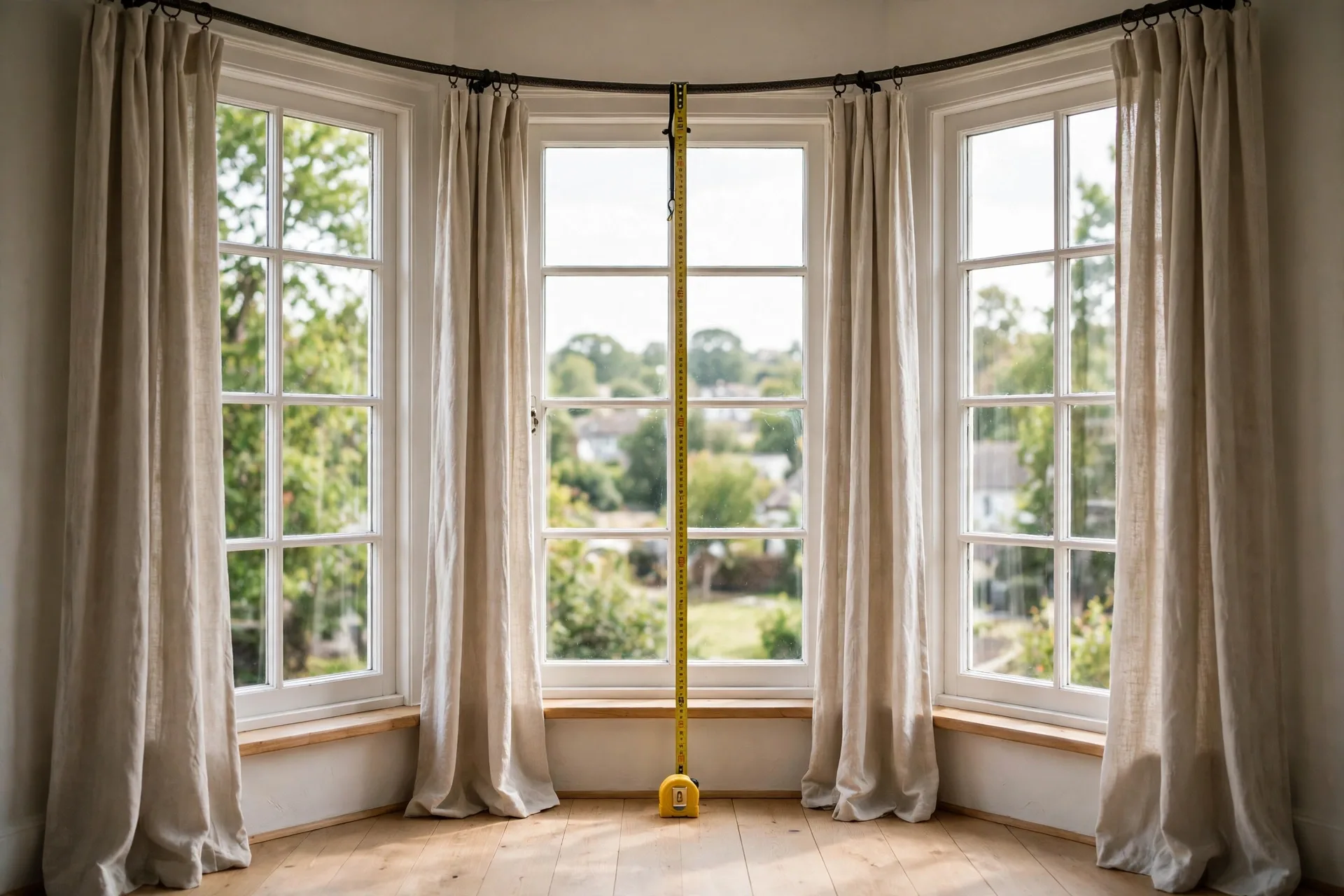
For eyelet curtains, measure from the top of the rod; for pencil pleat and pinch pleat curtains, measure from the underside of the ring. Take the shortest of the three measurements and record it as your drop, because a panel ordered to the longest drop will pool on the floor at the shortest facet, while a panel ordered to the shortest drop will hang cleanly everywhere, with only a small hover at the longest facet. Some makers suggest puddling where the difference is large, but a puddle hides the difference rather than fixing it, and it gathers dust in a bay that is used as a seat.
Check the drop again after the track is fitted, because the track position can shift the drop by the depth of the track itself. Measure from the fitted track, not from the position you planned, and confirm the shortest drop before you order. A bay curtain that is too long at one end is the most visible measuring mistake there is, because the eye catches the uneven hem across the whole bay at once.
The drop itself has named finishes: sill length, floor length, and puddle length are the three options, and the shortest-drop rule above picks the measurement, not the finish. Measure the drop from the top of the rod or track so the heading hides it, and give exact measurements with no deductions, because the maker deducts the track depth when the curtains are made.
The finishes are measured in small figures. Just off the floor means about 3/16 to 3/8 in (5 to 10 mm) shorter than the floor, touching the floor skims up to about 3/16 in (5 mm), and a puddle adds 1 to 6 inches of fabric on the floor, with 3 inches a stylish puddle and 4 to 6 inches a glamorous one. A cafe length is measured differently again: end the panel 0.4 to 0.8 in above the sill, and a ring cafe curtain hangs 0.8 in below the top of the rod.
A bay measuring checklist you can tick off
Run this checklist before you order, and do not order until every line is ticked. A bay order is expensive to remake, and most of the mistakes are caught by this list.
| Check | Ticked |
|---|---|
| Inside or outside the bay decided, and the measurement follows that choice | |
| Each facet measured on its own, left, center, and right, with a sketch and labels | |
| Facet widths measured at track height, with the tape flush to the frames | |
| Angles noted at every corner, 45 degrees or 90 degrees checked with paper, anything else written down | |
| Offsets and projections noted for every facet, with handles, locks, and sills that stick out | |
| Track or separate rods decided, and the measurement follows that choice | |
| Track length is the sum of the facet widths plus the bend allowances for your track | |
| Stack room of about 8 to 12 in (20 to 30 cm) at each end, more for full panels | |
| Handles and cranks checked with every window open, clear of the track and the panels | |
| Drop measured on all three facets, from the track or rod, and the shortest recorded | |
| Fullness and panel count worked out from the track length, not from the straight-across width, at 2.5x fullness for a luxurious look | |
| Every figure measured twice, and any figure that did not repeat measured a third time |
If any line is not ticked, the order is not ready. The checklist takes ten minutes and saves a remake that takes weeks.
Mistakes that leave a bay curtain short or gaping
The most common bay mistake is measuring straight across the front of the bay instead of along its shape, which gives a total that is shorter than the track path by the depth of the angles, so the curtains end up short at the corners and gaping at the sides. The second is measuring the window instead of the track, because the track sits higher and wider than the window, and the drop and the width both follow the track. The third is ordering to the longest drop instead of the shortest, which leaves one panel pooling on the floor while the others hover.
Other mistakes follow from the corners: forgetting that pinch pleat curtains have much less width adjustment than pencil pleat, so an inaccurate measurement cannot be gathered out; choosing a rod with standard support brackets when the curtains need to travel all the way around, because the brackets block the rings at every corner; and forgetting that the panels need stack room at the ends, so they hang over the side glass when open. A further mistake is measuring the drop from the ceiling instead of from the track, which adds the track depth to the length and leaves the panels too long. Each of these is caught by the checklist, which is why the checklist comes before the order.
Frequently asked questions about measuring for bay window curtains
Most bay measuring questions come down to the facets, the angles, and the drop, and to whether a track or separate rods fit better.
Should I measure a bay window straight across the front?
No. Measure along the full shape of the bay, facet by facet, because the curtains travel around every angle and the track path is longer than the straight line across the front. A straight-across measurement ends up short at the corners and leaves gaps at the sides. Measure each facet on its own, add them together, and add the bend allowances for your track.
Do I measure the window or the track for bay curtains?
Measure the track, not the window, because the drop and the width both follow the track. If the track is already fitted, measure from end to end along its full shape, and measure the drop from the track down to where you want the curtains to finish. If the track is not fitted yet, measure the shape of the bay where the track will sit, at track height.
How do I measure the angles of a bay window?
Most bays have 45 degree or 90 degree corners. Check with a sheet of paper: fold one corner of an A4 sheet so the edges meet for 45 degrees, or hold an unfolded sheet into the corner for 90 degrees. If the paper sits flush against both sides, the angle matches. If it does not, note the angle as non-standard and tell the track maker, because the track has to be bent to your bay.
How much stack space do bay curtains need at the ends?
Allow about 8 to 12 in (20 to 30 cm) of stack room at each end, and more for fuller panels, because a full panel stacks wider than a slim one. When open, the curtains should sit neatly at the outer edges of the bay, clear of the glass, so the bay lets in the most daylight and the seat or sill stays clear. Measure the stack room from the end of the glass to the end of the track.
Should bay curtains go inside or outside the bay?
Inside the bay keeps the bay usable as a nook and follows its shape on a shaped track, but the panels stack inside the bay when open and cover part of the side glass. Outside the bay hangs on a straight rod across the front, closes the bay off entirely when drawn, and suits a bedroom where darkness matters. Decide first, because the measurement follows the choice.
What is the shortest drop rule for bay windows?
Measure the drop on the left facet, in the middle, and on the right facet, from the track or rod down to where you want the curtains to finish, and order the shortest of the three. A panel ordered to the longest drop will pool on the floor at the shortest facet, while a panel ordered to the shortest drop hangs cleanly everywhere. Measure again after the track is fitted, because the track position can shift the drop.
Track or separate rods for a bay window?
A shaped track is the easiest option for most bays, because the curtains travel around every angle on one continuous run and meet in the middle without a gap. Separate rods give a more traditional look, with one rod per facet, but the panels meet at the corners and do not travel around them, so the corners always show a small break. A track suits a bay where the curtains move every day, and separate rods suit a bay where they stay mostly put.
Can I use the same measurements for blinds and curtains in a bay?
No. Measure the blinds and the curtain track separately, and plan the track position so it clears the blind headrails and brackets. Individual blinds sit in each section of the bay with a little room to spare at the corners, while the curtain track follows the full shape of the bay, so the two need different figures and different clearances.
For other measuring help, see Best Window Curtains.
This guide is research-based curation: we compared maker specifications, published reviews, and current prices. Read how we choose.