 Best

Best Ceiling Curtain Tracks
A ceiling track hangs curtains from above, so tall windows, room dividers, and windows with no wall space above them finally dress properly.
The best ceiling curtain track is the one whose material and weight rating match the curtains it must carry, mounted on brackets spaced for the load, because a track spreads the weight across many carriers and that only works when the track itself is strong enough. An aluminum track suits most homes and most curtain weights, a bendable track suits bay windows and room dividers, and a double track suits layered curtains. Measure the run, weigh the layers honestly, and choose the track by weight and shape, not by the length printed on the box alone.
A ceiling track is a rail fixed to the ceiling, with small carriers that slide along it and hold the curtain hooks. It suits windows where a wall rod cannot work: floor-to-ceiling glass with no wall above it, a bay window that turns a corner, a room divider that needs curtains across open space, and a sliding door that needs panels to glide daily.
A rod and a track are different tools: a rod is a rigid bar on decorative brackets, suited to heavier curtains and a traditional look, while a track is a rail along the wall or ceiling, and a light PVC track suits lightweight curtains, modern spaces, and smooth, quiet operation.
Tracks also serve beyond windows: shower curtains, RVs, and bunk beds all use ceiling tracks where a rod cannot fit.
Ceiling curtain track picks by room and curtain weight
A single aluminum track suits a floor-to-ceiling window with one layer, a double track suits layered sheers and drapes, and a bendable track suits a bay or a curved run. The picks below are grouped by room and curtain weight, not by brand. No pick names a maker or a size here, because those vary by listing and must be confirmed on the listing before you order. Check the material, the weight rating, the bracket spacing, and the finished length on the listing for the set you choose, and count the carriers and hooks the set includes before deciding.
As an Amazon Associate, we earn from qualifying purchases.
| Pick | Type | Best for |
|---|---|---|
| 1 | Aluminum single track set | A floor-to-ceiling window with one layer |
| 2 | Aluminum double track set | Layered sheers and drapes on one window |
| 3 | Bendable PVC track set with steel core | A bay window or a curved run |
| 4 | Heavy-duty aluminum track set | Heavy lined or blackout curtains |
| 5 | Flexible track set for a room divider | Dividing a room with curtains |
| 6 | Wall-and-ceiling track set | A window with a low ceiling or a shallow wall above it |
1. Aluminum single track set: best for a floor-to-ceiling window with one layer
- Best for: A tall window or sliding door where one layer of curtains must hang from the ceiling to the floor.
- Key features: Single aluminum channel, roller carriers that glide smoothly, ceiling brackets spaced for the run, connectors for joining sections.
- Pros: Clean look with no visible rod, curtains hang straight from ceiling to floor, aluminum resists rust and holds its shape.
- Cons: One layer only, so layering needs a second track, needs solid ceiling mount, so check the ceiling type first.
Choose a length on the page (6, 8, 10, 12, or 15 ft) to fit the window.
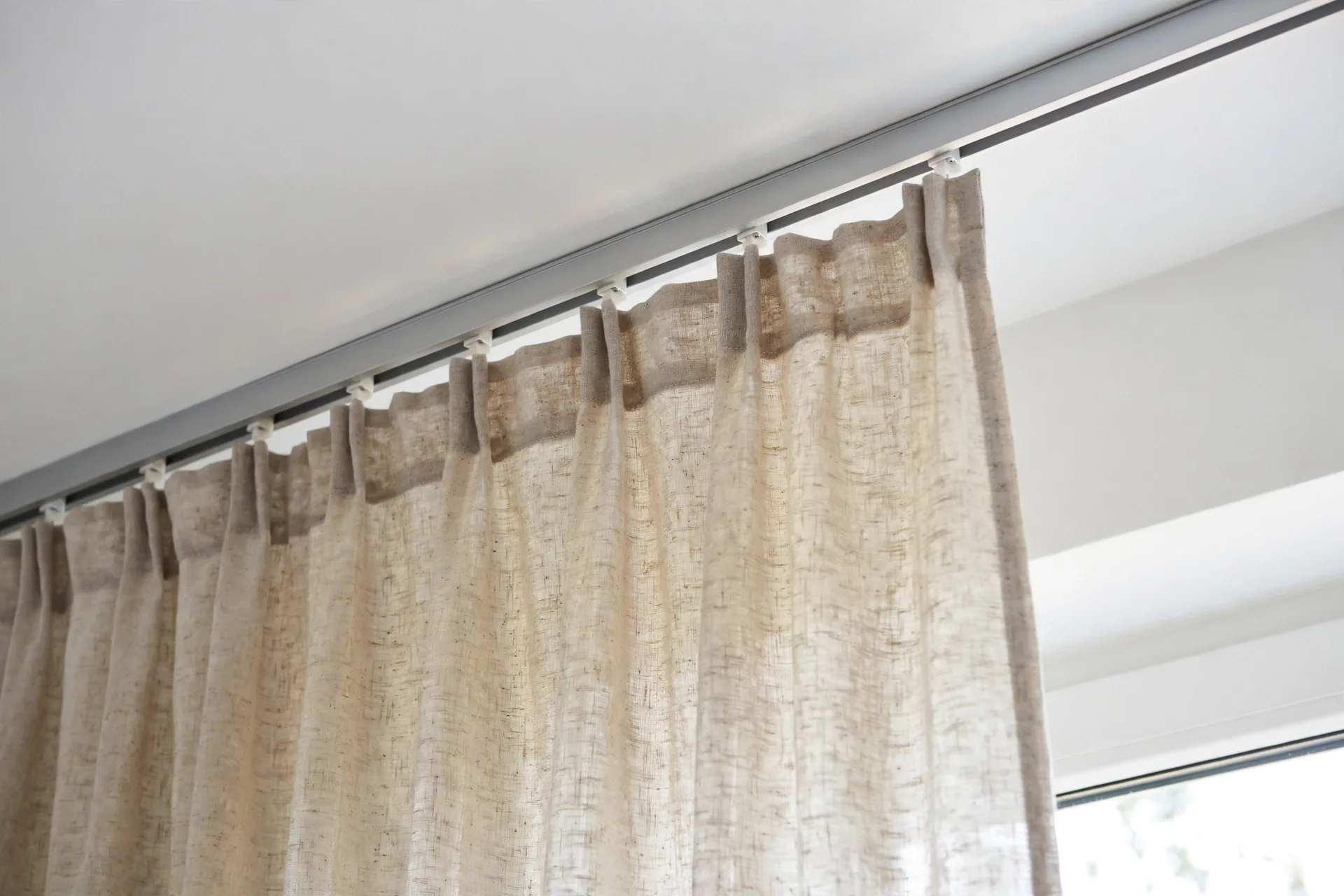
2. Aluminum double track set: best for layered sheers and drapes on one window
- Best for: A window where sheers must sit behind drapes and each layer must move on its own.
- Key features: Two parallel aluminum channels in one fitting, separate carriers for each layer, ceiling brackets for both channels, end stops on each channel.
- Pros: Both layers move independently, sheers give day privacy while drapes give night darkness, one fitting holds both tracks.
- Cons: Wider fitting needs more ceiling room, heavier than a single track, so the brackets and anchors must suit the combined load.
Choose a length on the page to fit the window.

3. Bendable PVC track set with steel core: best for a bay window or a curved run
- Best for: A bay window, a curved wall, or an L-shaped run where a straight track cannot follow the shape.
- Key features: Flexible PVC track with a steel core for strength, bends by hand to the shape of the window, carriers that round the bend, cut to length.
- Pros: Follows curves a rigid track cannot, easy to cut and shape at home, suits bay windows and corner runs without joints.
- Cons: Lower weight rating than rigid aluminum, so keep the curtains light to medium, carriers can bind on a tight bend if the curve is too sharp.

4. Heavy-duty aluminum track set: best for heavy lined or blackout curtains
- Best for: Heavy lined drapes, blackout curtains, or interlined panels on a ceiling track.
- Key features: Heavy-duty aluminum channel, roller carriers, brackets spaced closely for the load, listed for heavy curtains without bending or sagging.
- Pros: Holds heavy layers without sagging, roller carriers glide smoothly under load, suits daily use on a wide window.
- Cons: Heavier and more visible than a light track, needs joists or rated anchors, so the mounting matters as much as the track.
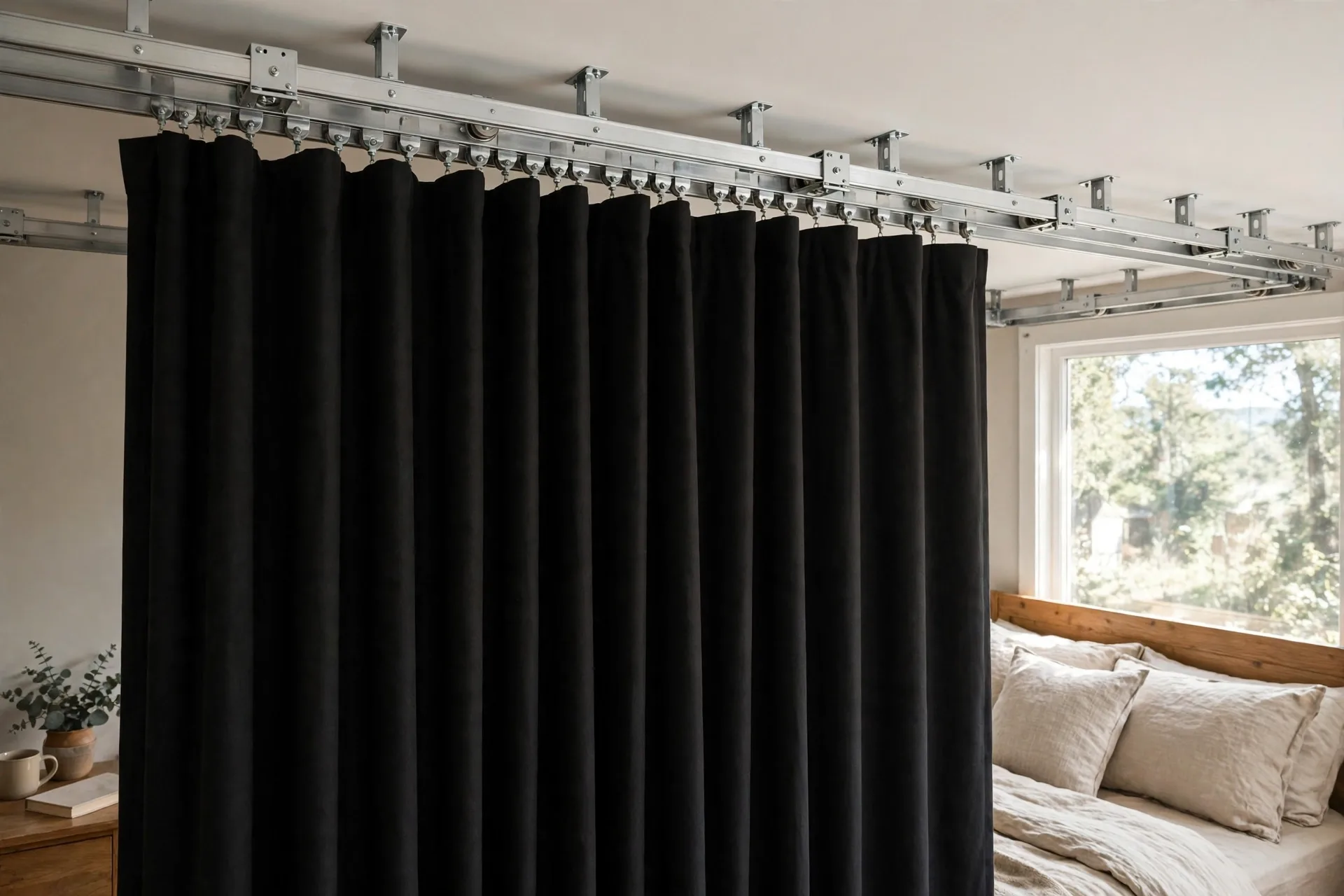
5. Flexible track set for a room divider: best for dividing a room with curtains
- Best for: Splitting a studio, a shared bedroom, or an open room with a curtain wall that can open and close.
- Key features: Long flexible track that spans the room, ceiling brackets along the run, carriers spaced for a full curtain wall, end stops at both ends.
- Pros: Turns one room into two without building a wall, curtains stack to one side when open, flexible track follows a straight or gently curved line.
- Cons: A long run needs many brackets and a level ceiling, a divider curtain needs enough fabric to cover the full run without gaps.

6. Wall-and-ceiling track set: best for a window with a low ceiling or a shallow wall above it
- Best for: A window where the ceiling is low or the wall above the window is too shallow for a rod, and the track must mount either way.
- Key features: Brackets that fit ceiling or wall mounting, aluminum channel, carriers and hooks included, cut to length.
- Pros: Mounts where a rod cannot, keeps the track close to the ceiling for a tall look, one set covers both mounting options.
- Cons: Wall mounting needs a solid wall above the window, the track sits further from the glass on a wall mount, so light can leak at the sides.
Choose a size on the page (3-6, 6-9, 9-12, or 12-18 ft), each size carries its own load rating, so check the rating on the size chosen.

One channel or two: single tracks and double tracks
A single track carries one layer of curtains on one channel, and it suits every window where one layer is enough: a sheer alone for day privacy, a blackout panel alone for sleep, a plain drape alone for warmth. A single track is slimmer, lighter, cheaper to fit, and easier to keep level, and it needs fewer brackets than a double track. Choose a single track when the window has one job and the curtain does it alone.
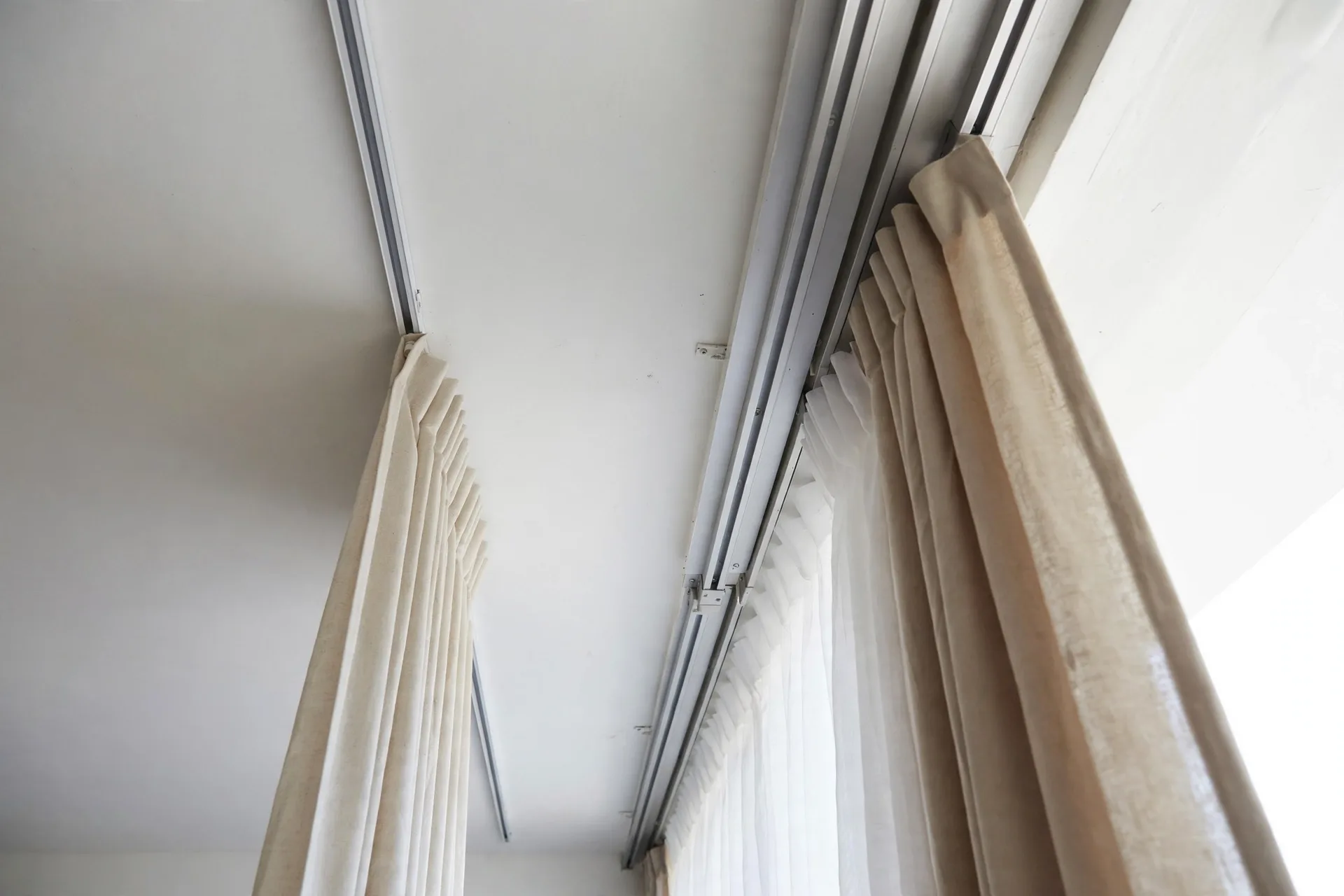
A double track carries two layers on two parallel channels, with the sheer on the channel nearer the glass and the drape on the channel nearer the room, and each layer moves on its own carriers. It suits the classic pairing of sheer behind and drape in front, giving day privacy from the sheer and night privacy and darkness from the drape. A double track needs a wider fitting and more ceiling room, and it carries the combined weight of both layers, so the brackets and anchors must suit the total load.
A triple track adds a third layer where two are not enough, so sheer, blackout, and a decorative panel can each move on their own channel.
Some tracks combine three jobs in one fitting: track, valance, and a light bar, so the valance and the lighting sit on the same run as the curtains. The choice is simple: one layer, one channel, two layers, two channels. For the darkness job in full, see Best Blackout Curtains, and for the sheer job, see Best Sheer Curtains.
Straight tracks and bendable tracks
A straight track is a rigid rail that runs in a straight line, and it suits flat windows, sliding doors, and room dividers that run straight across a room. Rigid aluminum straight tracks carry the most weight, glide the smoothest, and last the longest, because the carriers run on a true line with no curve to bind them. A straight track can be joined in sections for a very long run, but each joint is a point where carriers can catch, so fewer joints glide better.
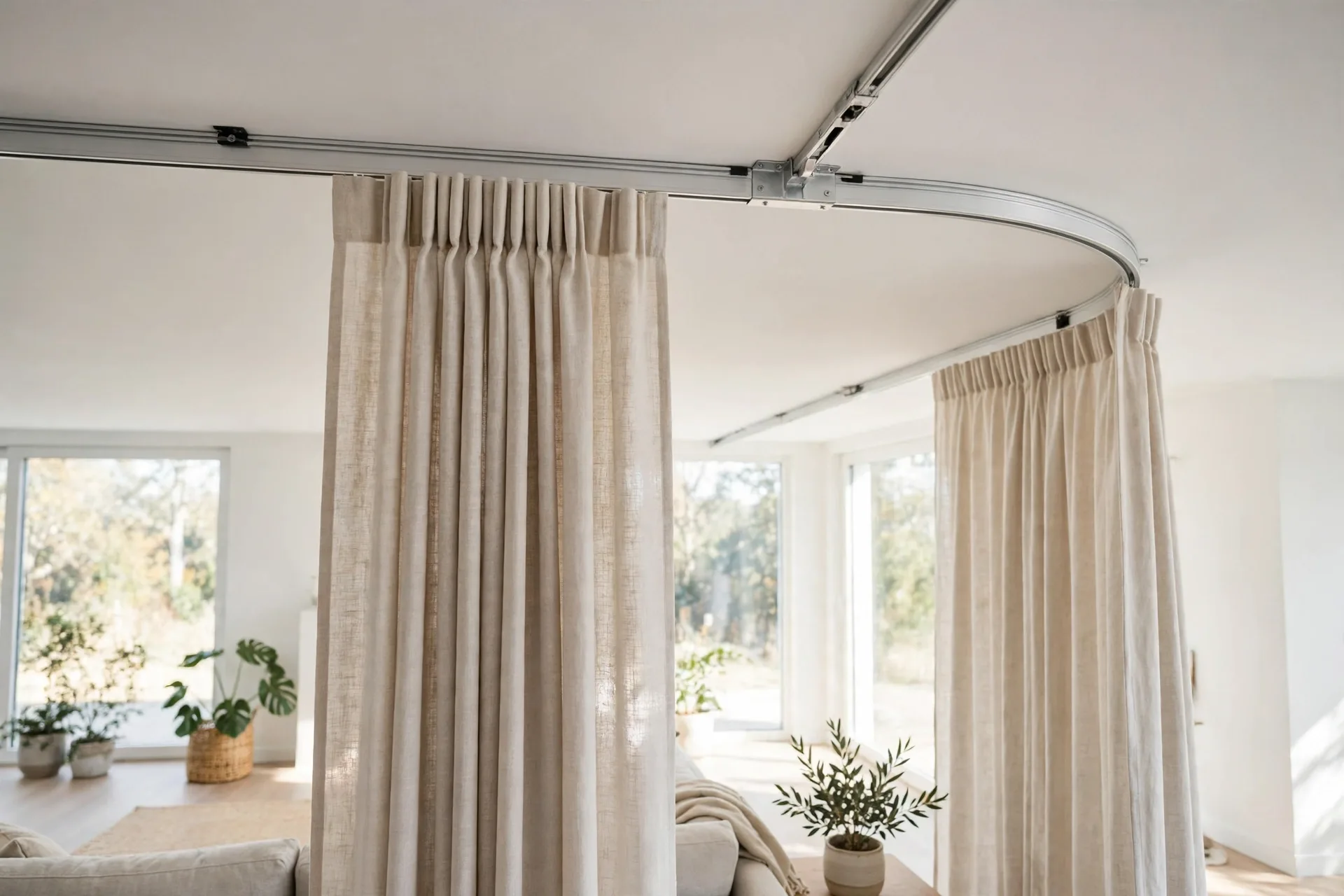
A bendable track flexes by hand to follow a curve, and it suits bay windows, curved walls, L-shaped runs, and corners where a straight track would leave a gap. Most bendable tracks are PVC with a steel core, which gives the flex without giving up all the strength, and they cut to length with a fine saw. The bend has a limit: a curve bent too tight makes the carriers bind and the curtains stick, so check the listing for the minimum bend radius and shape the track gently. For a bay window with sharp corners rather than a smooth curve, rigid track sections joined with corner connectors often glide better than one sharply bent flexible track, because the carriers run straight through each section and only turn at the connector. For a bay window, measure each facet of the bay before choosing between a bendable track and rigid sections with corner connectors.
Check the listing for the minimum bend radius of a bendable track: mark the curve on the floor first, then shape the track to the mark, because a curve bent tighter than the radius makes the carriers bind.
Corner tracks join straight and curved sections at angles, with 90-degree corner connectors and top brackets for L-shaped rooms, so a track can turn a corner without a joint that catches.
Track material and the weight rating that matters
Track material decides how much weight a ceiling track can carry and how long it lasts, and the weight rating on the listing is the number that matters most. Aluminum is the best all-round material: strong, light, rust-proof, and smooth, with a weight rating that covers most home curtains, and heavy-duty aluminum covers lined and blackout layers too. Steel is stronger still but heavier and can rust in a damp room unless it is coated, so it suits heavy commercial runs more than home windows. PVC is light, cheap, and flexible, which makes it the material for bendable tracks, but its weight rating is lower, so it suits sheers and light panels rather than heavy drapes.
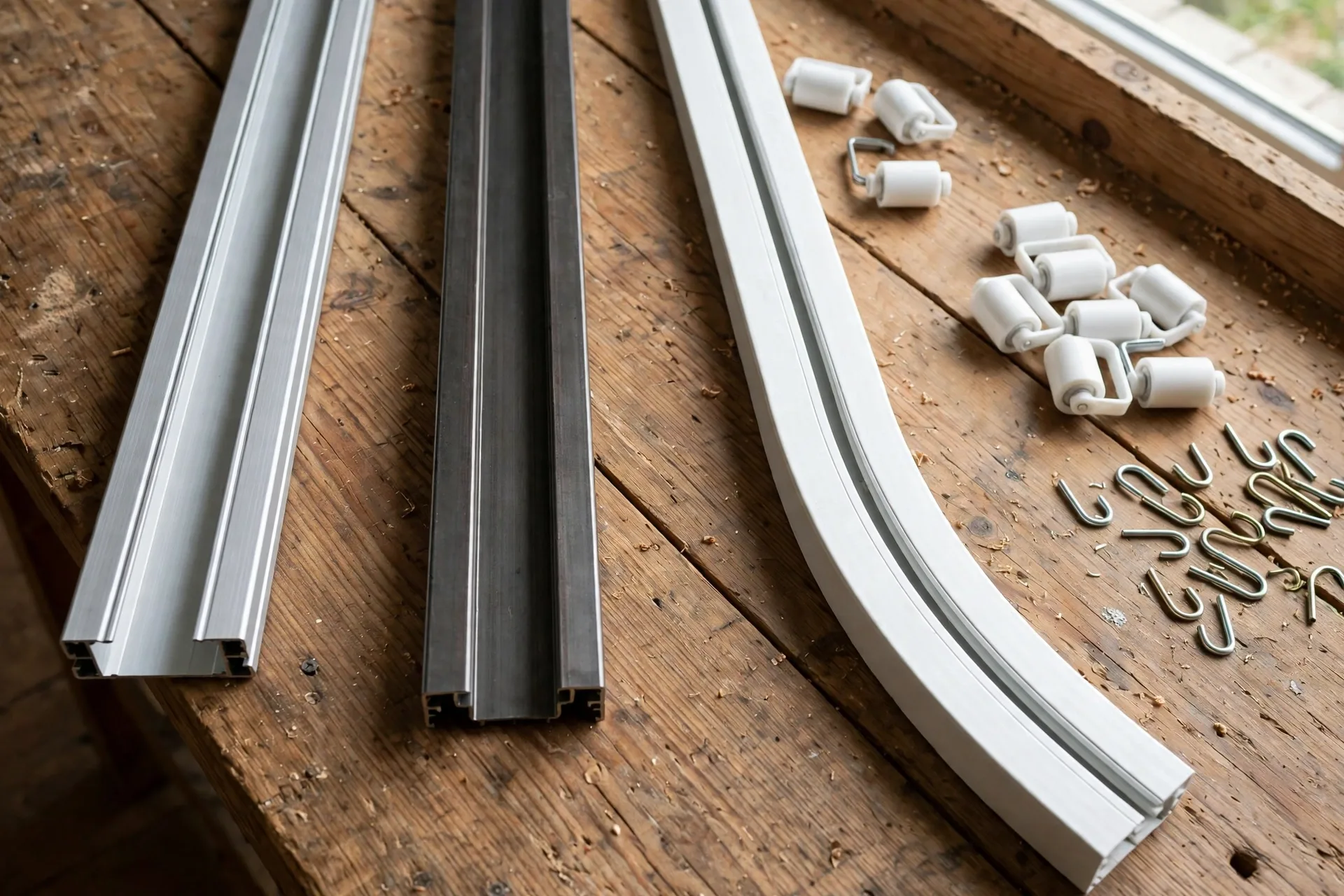
Wood is the classic material, with a warm look that suits traditional rooms, but check its weight limits before loading it with heavy drapes. Plastic tracks can also warp under heavy loads or humidity, so keep them on light curtains in dry rooms.
Read the weight rating as the total load for the whole run, not per bracket, and compare it against the combined weight of every layer the track will carry, including linings. Choose a track rated comfortably above the curtain weight, because a track loaded to its exact limit sags between brackets, the carriers bind, and the curtains drag. A track with no stated weight rating should be treated as light-duty and used for sheers only. The bracket spacing on the listing matters as much as the material: a strong track on brackets spaced too far apart still sags. Check both numbers before ordering.
Ceiling brackets or wall brackets
Ceiling brackets fix the track to the ceiling, and they suit every window where the curtains should hang from the very top: floor-to-ceiling glass, a window with no wall above it, a room divider, and a bay window where the track must follow the ceiling line. Ceiling mounting makes the room read taller, because the curtain runs the full height, and it keeps the wall free for furniture and art. The ceiling must be solid enough to hold the load: a joist is the best anchor, a solid concrete ceiling needs masonry anchors, and a drywall ceiling needs rated toggle anchors rather than plain screws.
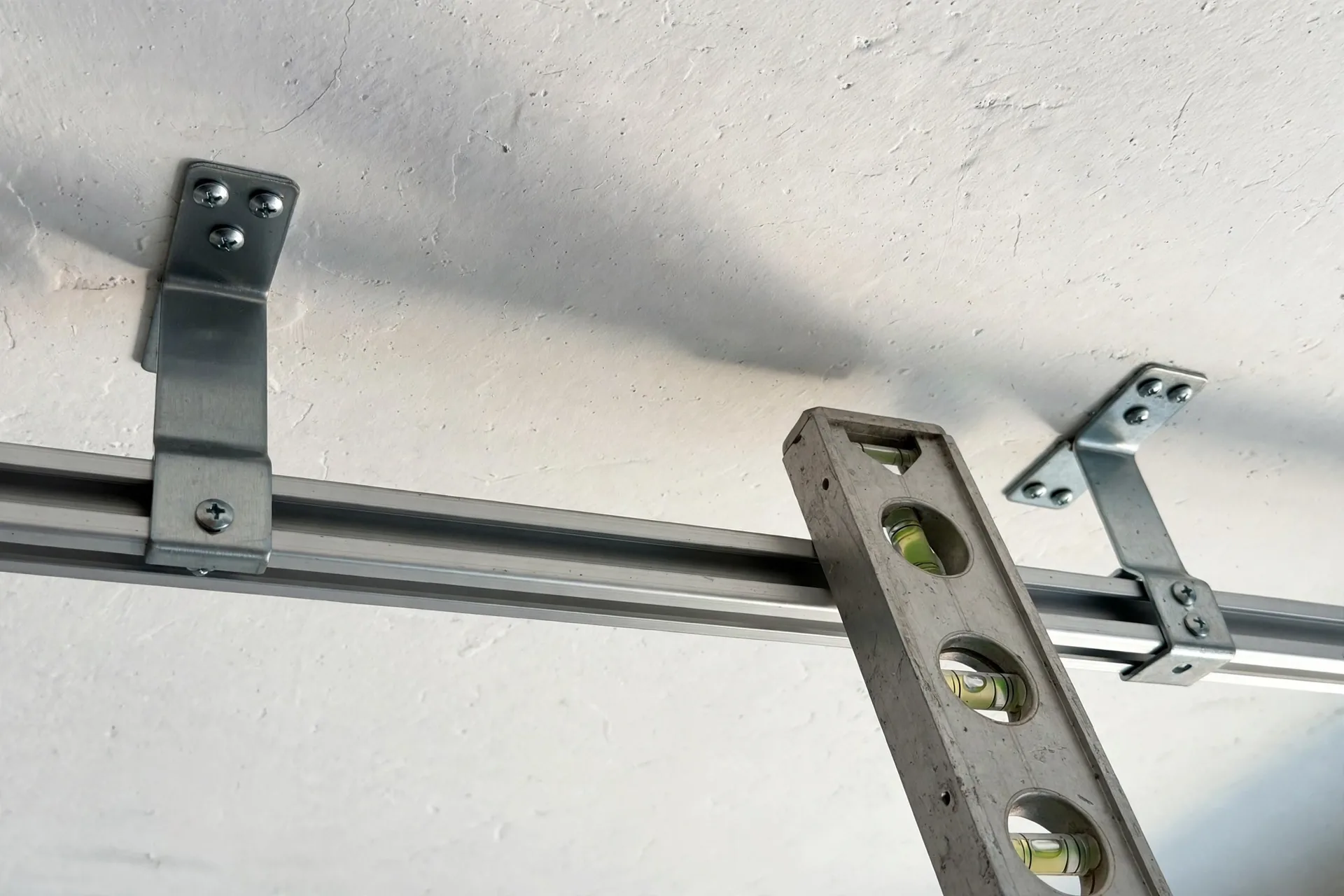
Wall brackets fix the track to the wall above the window, and they suit windows where the ceiling cannot be drilled, such as a rented home, a concrete ceiling with services running through it, or a ceiling that is not level. Wall mounting needs a solid strip of wall above the window at least as deep as the bracket, and the track sits further from the glass, so light can leak at the sides and the curtains hang slightly away from the wall. Some sets include both bracket types, which is the most flexible buy, because the same track can mount to the ceiling in one room and to the wall in another. Whichever mounting you choose, fix into something solid, test each bracket with a firm pull before hanging the curtains, and add a bracket rather than hoping the load will hold.
The same track rates lower on a wall mount than on a ceiling mount, so check the rating for the mounting you will actually use, because a rating quoted for the ceiling does not carry over to the wall.
Set the track 4 to 6 inches from the wall, and 6 inches clear of the walls at each end, and install it as close to the ceiling as possible unless a decorative piece warrants a lower line.
A drop ceiling needs special clips rather than standard brackets, and coastal homes and bathrooms suit marine-grade or anodized aluminum, because salt air eats at ordinary metal.
A recessed track disappears into the ceiling, but it needs a minimum ceiling depth of 4 inches, and professional installation is recommended, because the channel must be cut into the ceiling itself.
Ceiling type decides the hardware: plaster needs appropriate anchors and sometimes longer screws, and never rely on plaster alone, with masonry-style screws into lath where the ceiling is lathed, concrete or masonry needs concrete screws or masonry anchors with a masonry bit, with dust cleaned from the holes, beadboard and metal grid ceilings need substrate-specific hardware. Always check for electrical wires, plumbing, or other obstacles before drilling.
Carriers, gliders, and hooks: the small parts that decide how smooth it feels
Carriers, also called gliders or rollers, are the small wheels that run inside the track and hold the curtain hooks, and they decide whether the curtains glide or stick. Single-wheel carriers suit light curtains and short runs, while double-wheel carriers suit heavy curtains and long runs, because two wheels spread the load and roll more smoothly. Ball-bearing carriers glide the quietest and suit curtains that open and close daily, such as a sliding door or a room divider. Count the carriers in the set before ordering, because a track that arrives short of carriers leaves gaps in the curtain heading and the fabric bunches.
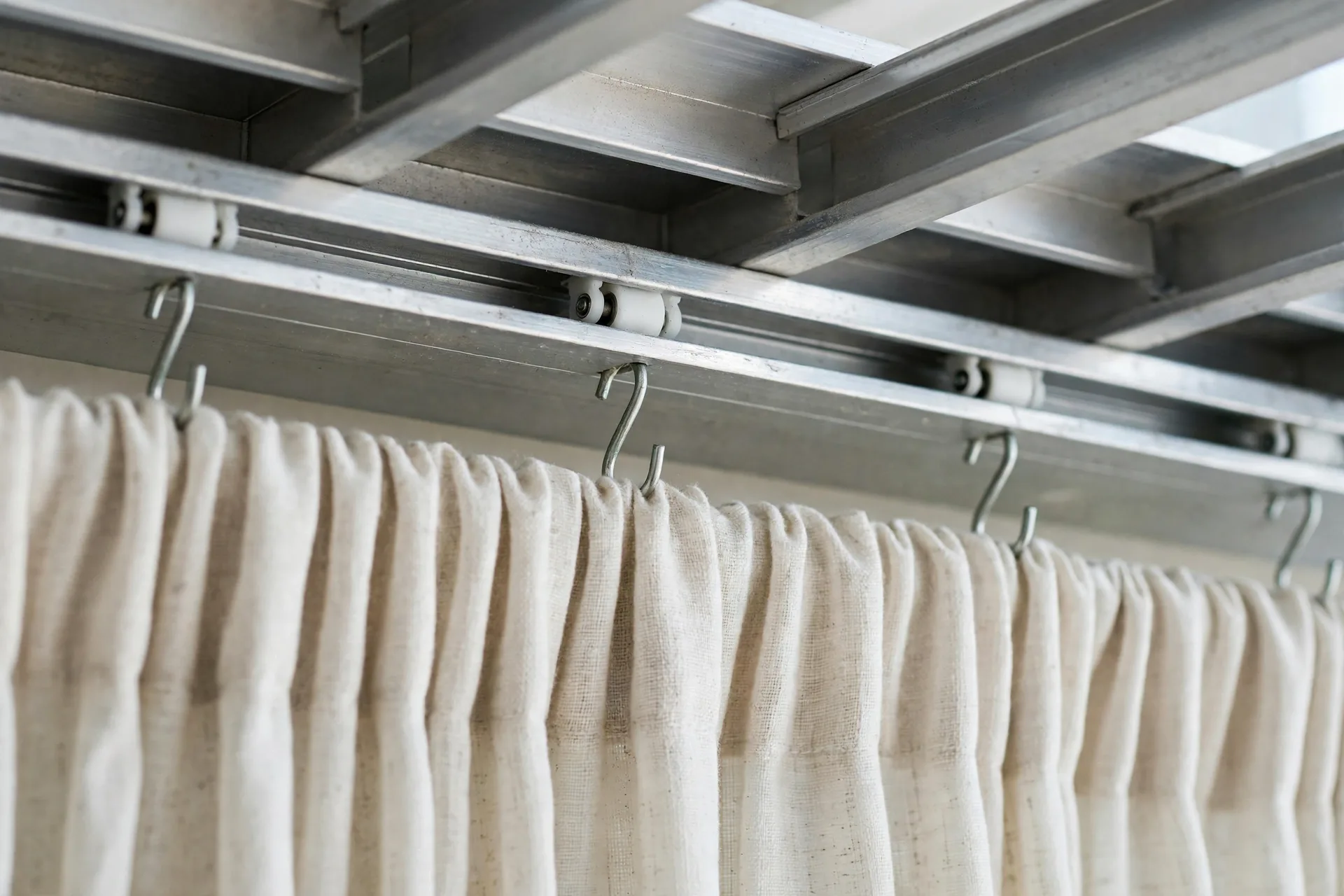
Hooks connect the curtain heading to the carriers, and the hook type must match the heading. Pin hooks suit pinch-pleat and pencil-pleat headings, clip hooks suit plain panels and sheers, and ring hooks suit eyelet headings. Check that the hooks in the set match your curtains, because the wrong hook either will not fit the heading or will not sit right on the carrier. End stops keep the carriers from sliding off the end of the track. Keep a few spare carriers and hooks, because a broken carrier is the most common reason a track starts to stick.
Match the hanging method to the fabric: pin-hook curtains suit heavier fabrics, clip rings are easier and quicker but suit light fabrics only, and grommet curtains need a track-fit check before ordering.
Know what comes in the box before you order: track, carriers or gliders, end stops, mounting brackets, screws, end caps that also stop curtains sliding off the end, and corner connectors for curved or corner runs.
Finish is a room choice as well: brushed nickel suits living areas, matte white suits bedrooms, and marine grade suits bathrooms, with decorative end caps or finials where the track shows, and a hidden recessed track where it should not.
Measuring track length so curtains close and stack right
Measure the track length from the full run the curtains must cover, not from the window alone. Start with the width of the opening, then add extra length on each side so the curtains can stack clear of the opening when open and overlap in the middle when closed. A track that only just covers the window leaves the panels hanging over the glass even when drawn, which dims the room all day, while a track with enough extra length lets the room open fully to the light. For measuring in full, see How to Measure for Curtains.

Add a center overlap where two panels meet, because panels that only just touch leave a light gap in the middle, and a small overlap closes it. For a room divider, measure the full span of the room and add stack room at one end so the curtain can gather to the side when the room is open. For a bay window, measure each facet of the bay separately and add the bend allowance, because a bendable track needs extra length to round the curve, and a rigid track needs a connector at each corner. Cut the track to length with a fine-toothed saw, file the cut smooth so the carriers do not catch, and fit the end stops before hanging the curtains. Measure twice, cut once, and test the glide with the carriers before the curtains go up, because a track that is too short cannot be lengthened and a track that is too long is easy to trim.
Add 6 to 12 inches on each end beyond the opening, so the panels clear the opening and stack clear when open.
A retractable track adjusts without tools across a range of about 51 to 94 inches, which suits a window where the exact width is not yet fixed.
Heavy and layered curtains on a ceiling track
Heavy and layered curtains suit a ceiling track well, because a track spreads the load across many carriers instead of hanging it all from two brackets the way a rod does. The checks that make it work are the track material, the bracket spacing, and the carrier count. Choose heavy-duty aluminum for lined, blackout, or interlined curtains, space the brackets closely along the run, and use double-wheel carriers that spread the load. A double track carrying sheers plus heavy drapes needs brackets rated for the combined weight of both layers, not the heavier layer alone.

Watch the stack: heavy layers gather thick when open, so allow more stack room at the ends than a light curtain needs. Watch the overlap: heavy panels need a real center overlap to close without a light gap, because stiff lined fabric does not fall into a soft seal the way a light fabric does. Watch the glide: test the full run with the curtains hung, because a track that glides empty can bind under load where a bracket sits slightly high or a joint sits slightly proud.
Long spans need extra support: anti-sag support bars suit spans over 3 meters, and very heavy loads call for a double-bracket system rather than single brackets spaced wide.
Standard residential tracks suit light curtains, while heavy-duty tracks carry lined and blackout panels, so match the figure on the listing to your curtains before ordering.
Work the load out before ordering: weigh the curtains from fabric weight per square meter times total fabric area (width × drop), then add the track hardware weight, valances, liners, and hooks and carriers, because the rating must cover everything hanging from the track.
Keeping a ceiling track sliding smoothly
A ceiling track stays smooth when it stays clean and level, and the habit that keeps it smooth is a quick clean every few months. Vacuum the channel gently with a soft brush head to lift dust and lint, then wipe the channel with a damp cloth and dry it, because dust in the channel is the most common reason carriers start to stick. A small amount of silicone spray on the carrier wheels helps a stiff track, but never use an oil-based lubricant, because oil attracts dust and makes the problem worse.
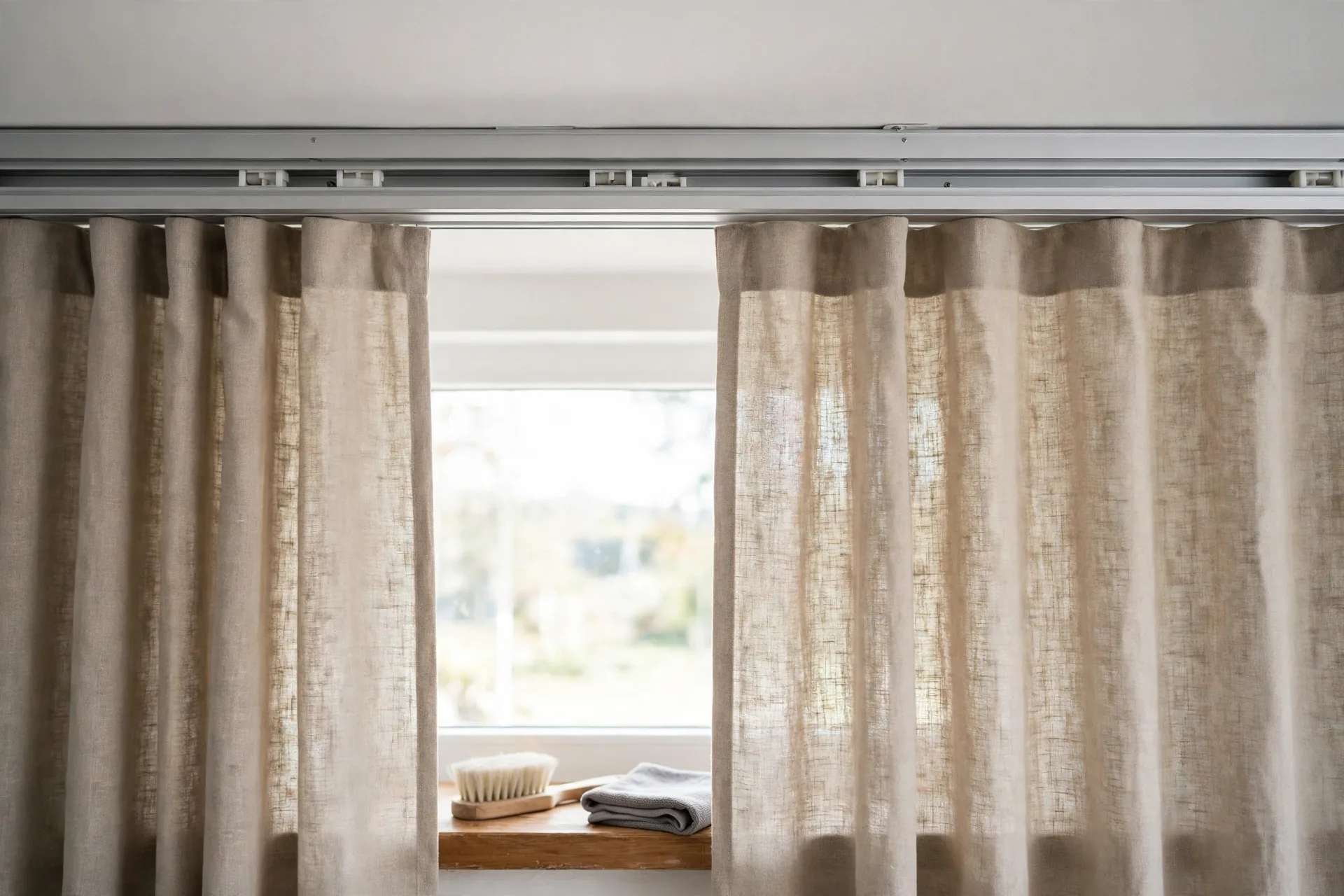
Check the brackets twice a year, because a bracket that has worked loose lets the track dip and the carriers bind at the dip. Check the end stops as well, because a missing end stop lets carriers slide off the end and the curtain drop. Replace a worn carrier as soon as it starts to stick, because one bad carrier drags the whole run and wears the channel. A track that is cleaned, checked, and kept level glides for years.
Keep a schedule for it: dust weekly, deep clean monthly, lubricate quarterly, and check the brackets every 6 months. Uneven movement, scraping sounds, or gaps between track and ceiling are signs to act on, and carriers jumping off at the ends usually mean the end caps or cap inserts are worn. Persistent skipping or binding calls for an inspection for warping, misaligned corners, or damaged carriers, with parts replaced as needed. Use a silicone-based spray or dry lubricant, never oil-based, because oil attracts dust and degrades the track. Call a professional where the track is bent or damaged, where it is pulling away from the ceiling, or where a motor has an issue.
Level matters most of all: the track must be perfectly level or carriers bind and curtains drift, so test with light pulls before hanging heavy drapes, and where a curtain pulls to one side, check bracket level and spacing, that the track is fully seated in the brackets, and that there are no kinks or bends, adding a center support for long runs.
Frequently asked questions about ceiling curtain tracks
Most ceiling track questions come down to weight, shape, and whether the ceiling can hold the track.
What is a ceiling curtain track?
A ceiling curtain track is a rail fixed to the ceiling, with small carriers that slide along it and hold the curtain hooks. It suits floor-to-ceiling windows, bay windows, room dividers, and windows with no wall space above them, where a wall rod cannot work. Curtains hang from the ceiling to the floor and glide along the track to open and close.
Single or double ceiling track: which should I choose?
Choose a single track when one layer of curtains does the job, and a double track when two layers must move independently, such as sheers behind drapes. A double track needs a wider fitting and brackets rated for the combined weight of both layers. Buying a double track for a single layer wastes ceiling room, while forcing two layers onto a single track tangles them.
Can a ceiling track hold heavy blackout curtains?
Yes, a heavy-duty aluminum ceiling track with double-wheel carriers and closely spaced brackets holds heavy lined and blackout curtains well, because the track spreads the load across many carriers. Check the weight rating on the listing against the combined weight of every layer, and fix into joists or rated anchors. A light PVC track does not suit heavy curtains.
How do I measure for a ceiling curtain track?
Measure the width of the opening, then add extra length on each side so the panels can stack clear when open, and add a center overlap so they close without a light gap. For a bay window, measure each facet separately and add the bend allowance.
Straight or bendable ceiling track: which is better?
A straight rigid track is better for flat windows and long straight runs, because it carries more weight and glides smoother. A bendable track is better for bay windows, curved walls, and L-shaped runs, because it follows the shape. For a bay with sharp corners, rigid sections joined with corner connectors often glide better than one sharply bent flexible track.
Can I install a ceiling track in a rental?
A standard ceiling track needs screws into the ceiling, so it is not a no-drill fitting, though adhesive track systems exist that stick to a smooth ceiling or wall with no drilling. Those suit light curtains only, and the glue may not hold heavy curtains, or hold over time, so most leases still do not allow a screwed track without permission. Ask the landlord first, and if drilling is not allowed, use a tension rod or an adhesive-mounted rod instead. A track that is removed at the end of a tenancy leaves holes that need filling.
What carriers and hooks do I need for a ceiling track?
Use single-wheel carriers for light curtains and double-wheel or ball-bearing carriers for heavy curtains and daily use. Match the hooks to the heading: pin hooks for pleated headings, clip hooks for plain panels and sheers, and ring hooks for eyelet headings. Count the carriers in the set before ordering, and keep a few spares.
How do I stop a ceiling track from sticking?
Keep the channel clean by vacuuming it gently and wiping it with a damp cloth, use a small amount of silicone spray on the carrier wheels if it stiffens, and never use oil-based lubricant. Check the brackets for looseness, and replace any worn carrier as soon as it starts to stick.
For the full curtain range, see Best Window Curtains.
This guide is research-based curation: we compared maker specifications, published reviews, and current prices. Read how we choose.