 Best
How to Layer Curtains
Layer curtains when one panel cannot do both jobs: a light layer by the glass for soft daylight, and a heavier layer in front for night privacy and darkness.
A single sheer looks lovely at noon and leaves a room exposed after dark. A single blackout panel gives darkness at night and shuts the daylight out by day. Two layers end that trade. By day, close the light layer and open the heavy one for filtered light. At night, close the heavy layer for privacy and darkness.
What layering a window actually means
Layering a window means running two window treatments on the same window so each one does a different job. The back layer, closest to the glass, usually filters light or gives fine control over it. The front layer, on the room side, usually gives privacy, darkness, or a finished look. Together they give four settings from one window: both open, the light layer closed, the heavy layer closed, and both closed.
That range is the point of layering, and it is also what separates it from simply hanging thicker curtains. A thick single panel has one setting: open or closed. A layered window lets you change the light through the day without changing the curtains. Two layers also add depth that one flat panel cannot match. Two layers trap more air at the window than one, so a layered window can feel less drafty than a single panel, and a heavier thermal front layer traps still more air than a light sheer alone. That trapped air softens echo in the room too, but layering only reduces sound, it never soundproofs a window, so street noise will still come through, softened rather than blocked. For how window coverings affect heat in the home through the seasons, see guidance on energy-efficient window coverings from the U.S. Department of Energy. For the basics of each fabric on its own, read Best Sheer Curtains and Best Blackout Curtains before you pair them.
Sheer plus blackout: the daylight and night privacy pair
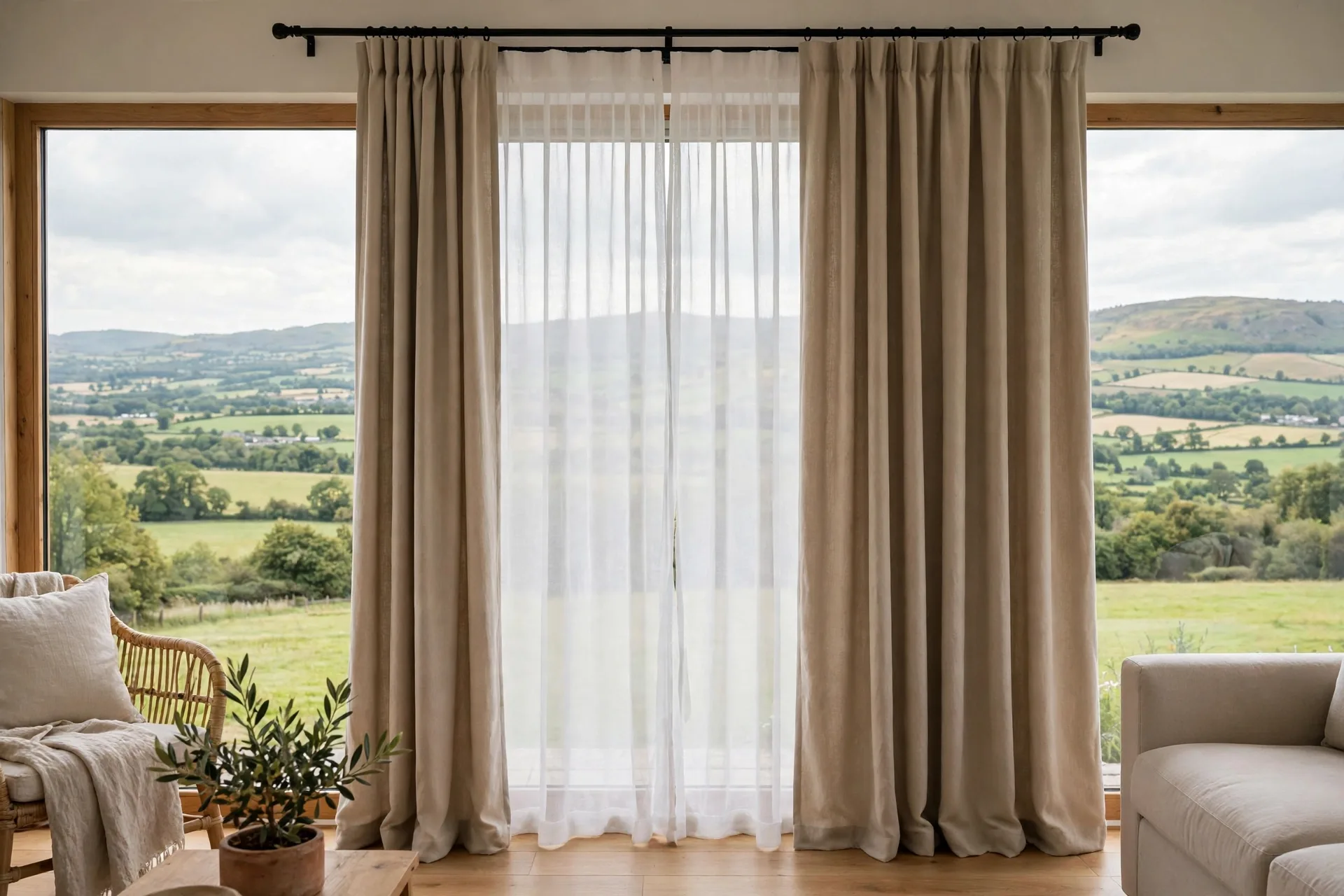
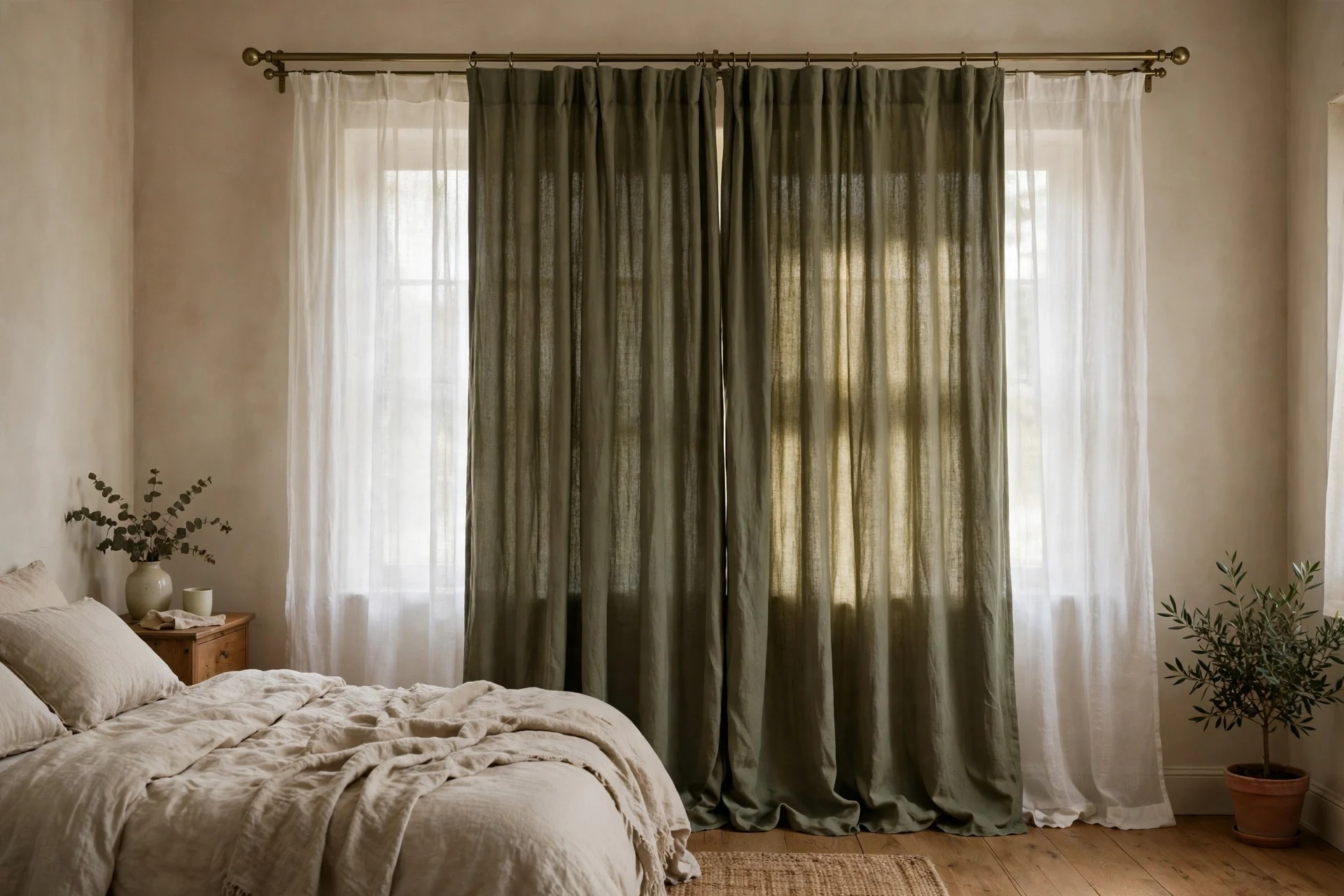
For daylight and night privacy in one window, sheer plus blackout is the pair to start with: the sheer stays closed by day, the blackout closes at night, and each layer does the job the other cannot. By day, open the blackout panels and close the sheer for soft, filtered light with daytime privacy. At night, draw the blackout panels closed over the sheer for privacy and darkness.
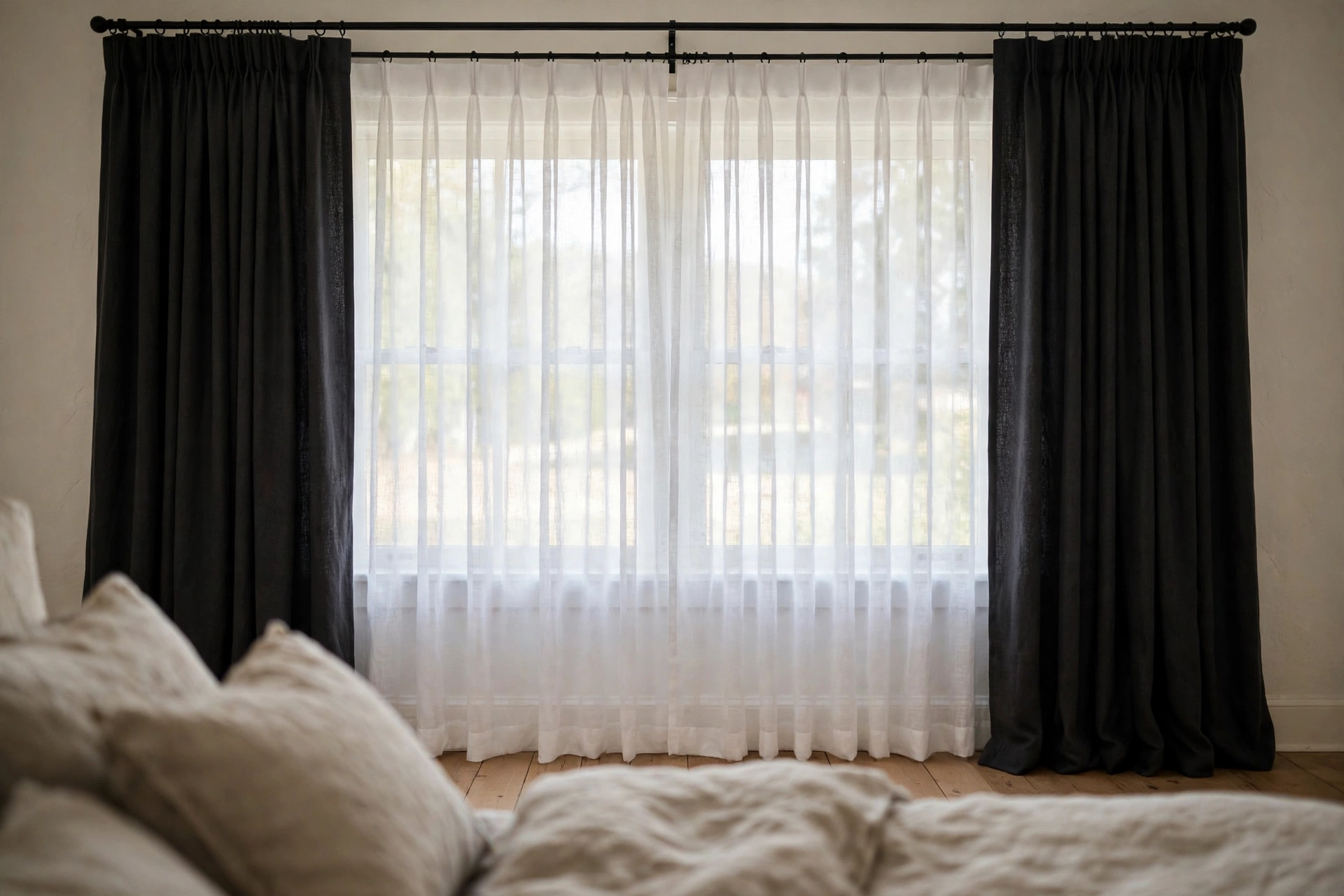
Three details decide whether this pair works or disappoints. First, the sheer gives daytime privacy only while the room is darker than outside, so it is not a night privacy layer on its own. Second, layering alone does not make a room blackout: light still slips through gaps at the top, sides, center, and bottom unless the front layer covers the window fully and overlaps in the middle when closed. Set the rod 4 to 6 inches above the frame and about 6 to 12 inches beyond each side, as planning ranges, so the front panels stack on the wall when open and cover the edges when closed, and follow the fitting steps in How to Hang Curtains. Check for light lines at night after hanging. Third, match the front label to the real job: room-darkening fabric cuts most light but is not true blackout, so a bedroom facing street lights needs the blackout label, not just a dark color. Best Curtains for Bedroom covers the sleep side of that choice in more depth.
Blind plus curtain: the neat base layer with a soft front
Put the blind closest to the glass and the curtain in front of it: the blind handles fine light control through the day, and the curtain softens the window and adds privacy at night. This pair suits a room that already has blinds, and a room where curtains alone feel too soft for daytime glare. Roller, Roman, or Venetian blinds all work as the base layer, since each one sits close to the glass and adjusts the light in small steps. Cellular or honeycomb shades, vertical blinds, and wood or faux-wood blinds also work as base layers in the same position. A blind adjusts light with slats, while a shade is a flat or folded fabric panel that rises and falls as one piece, so check which type you already have before choosing the rod depth. For how blinds compare with curtains on light, privacy, and cleaning, see Curtains vs Blinds.
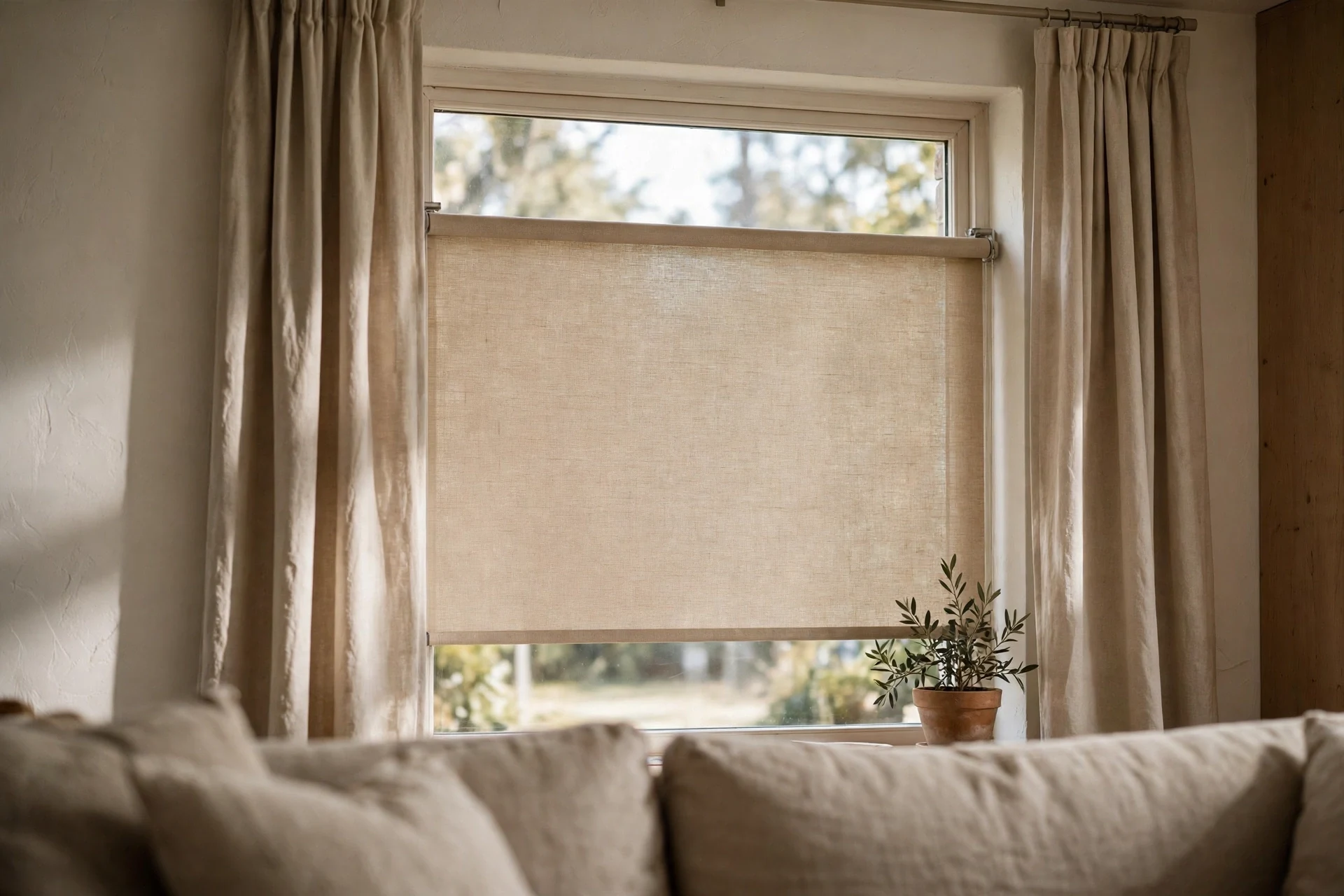
Hang the curtain rod above and wider than the window so the open curtains stack on the wall and leave the blind fully visible. Plan the inner line about 2 to 3 inches off the wall, the outer line about 3 to 4 inches off the wall, and a gap of up to 2 inches between the two lines, as planning ranges, so the front layer clears the back layer and the rod sits far enough out to clear the blind headrail. Choose a rod that holds the curtain clear of the blind headrail, so the blind still moves freely and the curtain never catches on it. By day, use the blind for glare and privacy, with the curtains open at the sides. In the evening, draw the curtains closed for a softer room, with the blind behind them as a second seal. If the room has children, keep blind cords out of reach or choose a cordless blind.
Sheer plus drape: softness first, darkness second
Sheer plus drape suits a room that needs softness more than darkness: the sheer gives daytime privacy and filtered light, and the drape gives evening privacy and a finished look. A drape here means a heavier decorative panel, in linen, cotton, velvet, or a lined weave. It may be lined, but it is not always a blackout panel. If the room needs true darkness, choose a blackout front layer instead.
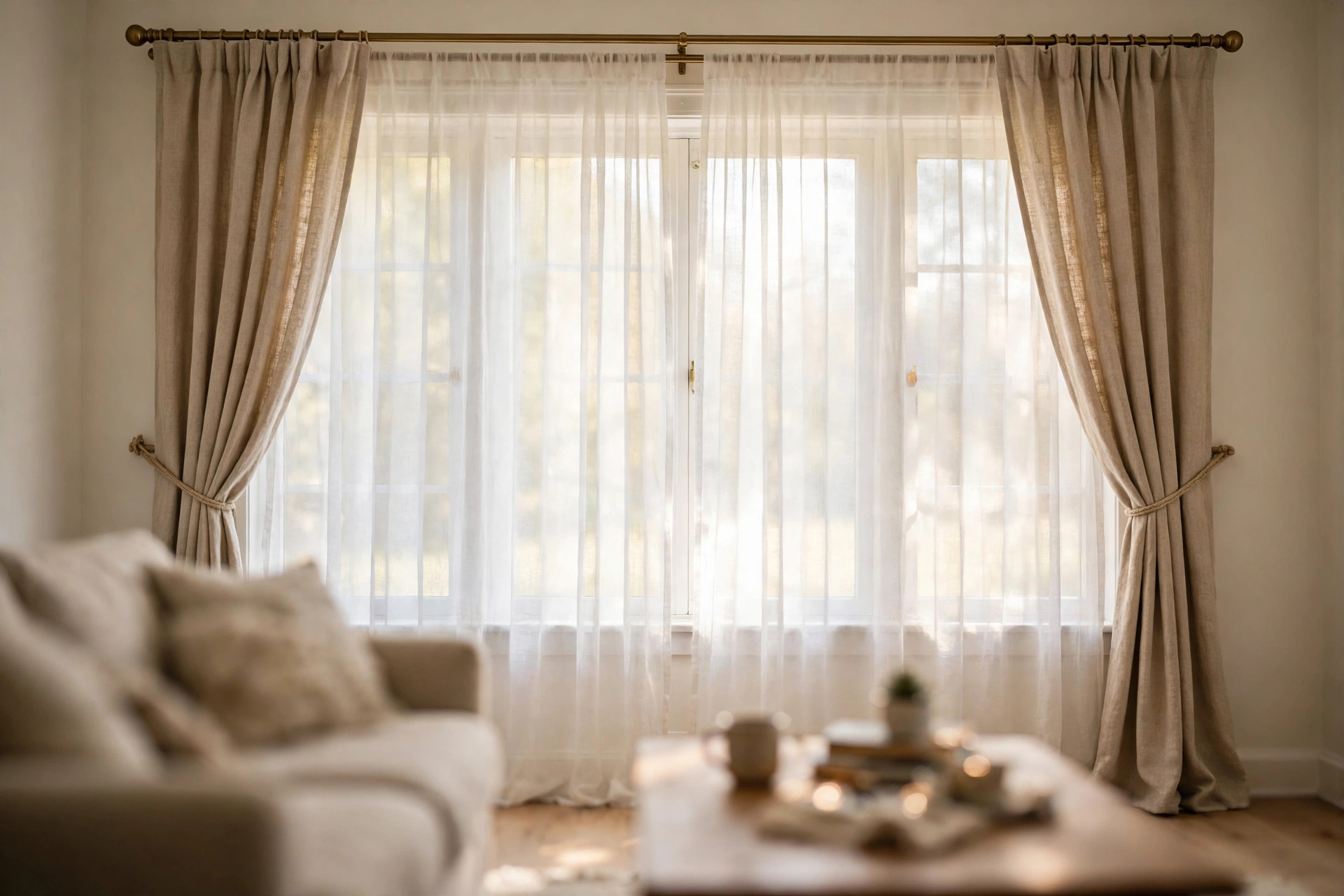
This pair shines in a living room or dining room, where full darkness is rarely needed. The sheer stays closed through the day for a soft glow, and the drape frames it from the sides, drawn closed in the evening for privacy. A linen-look sheer pairs well with a textured drape, since the two fabrics read as different layers even in the same color family. Velvet drapes give the richest look, but they are also the heaviest, so they need a rod rated for that weight, and they suit a larger room better than a small one. Best Curtains for Living Room covers how a living room pair should handle glare and evening privacy together.
Sheer over sheer is a separate pair, not just a lighter version of sheer plus drape. It suits a dining room or sunroom where brightness matters more than evening privacy, and it works best when both sheers stay in one tone family, with the front sheer slightly deeper or warmer than the back sheer, so the layers read as depth rather than duplication. It is a poor bedroom pair, because two sheers still give almost no night privacy once the room lights are on.
Double rods and tracks in brief: how the layers move on their own
A double rod or a double track is the simplest way to keep two layers independent: one line carries the back layer, the other carries the front, so each layer opens and closes on its own. Independence is the whole reason to choose this hardware. Without it, you own the layered look but not the layered control.
| Setup | How the layers move | Best for |
|---|---|---|
| Double rod | Back layer on the inner rod, front layer on the outer rod, each sliding on its own | Most homes, and the standard choice for sheer plus blackout |
| Two separate rods | Each layer on its own rod, set at its own depth and height | Heavy or wide panels, and windows where the layers suit different heights |
| Double track | Both layers on gliders in one track unit, often ceiling mounted | Wide windows, and panels opened and closed every day |
| Single rod | Both layers share one rod and move together | A fixed decorative look where the arrangement rarely changes |
A double rod suits most windows because one bracket set carries both rods. Two separate rods suit a heavier pair, since each rod carries less weight, and they allow the front layer to sit higher than the back layer. A double track gives the smoothest daily movement, which matters on a wide window opened and closed several times a day. A single rod is the cheapest route and the right one only when the layers will stay put. If daily day and night control matters, choose a double rod or a double track instead. On a double rod, plan the inner rod about 2 to 3 inches off the wall and the outer rod about 3 to 4 inches off the wall, with up to 2 inches between the lines, as planning ranges, so each layer travels without catching the other. This guide covers hardware only as a choice between these options; for rod choice itself, see Best Curtain Rods, and How to Hang Curtains covers the general hanging steps. Layering without drilling needs a tension rod or adhesive brackets, and the no-drill hanging guide covers the five methods.
Which layer goes where, and why the order matters
The usual order is light layer closest to the glass and heavier layer on the room side, because that order gives the easiest daily use. You open the heavy layer by day to reveal the sheer, and close it at night without reaching through another fabric. The sheer heading stays hidden behind the front panel, and the sheer takes less wear, since it sits behind the layer you handle every day.
Two exceptions are worth choosing on purpose rather than by accident.
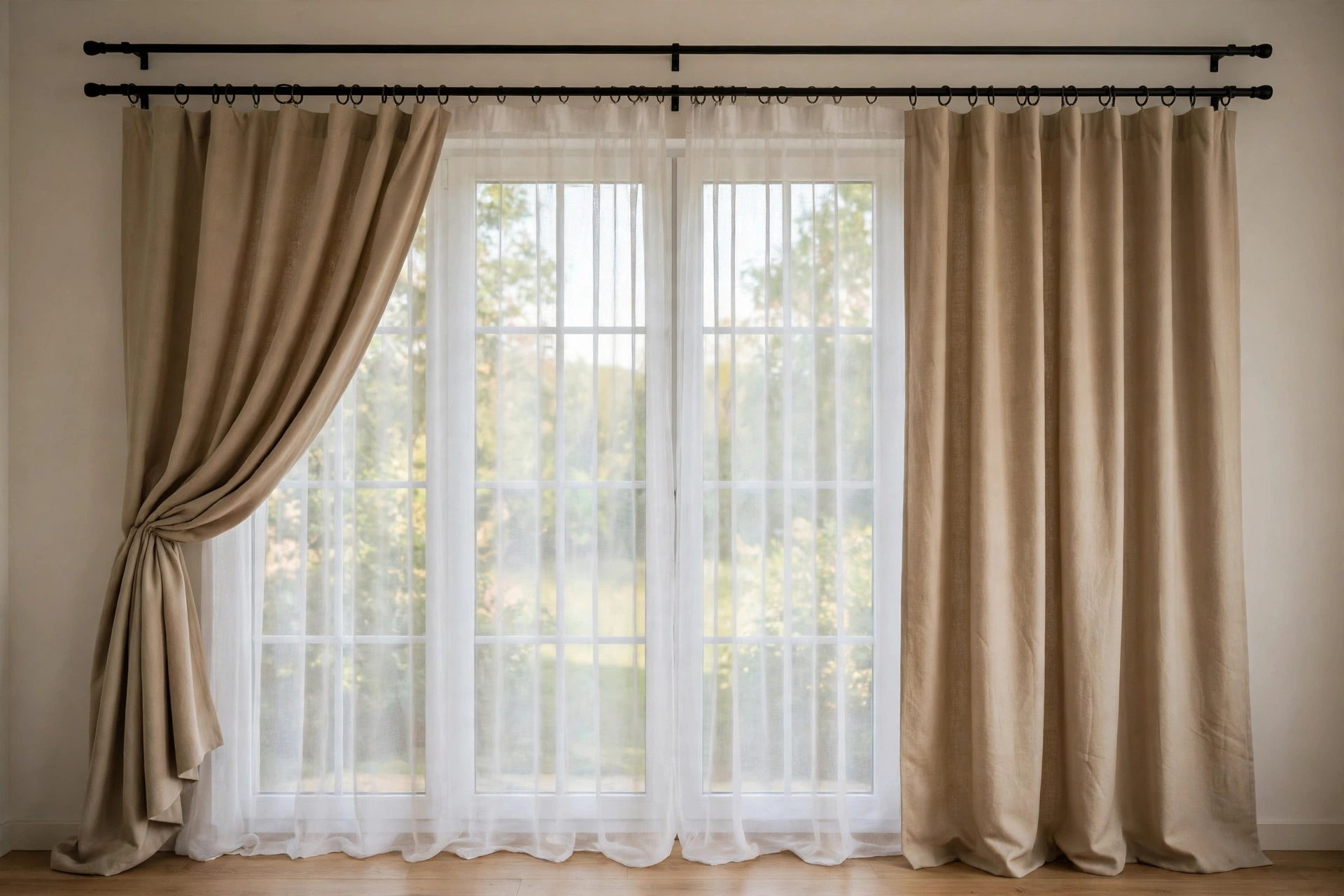
The first is the reversed order, sheer in front of a solid panel, which gives a soft, hazy finish over a dark fabric and suits a formal room or a feature window. It costs daily ease: you must open the front sheer to reach the solid layer, the sheer shows creases and hardware more, and a fine sheer snags more easily on the room side. The second exception is a blind or shade as the base layer, which always sits closest to the glass, with the curtain in front. A valance or cornice sits on top as decoration and hides the hardware, but it adds bulk, so it belongs only on a room that can carry it. A third layer is possible where the window needs all three jobs: a blind or shade closest to the glass for fine light control, a sheer in the middle for filtered daylight, and a front drape or blackout panel for night privacy. A valance can also act as the outer layer, on its own rod above the curtains, or as part of a drape-and-valance set on one rod, but it adds bulk, so it belongs only where the room can carry it. On each layer, pick a heading that slides well on its own line, such as grommets or rings for a layer opened daily, and check that each heading fits its rod before ordering.
Matching color and texture without making the window heavy
Pick one layer to lead and let the other support it: pattern, strong color, or rich texture goes on one layer only, and the second layer stays quiet. Two layers competing for attention is the fastest route to a window that looks busy, even when each fabric looks good on its own. Start with the front layer, since it is the layer the room sees most.
Match the front layer close to the wall tone and the window recedes, which calms a small room and makes the space feel larger.
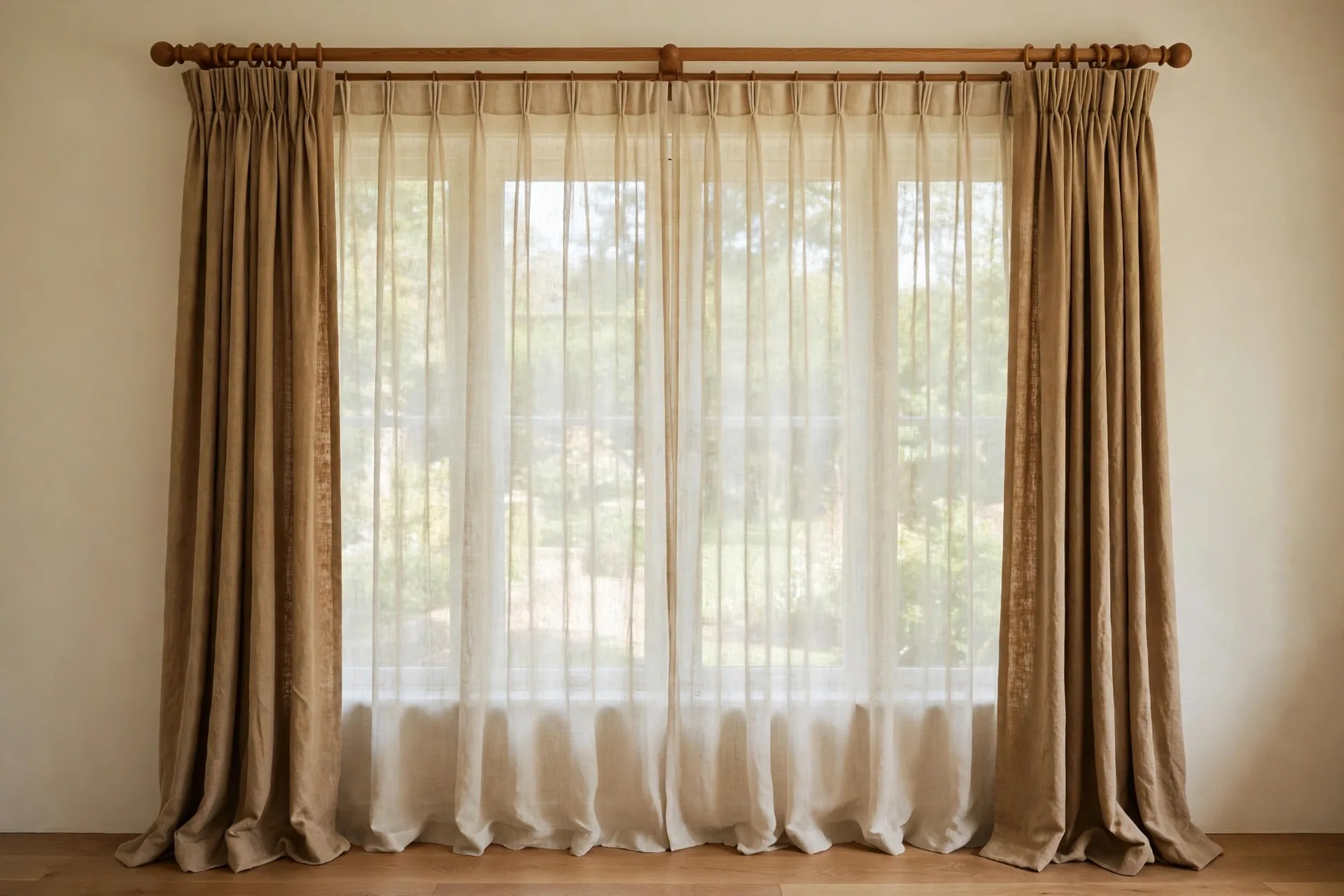
Contrast it strongly with the wall and the window becomes a statement, which suits a larger room with plain walls. For a softer version, stay in one color family, such as a pale oatmeal sheer behind a deeper sand drape. Texture often does more work than color: a crisp linen-look sheer behind a plush velvet panel adds depth even when both layers are neutral. Put pattern on one layer only, and keep the other solid. Before ordering, check fabric samples against the wall in daylight and again under lamplight, because a sheer tints the light that passes through it.
Sizing layered panels so both layers close and stack cleanly
Size each layer as if it had to close the window on its own: a layer that only just spans the glass will pull flat and leave gaps when closed. It is tempting to order the sheer narrow, since it sits behind the front layer, but a thin sheer looks sparse when closed, and a narrow front layer leaves a light line down the middle at night. As a starting point, the combined width of the panels on each layer should reach about 1.5-2 times the rod width, with sheers toward the fuller end of that range, since a sheer needs more fabric to avoid looking flat. By heading, plan for about 2 times the rod width for grommet panels (about 1.75 to 2.25 times), about 2 to 3 times for rod-pocket panels, about 2 times for back-tab panels, and about 2.5 to 3 times for pleated panels. Curtain Sizes and Lengths covers heading and fullness choices in more depth, and How to Measure for Curtains covers the numbers to take before ordering.
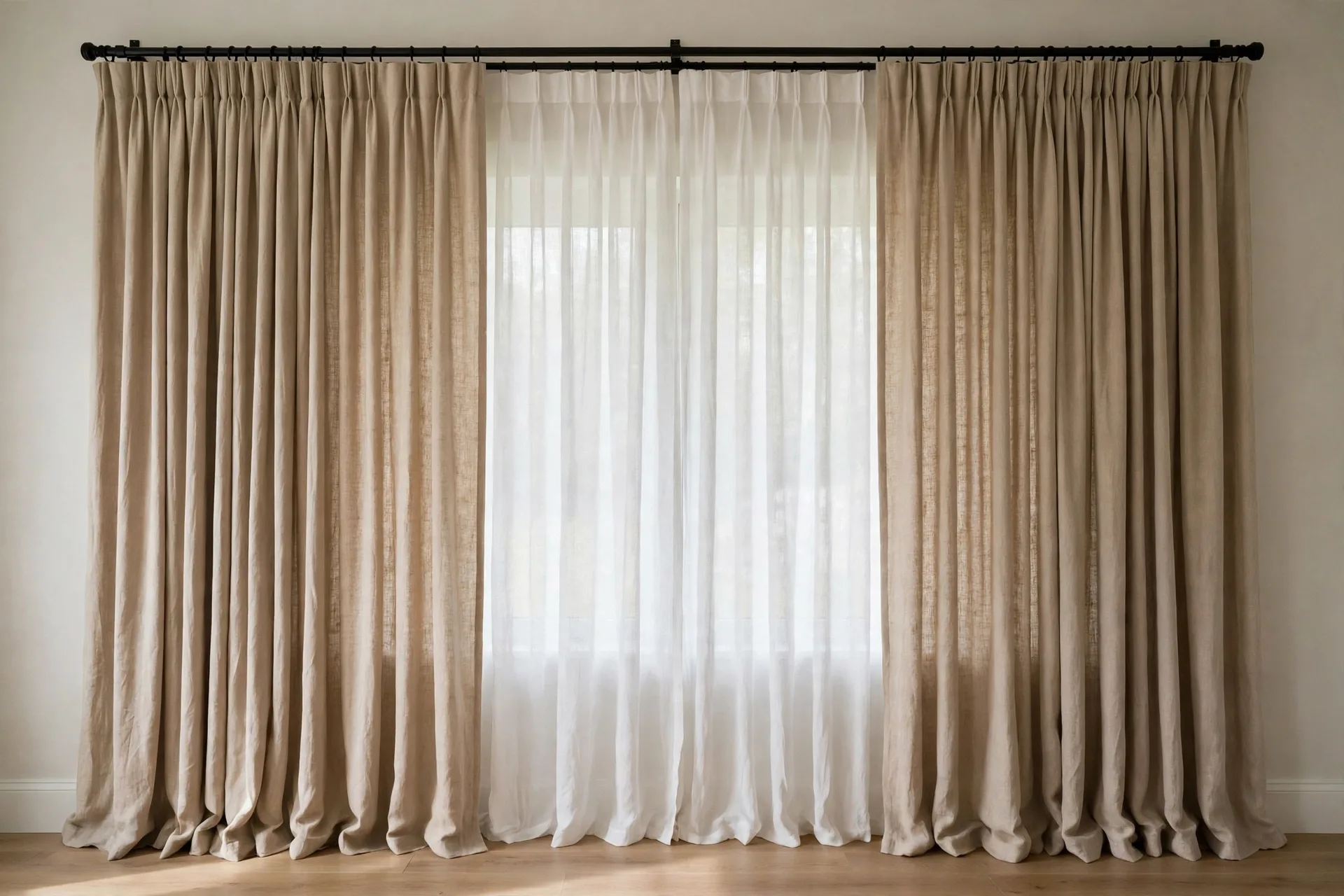
Keep both layers the same length in most rooms, so the hems line up and the window looks planned. If one layer must differ, make the sheer slightly shorter, so it never peeks below the front hem. For length, a float hem sits about 1 inch above the floor and suits a busy room or an uneven floor, since it stays clear of feet and the vacuum path. A kiss hem grazes the floor and suits most layered windows, since it touches without pooling and stays tidy with normal vacuuming. A puddle hem pools about 3 inches on the floor and suits a formal room with little foot traffic, but it gathers dust and must be lifted for cleaning. Finally, leave stack room: when both layers are open, the panels must sit on the wall beside the window, not across the glass. Measure the stack width of both layers together before settling the rod length.
Layering by room: bedroom, living room, and the rooms after that
Match the pair to how the room is used: a bedroom needs darkness, a living room needs daylight plus evening privacy. In a bedroom, the job is sleep: a sheer behind a blackout front layer, on a double rod, with the front panels overlapping in the middle, gives soft daylight and real darkness at night. Check for light lines after hanging, and treat a room-darkening front layer as weaker where street lights or early sun reach the window. Best Curtains for Bedroom covers the sleep side of this choice.
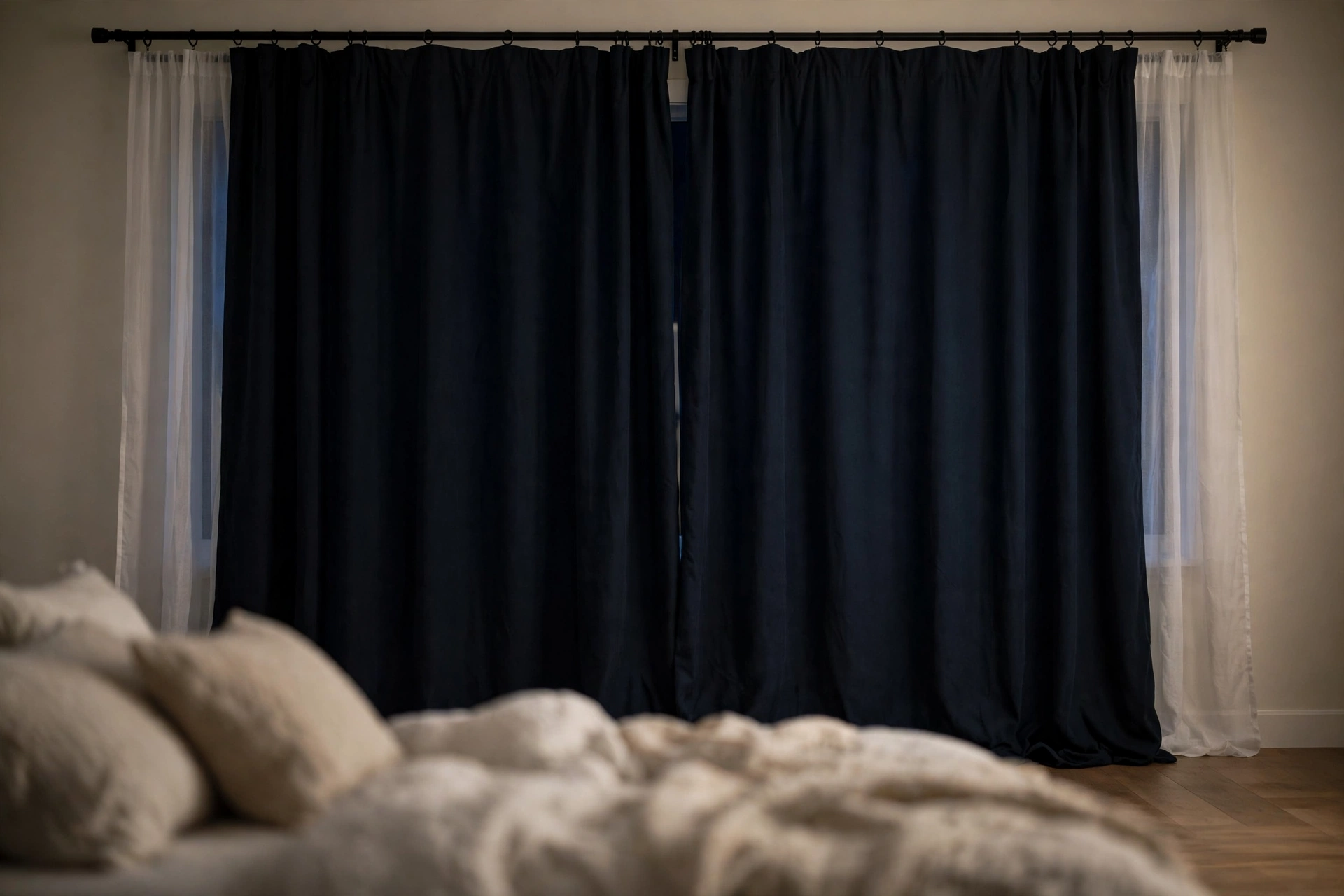
In a living room, the job is daylight plus evening privacy: a sheer behind a drape or a blackout front layer gives filtered light by day, cuts screen glare, and closes for privacy in the evening. A street-facing living room needs the same night warning as a bedroom. In a dining room or sunroom, where full darkness is rarely the goal, sheer plus sheer or sheer plus a light drape keeps the space bright. In a home office, a light-filtering front layer over a sheer cuts screen glare while keeping the room usable. In a nursery or a child's room, keep the blackout pair for naps, choose cordless hardware where possible, and keep cords and tiebacks out of reach. Cordless hardware is the safest choice where young children are present, and furniture should sit away from windows and window covering cords, following safety guidance on window covering cords from the U.S. Consumer Product Safety Commission. Avoid a long puddle hem in a child's room, since a pooling hem is a trip hazard and a climbing foothold. Best Curtains for Living Room and Best Window Curtains put these room choices into the wider picture.
Layered windows in small rooms: keeping bulk down
In a small room, keep layering light: one sheer plus one unlined or lightly lined front layer usually looks better than two heavy layers. Bulk is the main risk in a small room: a lined blackout panel plus a thick drape plus a valance can swallow a short wall and darken the room even with the layers open.
Four choices keep a small layered window in scale.
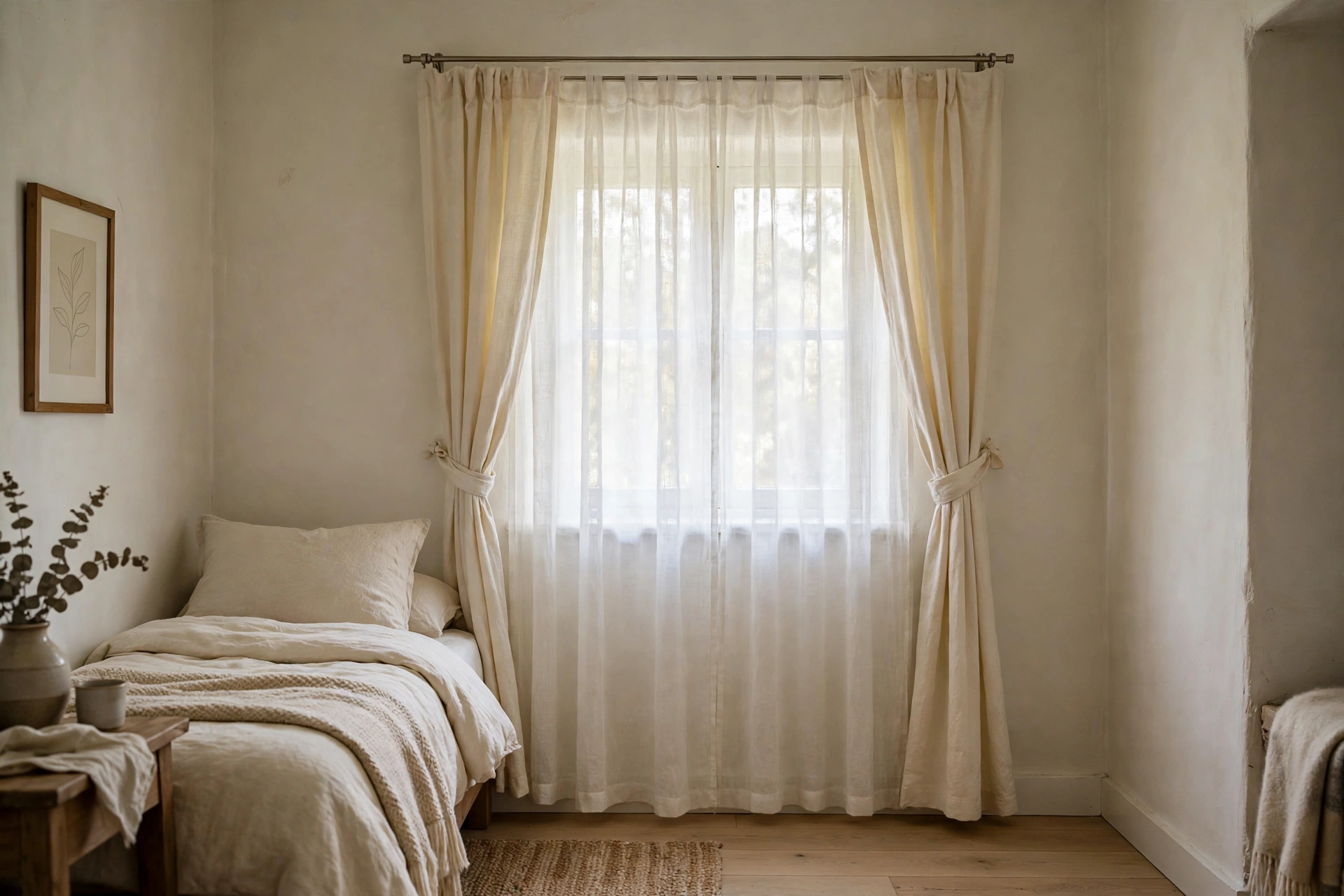
First, choose the lighter front layer: an unlined cotton or linen drape gives evening privacy without the weight of a lined blackout panel, unless the room truly needs darkness. Second, keep the front color close to the wall tone, so the window recedes instead of advancing into the room. Third, skip the valance, since it adds a third band of fabric at the top where a small room least needs it. Fourth, use tiebacks on the front layer to hold the open panels clear of the glass, so the sheer gets the full window width by day. A float hem just above the floor also helps in a small, busy room. If a small window still looks crowded after those choices, the answer is usually one layer fewer, not a thinner version of both.
Layering mistakes that make a window look crowded or fail at night
Most layered windows go wrong in the same few ways: a front layer too narrow to close, a sheer trusted for night privacy, or two heavy layers in a small room, and each mistake below comes with the fix that puts it right.
- Front layer too narrow. Fix it by ordering enough width for the front layer to close with folds left and overlap in the middle, so no light line shows down the center at night.
- Sheer treated as night privacy. Fix it by closing the front layer every evening, and by choosing a blackout or drape front layer, not a second sheer.
- Layers that cannot move separately. Fix it by choosing a double rod or double track when daily day and night control matters, and by treating a single rod as a fixed look only.
- Pattern or strong color on both layers. Fix it by keeping pattern on one layer and the other solid, and by letting one layer lead while the other supports it.
- Heavy plus heavy in a small room. Fix it by dropping one heavy layer for a lighter front fabric, skipping the valance, and matching the front color to the wall tone.
- Mismatched hems. Fix it by ordering both layers to the same length, or by making the sheer slightly shorter so it never peeks below the front hem.
- Front layer catching the layer behind it. Fix it by choosing a rod or track that holds the front layer clear of the back layer and, over a blind, clear of the headrail.
- Layers sewn together when one needs washing sooner. Fix it by keeping the layers separate, since sheers usually need washing before a front drape does.
Frequently asked questions about layering curtains
Layer curtains by giving each layer its own job and letting each layer move on its own: a light layer by the glass for daylight, and a heavier layer in front for night privacy and darkness.
Which layer goes closest to the glass when layering curtains?
Put the lightest layer closest to the glass and the heavier layer on the room side. That order lets you close the light layer by day and draw the heavy layer at night.
Do I need a double rod to layer curtains?
You need a double rod, a double track, or two separate rods if you want each layer to move on its own. A single rod gives a fixed look only, because both layers move together.
Can I layer curtains on a single rod with sheers in the center and solids at the ends?
Yes, for a fixed decorative look. Hang the sheers in the center and the solid panels at the ends on the same rod, and accept that the arrangement stays put, since the layers cannot move on their own.
Does layering curtains make a room blackout?
No, not on its own. A blackout front layer blocks light through the fabric, but light still slips through gaps at the top, sides, center, and bottom unless the front layer covers the window fully and overlaps in the middle.
Can I layer curtains over blinds I already have?
Yes. Keep the blind closest to the glass as the base layer, and hang the curtain in front of it on a rod that clears the blind headrail, so the blind still moves freely.
Should both layers be the same length?
Yes, in most rooms. Matching hems keep a layered window looking planned. If one layer must differ, make the sheer slightly shorter so it never peeks below the front hem.
How do I stop layered curtains looking bulky in a small room?
Keep one layer light. Pair a pale sheer with a single unlined or lightly lined front layer, skip a valance, and choose a front color close to the wall tone.
Do sheers give privacy at night when the lights are on?
No. A sheer screens the view by day, when the room is darker than outside. At night, with the room lit, the view reverses and the sheer stops hiding the room.
How do I wash layered curtains when one layer gets dirty faster?
Wash each layer on its own, following its own care label, and keep the layers on separate rods or tracks so you can take one down without disturbing the other. Between washes, dust or vacuum the layers to keep dust down, steam a wrinkled layer on the rod where the label allows, and choose dry cleaning over machine washing where the label points to professional cleaning. On the label, a crossed tub means do not wash, and a circle points to professional cleaning, following the care symbols under the ISO 3758 standard from GINETEX.
Can I layer three treatments on one window?
Yes. Put a blind or shade closest to the glass, a sheer in the middle, and a front drape or blackout panel on the room side, with each layer on its own line so it still moves on its own.
Can I layer a valance over layered curtains?
Yes, if the room can carry the extra bulk. Hang the valance on its own rod above the curtains, or choose a drape-and-valance set made to hang on one rod, and keep it off a small window where it will crowd the wall.
How wide should layered curtains be for my heading?
Plan for about 2 times the rod width for grommet panels (about 1.75 to 2.25 times), about 2 to 3 times for rod-pocket panels, about 2 times for back-tab panels, and about 2.5 to 3 times for pleated panels. Sheers sit toward the fuller end of their range so they do not look flat when closed.
Can I layer curtains over shades (not just blinds)?
Yes. Keep the shade closest to the glass as the base layer, and hang the curtain in front of it on a rod that clears the shade headrail, so the shade still rises and falls freely.
This guide is research-based curation: we compared maker specifications, published reviews, and current prices. Read how we choose.