 Best
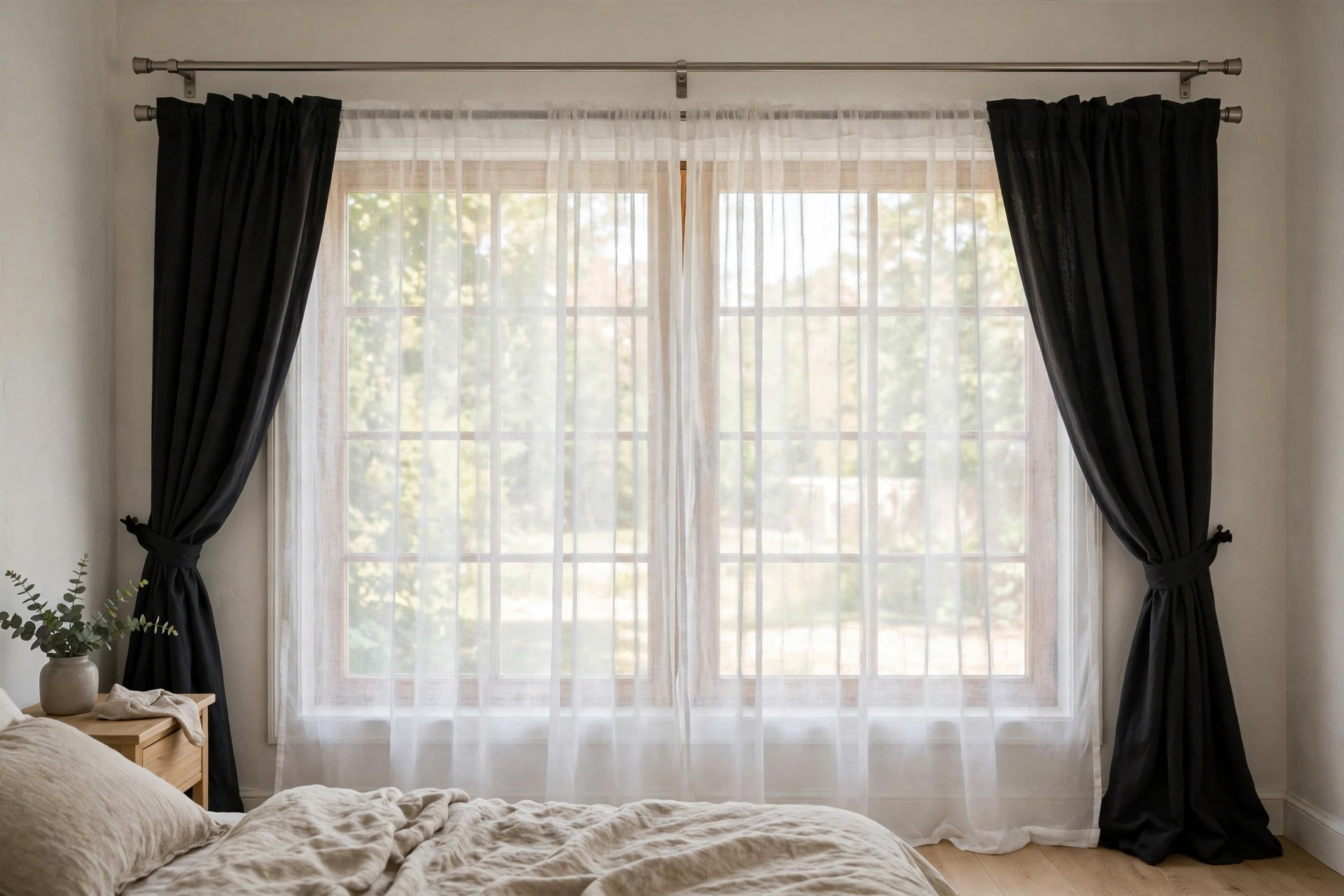
Sheer vs Blackout Curtains
Sheer curtains keep a room bright by day. Blackout curtains shut light out at night. This comparison helps you pick one, or layer both, room by room.
Sheer curtains suit a room that should stay bright by day, blackout curtains suit a room that must go dark at night, and many windows work best with both layered together. That one line settles most of the argument. The hard part is the window in front of you: a bedroom that faces a streetlight, a living room that glares in the afternoon, a ground-floor room where neighbors walk past. This comparison looks at sheer vs blackout curtains the way you will live with them, from morning light to lamps on at night.
The two types do opposite jobs. A sheer softens light and keeps a view. A blackout stops light and keeps a room private after dark. Neither one is better in every room. The right answer changes from room to room. Start with what each window must do at its hardest hour, then match the curtain to that hour.
Sheer curtains soften light and keep a room bright
Sheer curtains filter daylight into a soft glow while the room stays bright, and that is their whole job. They use light, open fabrics such as voile, chiffon, organza, and fine linen. The loose weave lets light through and takes the hard edge off direct sun. A room with sheers closed still feels like daytime. You can see shapes and greenery outside, the window looks dressed rather than bare, and glare on a table or screen eases without the room going dark.
Daytime privacy is the other thing sheers do well.
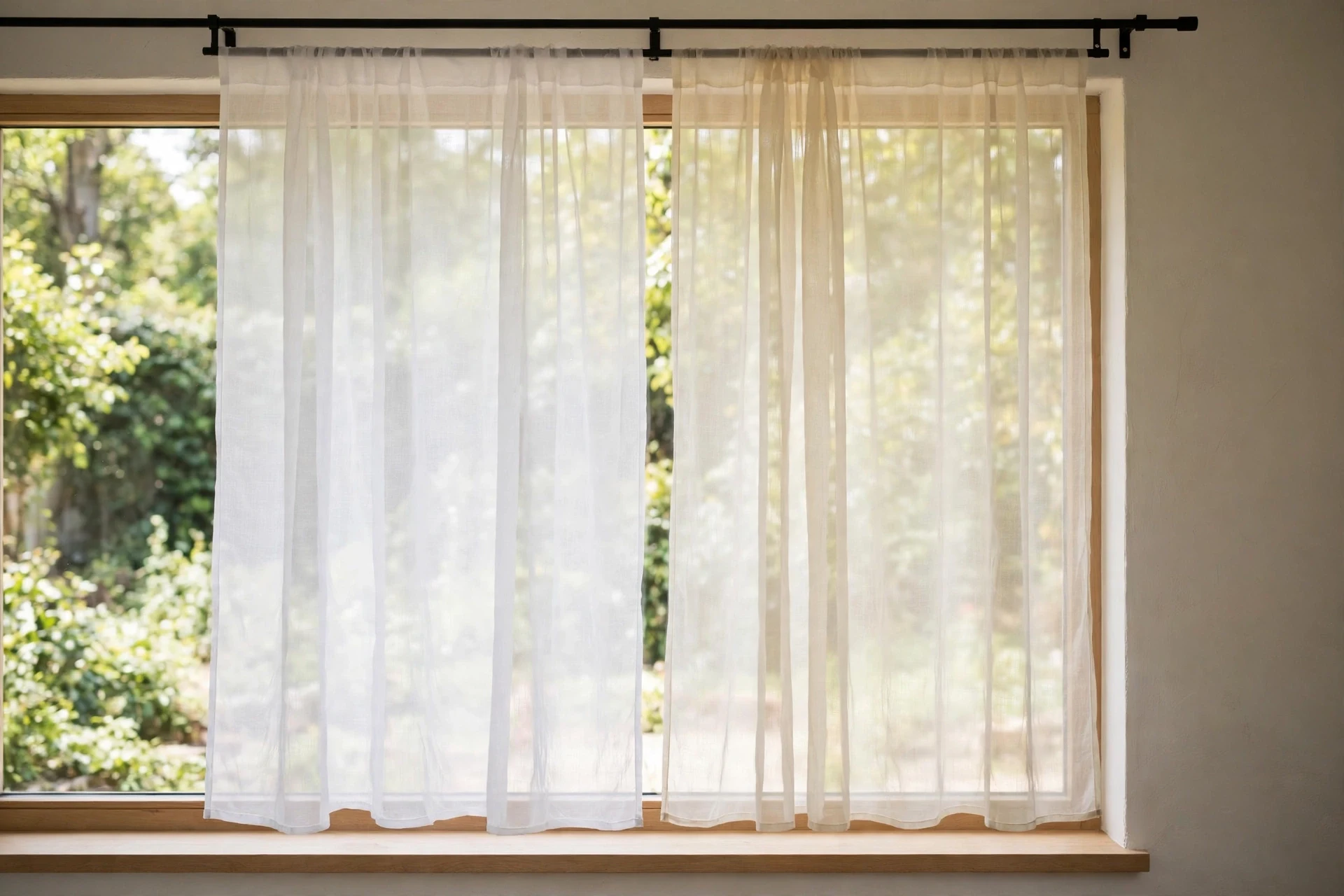
It works because of light, not because the fabric is thick. During the day, outside light is brighter than indoor light, so a person outside sees the bright fabric rather than a clear view in. That holds for a living room, a dining room, or an upper-floor window where the main worry is a soft screen from the street. It does not hold after dark. Once indoor lamps are on, the balance flips, and silhouettes and movement show through sheer fabric. Anyone buying sheers for a bedroom facing a sidewalk, or for a bathroom, needs to know that limit first.
Sheers also let air move. A light panel stirs and lets a breeze through in a way a heavy lined panel does not. The trade-off is heat and cold: sheers do not form a thick barrier at the glass, so a sunny room still warms up behind them. If heat or cold is the main problem, a heavier lined curtain is the tool for that job, as covered in Best Thermal Insulated Curtains. Care is simple in most cases, but check the label on the exact panel you buy. For sheer fabrics, headers, and washing advice in depth, see Best Sheer Curtains.
Blackout curtains shut light out and hold privacy all night
Blackout curtains block nearly all light through the fabric and give full privacy day and night. That is why they belong where sleep, darkness, or night privacy comes first. They use a dense, tight weave, or a lighter face fabric backed with an opaque lining that stops light passing through. Velvet, suede, and foam-backed or triple-layer fabrics are common blackout choices, compared by fabric in Curtain Fabric Types, since their weight and backing block light well.
The lining or weave does the work, not the color.
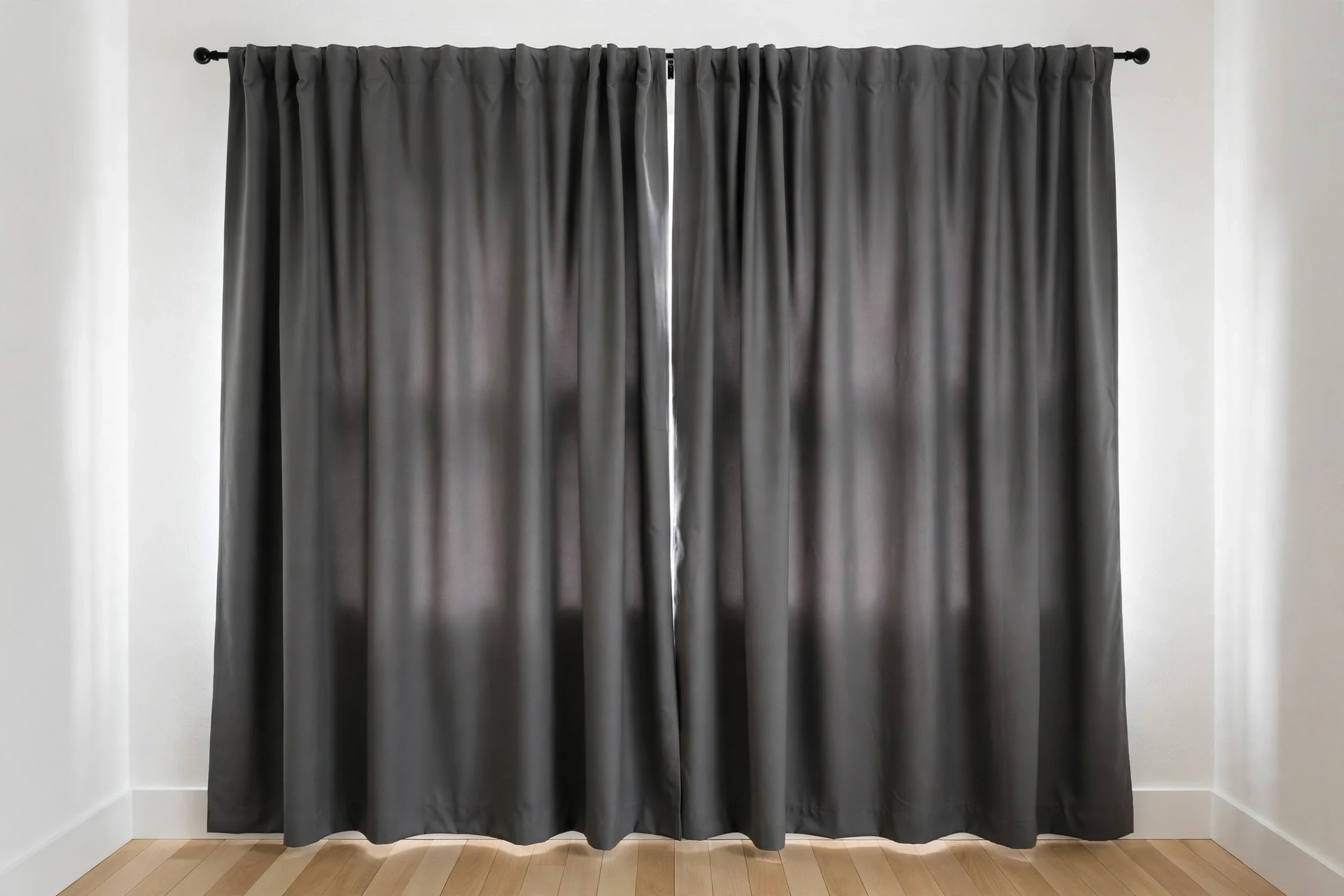
A pale blackout panel with a proper opaque lining darkens a room far better than a dark panel with no lining at all. Judge a blackout panel by its lining and weave, and check the listing for how the lining is described, rather than by how dark the fabric looks in a photo.
That darkness helps beyond the bedroom. A media corner or a room with a television becomes usable in bright afternoon sun once glare is gone. A child who naps during the day, or an adult who works nights and sleeps in daylight, gets a room that stays dark while the sun is up. Privacy holds after dark too: with lamps on inside, no shapes show through a closed blackout panel.
Blackout has two costs that have nothing to do with money. The first is weight and look: a closed blackout panel turns a bright room dark, and a heavy panel can make a small room feel closed in if it stays shut all day. The second is the rod: heavy lined panels need a rod and brackets strong enough to carry them, and a light rod that suited sheers may sag under blackout panels. Plan hardware with the heavier layer in mind, and read How to Hang Curtains before fixing brackets for a heavy set.
One more point decides whether blackout truly delivers darkness: the edges. Light slips in at the sides, above the rod, below the hem, and through the gap where two panels meet in the middle, even when the fabric blocks light well. A rod that runs past the frame on each side, panels wide enough to overlap in the middle, and a hem close to the floor all cut those leaks. Best Blackout Curtains covers light leaks and fabric choice in full. The measuring steps that keep panels wide enough sit in How to Measure for Curtains.
Blackout also protects what sits near the window. By blocking direct sun, a closed blackout panel slows fading on furniture, rugs, and wood floors, while lightweight sheers left in direct sun fade faster than heavier blackout fabric. Darker dyes on south-facing or west-facing windows fade more, so a room with strong sun and dark panels is where fading shows first. If the furniture matters as much as the sleep, that protection is a real reason to favor blackout or layering over sheers alone.
Heavy lined draperies also trap air at the window, and two layers hung together create a tighter air space than one layer alone. That trapped air softens heat loss in winter and heat gain in summer, which can ease energy bills, but the effect varies by climate, by season, and by how often the panels are opened and closed, so treat it as a help rather than a promise. For the seasonal habit behind that choice, see energy guidance on window coverings from the U.S. Department of Energy.
Sheer and blackout side by side through the day
A sheer wins the daytime and a blackout wins the night. The table below shows why that split matters more than any single feature. Read it by hour, not by curtain type: find the hour when your room fails you now, and see which column fixes that hour.
| Time of day | With sheers closed | With blackouts closed |
|---|---|---|
| Bright morning | Room stays bright, sun softened, view kept | Room goes dark, morning sun shut out |
| Harsh midday sun | Glare eased, room still bright, heat still builds | Glare gone, room cooler and darker |
| Afternoon screen time | Screen glare reduced a little, room stays light | Screen glare removed, room dark for viewing |
| Evening, lamps on | Privacy lost, shapes visible from outside | Privacy full, nothing visible from outside |
| Night sleep | Streetlight and early sun come through | Room stays dark for sleep |
Light-filtering fabrics sit between sheer and blackout: they soften light more than a sheer and give more daytime privacy, but they stop short of full darkness. Dimout fabrics go a step further, cutting most light and glare while still falling short of true blackout. A dimout panel suits an office or a television room that needs glare control without darkness, and a light-filtering panel suits a room where a sheer feels too thin but a blackout feels too heavy. Either one is worth checking before settling for an end of the scale that does not fit the room.
Five quick questions sharpen the choice faster than any feature list. Must this room go dark for sleep, and at what hour? Can people see in after dark, and does that worry you? Does sun glare spoil a screen, a desk, or a seat at a certain time of day? Is there a view worth keeping, or does the window face a wall, a parking lot, or a busy road? How small is the room, and will a heavy closed panel make it feel shut in? A room that answers yes to the first two questions needs blackout in some form. A room that answers yes to the view question and no to the sleep question is a natural sheer room.
Window direction sharpens the choice further. An east-facing window gets strong morning sun, so a bedroom there needs blackout that holds from dawn, while a west-facing window gets hot afternoon sun, so an eat-in kitchen there may need a blackout layer drawn for an hour at dinner time even though the room suits sheers by day. A south-facing window gets the strongest sun through the middle of the day and benefits most from blackout or layering, while a north-facing window gets soft, even light all day and usually suits sheers alone. Check the direction before you choose, since two rooms with the same curtains can behave very differently on opposite sides of the house.
Which one fits each room in your home
Bedrooms need blackout first, because sleep and night privacy set the bar. A bedroom with sheers alone lets in early sun and streetlight, and shows silhouettes once lamps are on. That is a poor trade for a room where rest matters most. Layer a sheer behind a blackout panel (closest to the glass) if you want the room to feel pleasant by day, but let the blackout layer carry the night. Sleeping guests follow the same rule: a guest room needs blackout for sleep, even for a short stay. For the full bedroom picture, see Best Curtains for Bedroom and the bedroom hub at Bedroom Guides.
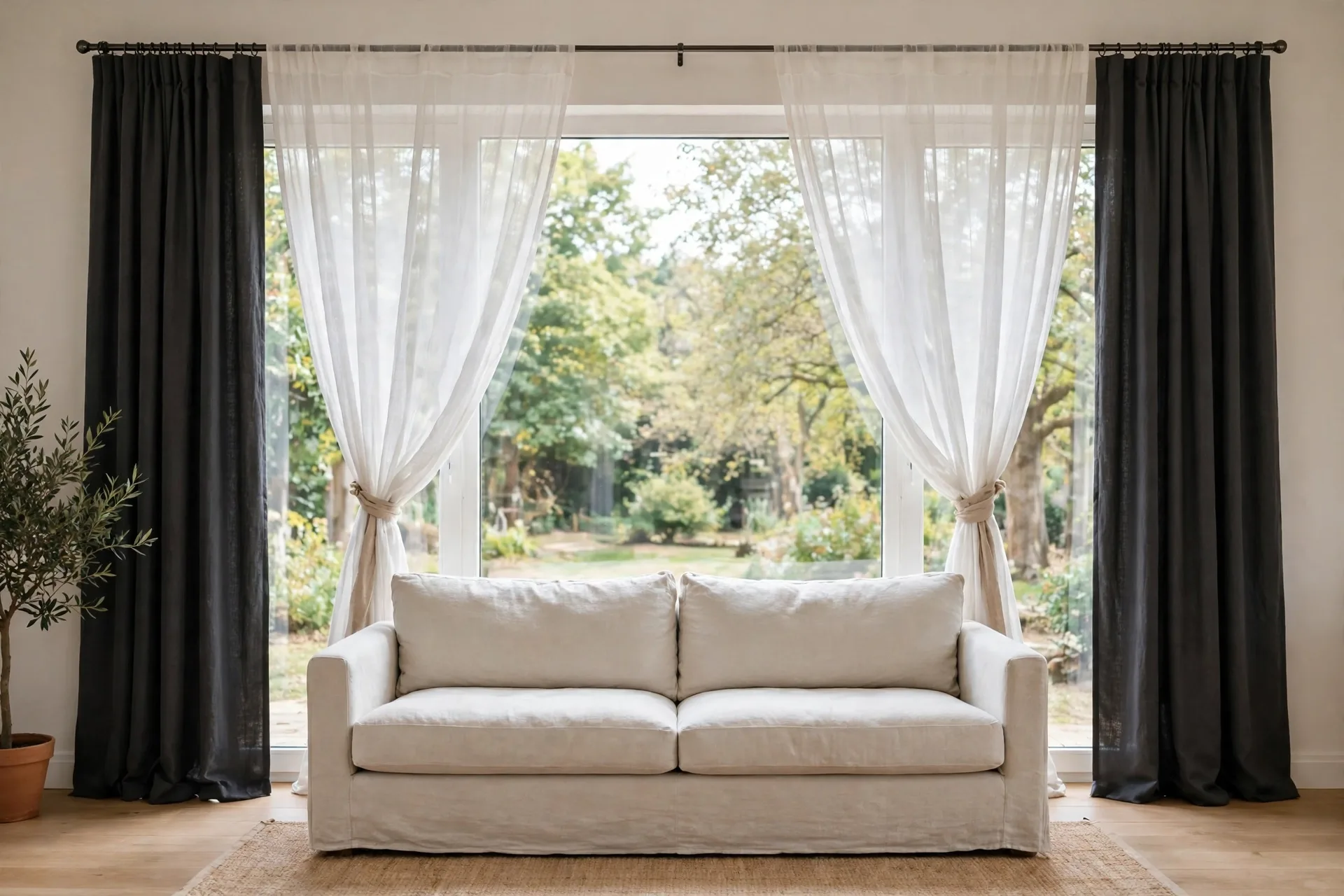
Living rooms split by how the room is used. A living room that is mainly a bright daytime space, with a view worth keeping and no sleep problem, suits sheers. Add a blackout layer only if afternoon glare spoils television or the room overheats in strong sun. A living room that doubles as a cinema corner or a nap spot for children leans toward layering from the start. Best Curtains for Living Room walks through living room direction, glare, and large windows in more detail.
Media rooms and television rooms need blackout or layering, because glare spoils a screen even in daylight and evening viewing needs real darkness. A blackout layer drawn for viewing, with a sheer behind it for daytime brightness, gives the room both moods without changing the curtains.
Kitchens and dining rooms usually suit sheers. Both rooms need daylight for tasks and meals. Both gather cooking smells and dust that make easy washing a real advantage. Neither room usually needs full darkness.
Bathrooms need night privacy first, since a sheer that screens by day fails once lamps are on. A lined or layered set suits a bathroom best: a blackout layer or a lining that closes at night, in a washable and moisture-tolerant fabric, so the panel survives steam and splashes. Never leave damp fabric shut against a steamy window for days, since trapped moisture invites mold and mildew.
Home offices need both light and glare control, and the answer often changes through the working day. Sheers give soft light that flatters video calls and keeps the room pleasant. A blackout layer drawn in front of them cuts glare on a screen during harsh sun. If the desk faces the window, test glare at the hour you actually work, not at noon on a cloudy day.
Children's rooms and nurseries follow the bedroom rule, with one extra point: daytime naps. A room where a child naps needs darkness in daylight hours, not only at night. So blackout carries more weight here than in an adult bedroom used only after dark.
Cords need their own check in a child's room. Curtains hung on a corded track or held with looped tiebacks can leave a loop within reach, so choose cordless, wand, or motorized controls where you can, fit cleats or tension devices that hold any remaining cords taut and out of reach, and keep cots, beds, and climbable furniture away from windows. Safety guidance on window covering cords from the U.S. Consumer Product Safety Commission recommends cordless coverings as the safest choice where young children are present.
Ground floor rooms facing a sidewalk, a shared path, or close neighbors need blackout or layering whatever the room is called, because night privacy fails first at street level.
Sunrooms suit sheers for bright daytime use, since the room is built for light, but add a blackout layer or a lining if the sunroom is overlooked after dark, since night privacy fails there just as it does at street level.
A simple two-layer plan for one window
Layering means putting sheer and blackout on the same window so each layer works at its own hour. The plan below keeps it to one window, one rod set, and one daily habit. Hang the sheer on the inner rod, closest to the glass. Hang the blackout on the outer rod, closest to the room. By day, keep the sheer closed and the blackout open: light filters in, daytime privacy holds, and the room stays bright. At night, or for a movie, or a nap, draw the blackout closed over the sheer: the room goes dark and private, and the sheer simply sits behind it. That daily rhythm is the whole plan.
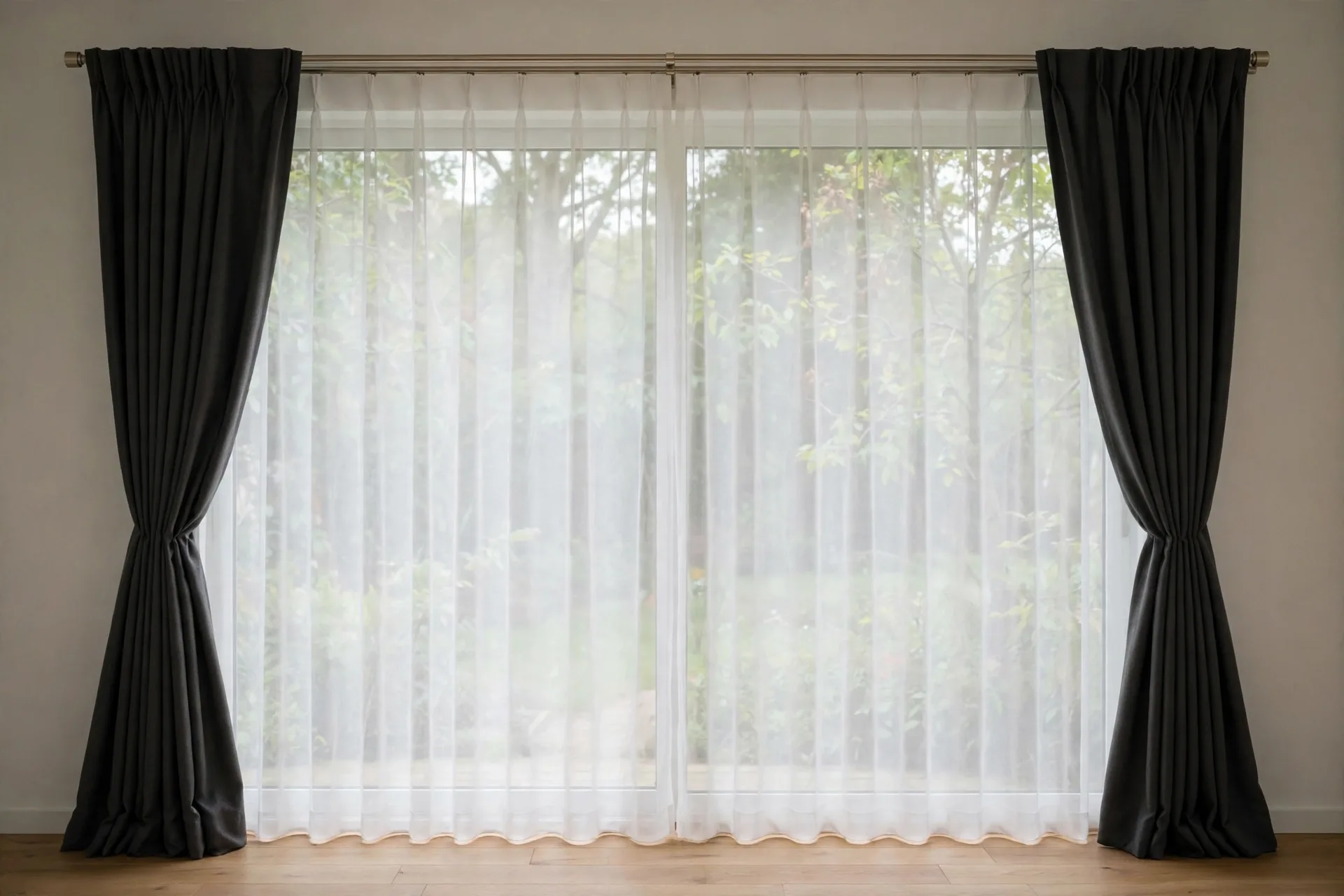
What to buy for each layer stays simple if you buy in pairs. For the inner layer, buy a sheer panel set wide enough to cover the rod with soft folds when closed, in a light color that keeps the room bright. For the outer layer, buy a blackout panel set with an opaque lining, wide enough to overlap in the middle and run past the frame at the sides. That stops light slipping around the edges at night. For hardware, buy a double rod, or a double track, with brackets strong enough for the heavier outer layer. Fix the brackets so the outer rod sits clear of the sheer layer when both are drawn. Measure the rod, not only the glass, as set out in How to Measure for Curtains. For layered pairs beyond this one-window plan, see How to Layer Curtains.
A separate blackout liner lets you keep curtains you already like and add darkness behind them. Hang the liner behind your existing curtains on the same rod or a second rod, and draw it at night while the outer curtains keep their daytime look. It beats replacing the set when the fabric, color, and fit already suit the room and only darkness is missing, though a full blackout set still seals edges better than a liner added after the fact.
What each choice costs you over time
Sheer curtains usually cost less per window than blackout curtains. The fabric is lighter and there is no opaque lining to pay for. Blackout curtains usually cost more, because the fabric is denser and the lining adds material and making. A layered window costs the most at the start, because it needs two panel sets plus a double rod or double track. That higher first outlay is the honest price of getting both daylight and darkness from one window. Judge it against buying the wrong single treatment and then buying again.
The first outlay is only part of the cost. Washing and care add up over the life of a curtain. Sheers wash often and usually wash easily, which keeps their running care simple. Lined blackout panels need gentler care. The care label on the exact panel decides whether it can be machine washed or needs a gentler route. So a blackout panel that cannot be washed at home may cost more in care over time than a sheer in the same room. Check that label before ordering, not after the first stain.
Washing sheers and lined blackout panels calls for different care. Wash sheers on a gentle, cold cycle with a mild detergent, and let them dry naturally rather than forcing them dry with heat. For a lined blackout panel, keep dryer heat away from coated linings, since heat can damage the coating, and use a steamer to ease wrinkles rather than pressing a coated panel. Whatever the type, the care label on the exact panel is the final authority, and it wins over any general guidance here.
The costliest mistake is buying twice. A sheer bought for a bedroom that then fails at night often ends up replaced by blackout. That means paying for two sets and living with the first set unused. A light rod bought for sheers that then sags under blackout panels means paying for hardware twice. Measuring first, choosing by the hardest hour of the room, and buying hardware for the heavier layer all cost nothing at the planning stage and save a second purchase later. If money is tight, cover the sleep rooms first with blackout or layering, and leave bright daytime rooms on sheers until later. Renters can start the same way with ready-made panels on no-drill rods or tracks, which hang without holes and move to the next home.
Mistakes that leave you with the wrong half of the day
Choosing sheers for a room that must go dark is the first mistake. It usually shows up on the first bright morning or the first night with lamps on. If sleep, naps, or night privacy matter in that room, a sheer alone will not carry them, however pretty it looks by day. Choosing blackout for a room that must stay bright is the mirror mistake. A kitchen or a daytime living room that lives behind closed blackout panels feels gloomy, and the panels end up left open all day.
Judging blackout by color is the next trap. A dark face fabric with no opaque lining lets light through, while a pale panel with a proper lining shuts it out. Color alone tells you almost nothing about darkness. Read the listing for the lining and the weave. If the listing does not say how darkness is achieved, treat that silence as a warning. Hanging either type on a rod that stops at the frame is another common slip. Light leaks at the sides, panels cannot overlap the frame, and a blackout set that should darken a room leaves bright strips at the edges. A rod that runs past the frame, panels wide enough to meet in the middle, and a hem near the floor all matter as much as the fabric itself. Curtain Sizes sets out lengths and widths that help here.
Ordering panels too narrow is a quiet mistake that shows up only when the curtains are closed. Panels that just span the rod hang flat like a sheet pulled tight, with no folds and with gaps where light and eyes find a way through. Forgetting the night test is the last mistake worth naming. Before you settle on sheers for a room, turn the lamps on at night, step outside, and look back at the window. What you see from outside is what neighbors see. That one minute outside tells you more about night privacy than any fabric description. If shapes show clearly, that room needs a blackout layer or a lining, not a prettier sheer.
Pick the light you want to live with
If you must pick only one curtain for a window, pick by the hardest hour that window must handle. A room that must go dark for sleep, naps, or night privacy needs blackout, even if it means giving up some daytime softness. A room that must stay bright for work, meals, or a view, with no sleep problem and no close neighbors after dark, is a sheer room. Blackout would only darken a space that should stay open. A room that needs both, and most bedrooms and many living rooms do, is a layering room: sheer by day, blackout by night, one window doing both jobs.
Best Window Curtains sets out the main curtain types side by side, and Best Linen Curtains covers the textured middle ground for rooms where neither sheer nor blackout feels quite right.
Frequently asked questions about sheer vs blackout curtains
The questions people ask most about sheer vs blackout curtains cover privacy at night, light, layering, and which rooms suit each one.
Can people see through sheer curtains at night?
Yes, in most cases people can see shapes and movement through sheer curtains at night once indoor lamps are on. During the day, brighter outside light makes the sheer read as a bright veil from outside, but after dark the balance reverses and the lit room shows through. For night privacy, a blackout layer or a lining that closes at night is needed.
Do blackout curtains block all light completely?
Blackout fabric blocks nearly all light through the fabric itself, but a room can still show light around the edges: at the sides, above the rod, below a short hem, and through the middle gap where panels meet. Wide panels, a rod that runs past the frame, an overlap in the middle, and a hem near the floor cut those leaks.
Can sheer and blackout curtains go on the same window?
Yes, sheer and blackout curtains work well on the same window on a double rod or a double track. Hang the sheer on the inner rod close to the glass and the blackout on the outer rod close to the room. Keep the sheer closed by day for filtered light and daytime privacy, and draw the blackout at night for darkness and full privacy.
Which is better for a bedroom, sheer or blackout?
Blackout is better for a bedroom, because sleep and night privacy set the bar there. Sheers alone let in early sun and streetlight and show silhouettes once lamps are on. A sheer layered behind blackout keeps the room pleasant by day while the blackout layer carries the night.
Which is better for a living room, sheer or blackout?
It depends on how the living room is used. A bright daytime living room with a view worth keeping suits sheers, while a living room used for movies, naps, or afternoon television benefits from a blackout layer as well. If afternoon glare spoils the television or heats the room, layering gives the room both moods without changing the curtains.
Do blackout curtains help with noise?
Blackout curtains can soften outside noise a little, because dense fabric and lining form a heavier layer at the window than a sheer. They do not soundproof a room, and they will not silence a busy road or loud neighbors. Buy blackout for darkness and privacy, and treat any quieter feel as a side benefit.
Are sheer curtains enough for a ground-floor window?
Sheer curtains are usually not enough on their own for a ground-floor window that faces a sidewalk, a shared path, or close neighbors. Daytime privacy holds while outside light is brighter, but night privacy fails once lamps are on, and street level puts passersby close enough to see shapes clearly. A blackout layer or a lining that closes at night is the safer choice there.
Can you wash blackout curtains?
Yes, if the care label allows it. Machine-washable blackout panels wash on a gentle, cold cycle with a mild detergent, while coated or lined panels may need gentler care. Keep dryer heat away from coated linings, since heat can damage the coating, and use a steamer for wrinkles. Always check the care label on the exact panel, since the label is the final authority.
Are blackout curtains energy efficient?
Blackout curtains can help with energy use, but the effect is qualified. Heavy lined draperies trap air at the window, and two layers create a tighter air space than one, which softens heat loss in winter and heat gain in summer. How much that matters depends on climate, season, and how often the panels are opened and closed, so treat blackout as a help with energy bills rather than a fix for a leaky window.
Do sheer curtains make a room look bigger?
Yes, sheer curtains can make a room look bigger. Hung high and wide, with panels that run past the frame and close to the floor, sheers draw the eye up and out and keep daylight in the room, so the window and the ceiling both appear taller. The effect works best when the panels stay open or softly gathered rather than drawn flat across the glass.
This guide is research-based curation: we compared maker specifications, published reviews, and current prices. Read how we choose.