 Best

Cotton vs Polyester Curtains
Cotton breathes and feels natural; polyester holds its shape and asks little of you. The right choice depends on the room, the washing routine, and how much fuss you will tolerate.
Cotton wins when the room is lived in all day and the fabric will be touched, seen up close, and washed often with care, while polyester wins when the window is hard to reach, the household is busy, or the curtains must keep their shape between washes with almost no effort. Neither fabric is better in every room, so the decision is a room-by-room one: cotton for the bedroom and the main living room where feel and air matter most, polyester for the kitchen, the kids room, and any sun-blasted window where easy care matters more than a natural hand.
This comparison settles the natural against the easy-care choice before you buy. It covers what each fabric actually is, how each behaves in a warm room, how each wrinkles, fades, and shrinks, the quiet differences in static, dust, and smells, how each washes, what each costs over its life, which fabric suits each room, and the blend that sits between the two. The verdict at the end is by lifestyle, not by fabric alone, because the same household can reasonably choose cotton in one room and polyester in the next.
Cotton vs polyester at a glance
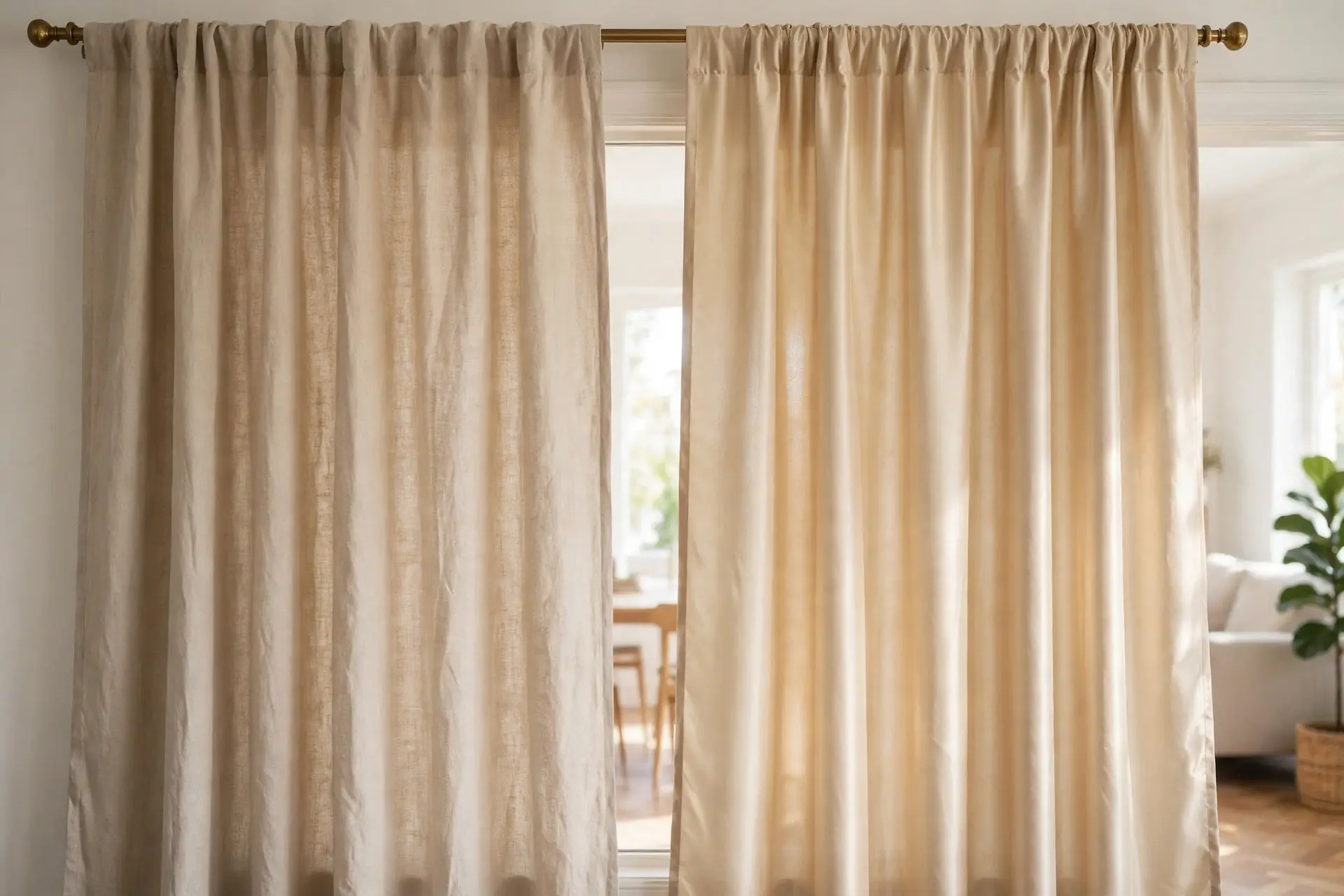
Cotton is a natural plant fiber, soft and matte, that lets air pass through the weave and feels cool to the touch, while polyester is a man-made fiber, smooth and springy, that holds its shape, resists wrinkles, and dries fast. Cotton asks for more care and gives a more natural look in return; polyester asks for almost no care and gives durability and steady color in return. The table below sets the two side by side so the trade-offs are visible before the detail.
| Quality | Cotton | Polyester |
|---|---|---|
| Feel | Soft, matte, natural hand | Smooth, sometimes slight sheen |
| Breathability | Lets air through the weave | Traps more warm air |
| Wrinkling | Wrinkles visibly, steams out well | Resists wrinkles, rarely needs ironing |
| Fading in sun | Fades sooner on sun-facing windows | Holds color longer in sun |
| Shrinkage | Can shrink on a hot wash | Holds its size in the wash |
| Static and dust | Little static, dust brushes off | Static can attract dust |
| Washing | Machine washable, cool and gentle | Machine washable, fast drying |
| Cost over time | Costs more up front, needs more care | Costs less up front, needs less care |
| Best rooms | Bedroom, living room, dining room | Kitchen, kids room, rental, sun-facing window |
Read the table as a starting point, not a verdict. A heavy lined cotton panel behaves differently from a light unlined cotton voile, and a matte heavyweight polyester behaves differently from a thin shiny one, so the weave, the weight, and the lining matter as much as the fiber name on the label. Check the label for the fiber content and the weave before ordering, because a panel sold as cotton may be a blend, and a panel sold as polyester may be a linen look with a very different hand.
Fabric weight is a label check worth making: a heavier polyester with a matte finish can look much like cotton at a normal distance, so weight and finish tell you more than the fiber name alone.
Thread count, weave quality, and fabric thickness are durability checks in the same way: a tight weave and a substantial thickness outlast a loose thin weave in either fiber.
Cotton also sits in the middle ground between polyester and linen: easier to care for than linen and more natural in hand than polyester, which is why it suits rooms where linen would be too much work and polyester would feel too synthetic.
What cotton brings to a window
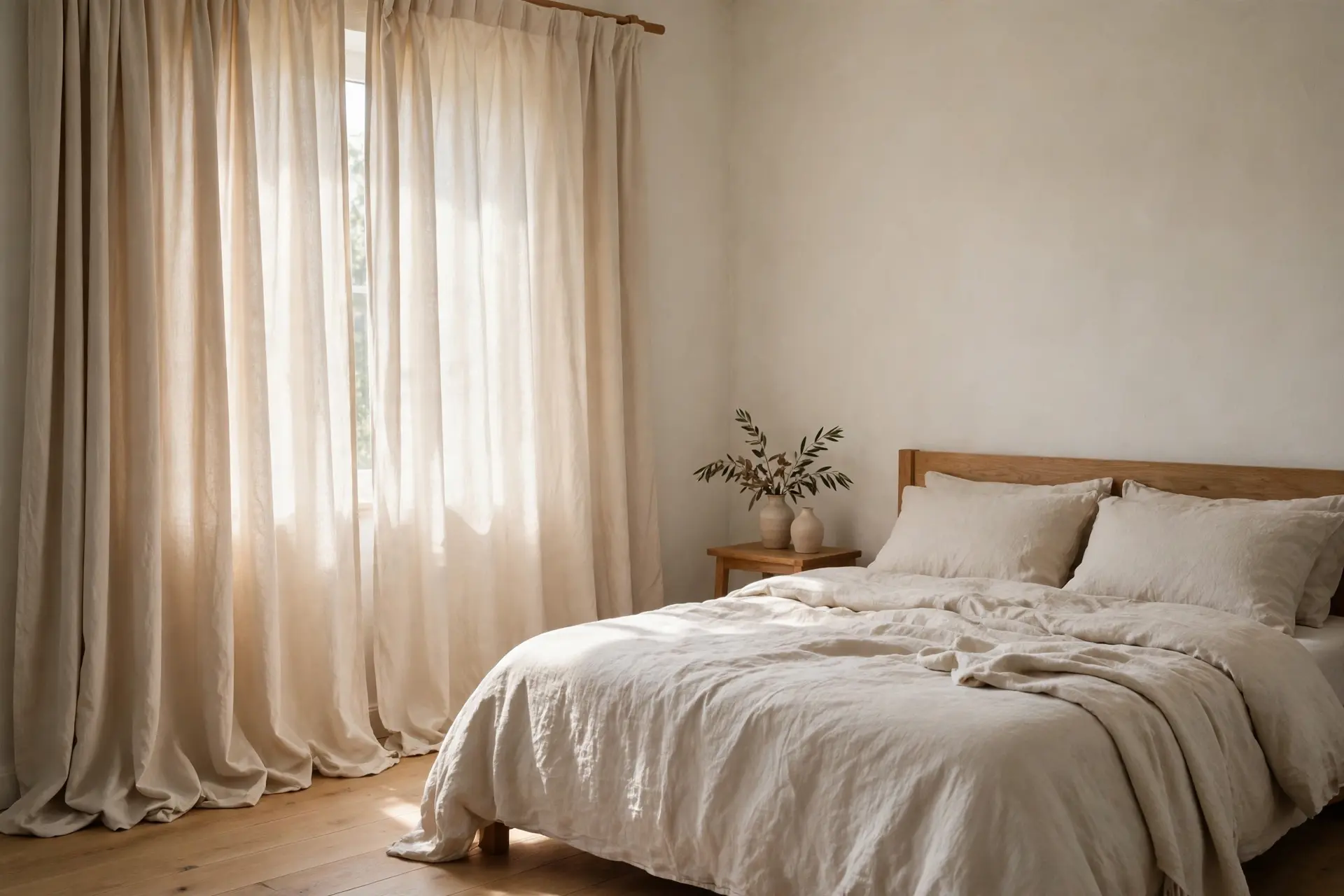
Cotton brings a natural, lived-in softness to a window that no man-made fiber quite matches, with a matte surface that takes light gently and a drape that falls in soft folds rather than stiff ones. It suits rooms where the curtains are part of the furniture of daily life: the bedroom where you wake beside them, the living room where you sit near them every evening, the dining room where meals happen under them.
Cotton is the fabric for rooms where feel matters, and its weaknesses, wrinkling, fading, and shrinkage, are the price of that feel.
What polyester brings to a window
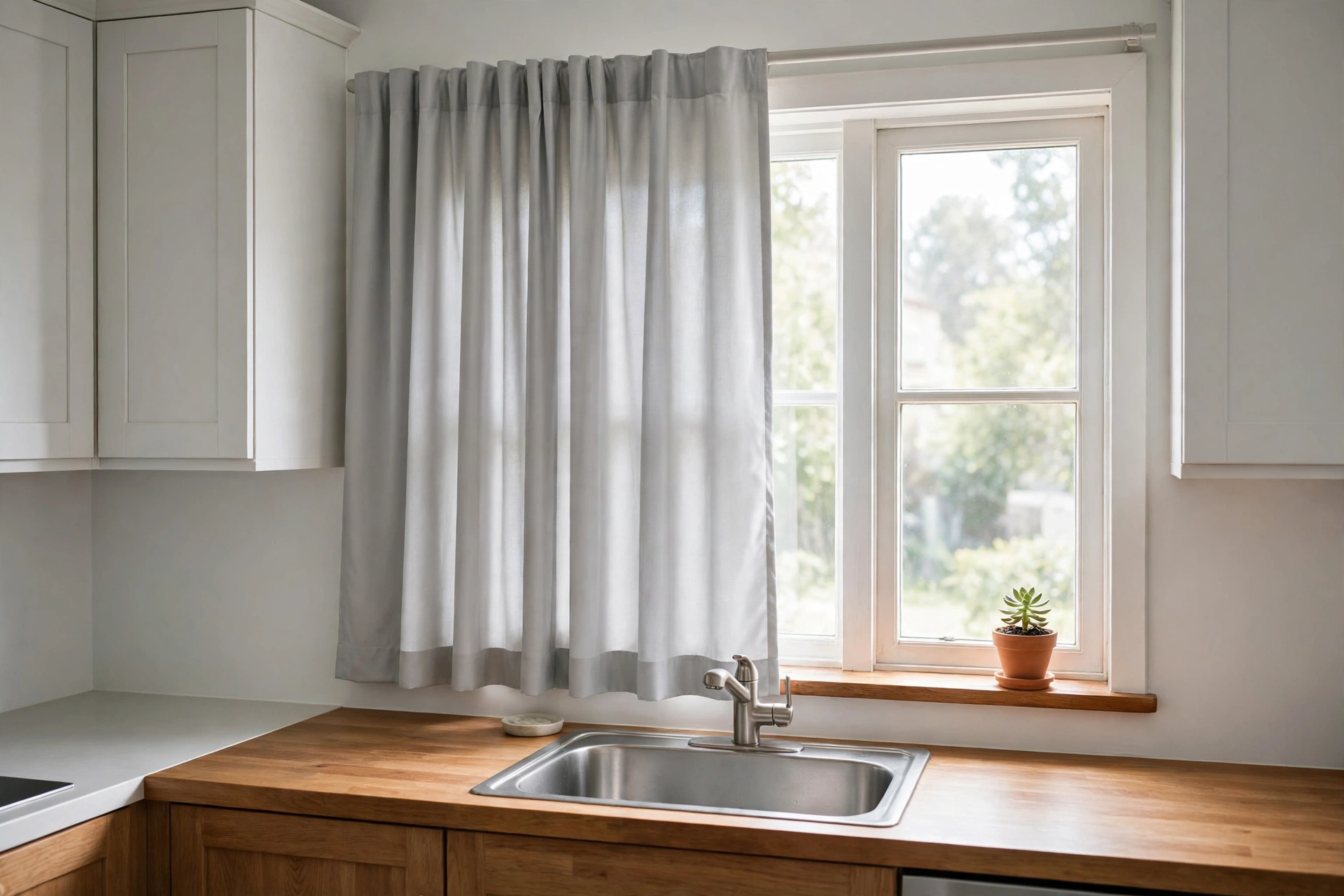
Polyester brings easy care and staying power to a window, with a smooth fiber that springs back after folding, resists creases, and keeps its color through seasons of sun. It suits rooms where the curtains work hard and get little attention: the kitchen where steam and splashes reach the fabric, the kids room where hands and toys reach it, the rental where the curtains must survive a move, the sun-facing window where the afternoon sun hits the panels for hours. Polyester dries fast after washing, so a panel can be washed in the morning and back on the rod by the afternoon.
Most blackout curtains are polyester at heart, because the fiber weaves dense and takes a foam or coated backing well. For the darkness job in full, see Best Blackout Curtains. Polyester takes vivid prints and holds them, so a patterned panel keeps its color where cotton would soften and fade. Its risk is a flat or shiny look where the weave is too smooth and the weight too light, so check a swatch before ordering: a good polyester has body and a matte or softly textured face, while a thin shiny one looks cheap beside wood and plain walls.
Print quality splits the two fibers as well: polyester holds vivid, intricate prints better, while cotton handles soft, muted prints more elegantly, so the pattern you want can decide the fiber.
Polyester also shrugs off small spills and stains, which is part of why it suits a kitchen, though the stain point is only half the kitchen story, as the smells section below explains.
Velvet shows the same split in miniature: cotton velvet is matte, premium, and breathable, while polyester velvet is shiny, wrinkle-resistant, less prone to staining, and more durable, and velvet in either fiber gives light and sound insulation.
Breathability and how each fabric feels in a warm room
Cotton breathes better than polyester, because its natural fibers let air move through the weave instead of trapping it, and that difference shows up in a warm room. A cotton panel in a room that runs warm feels cooler to stand beside and lets a breeze through the window pass more freely, which is why cotton suits bedrooms and living rooms in warm climates and in homes without air conditioning. The room feels less stuffy with cotton at the window, and the fabric itself feels cool and dry to the touch on a hot day.

For the warmth job in full, see Best Thermal Insulated Curtains. The practical rule is simple: where the room runs warm and the window opens often, cotton feels better; where the room runs cold and the window stays shut, polyester does more work. Neither fabric changes the temperature of a room on its own, but the one that matches the room's climate feels right while the other feels wrong.
Polyester traps heat, which is a benefit in cold months and a drawback in hot ones: where a room runs cold and the window stays shut, polyester does more work, and where there is no air conditioning, the same trapped heat can make the room feel stuffy. Polyester is a strong insulator for the same reason, so a polyester panel holds warmth in a cold room better than a cotton panel of the same weight.
Wrinkling, fading, and shrinkage over time
Cotton wrinkles more than polyester, and that is the first difference most owners notice. A cotton panel creases where it folds, where it is handled, and where it sits bunched at the side of the window, and the creases stay visible until the panel is steamed or ironed. Steaming works well on cotton, and a handheld steamer takes the creases out while the panel hangs, so the wrinkle problem is a maintenance habit rather than a permanent flaw. A cotton panel that is steamed after washing and hung while still slightly damp falls into soft folds and looks its best.
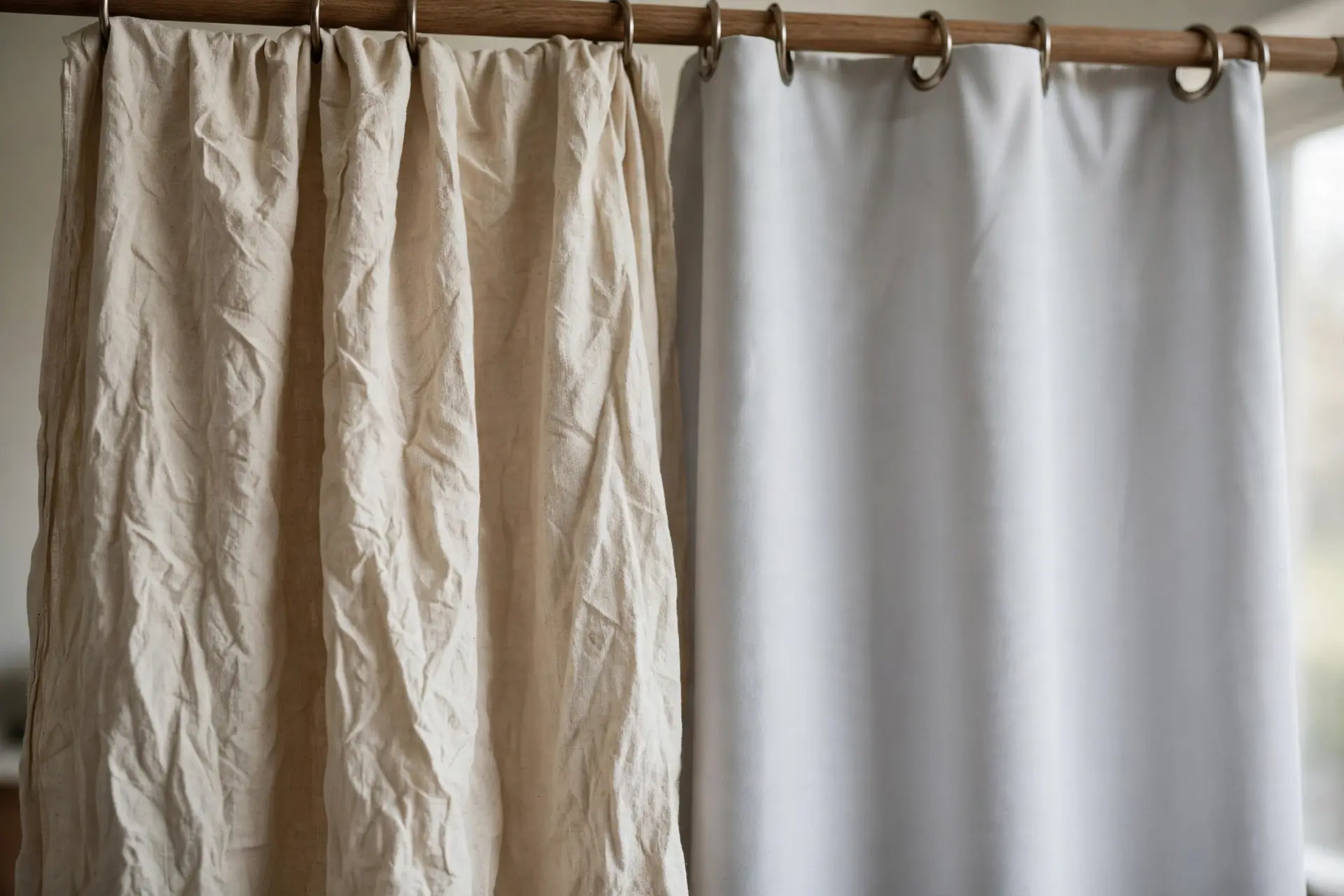
Polyester resists wrinkles by nature, because its fibers spring back after folding instead of holding a crease, so a polyester panel comes out of the wash and hangs straight with little or no ironing. That is the single biggest reason busy households choose it. Fading runs the other way in the long term: cotton fades sooner on a sun-facing window, because sunlight breaks down natural fibers and bleaches natural dyes, while polyester holds its color longer under the same sun. A cotton panel on a south-facing window will lighten at the face over a few seasons, while a polyester panel in the same spot keeps its color. Shrinkage is also cotton's risk: cotton can shrink on a hot wash, especially on the first wash, and a panel that fit floor length can end up short. Polyester holds its size in the wash, so a polyester panel that fits on day one still fits after a year of washing. Buy cotton pre-shrunk where the listing says so, wash cool, and the shrinkage risk drops sharply, but it never drops to zero the way it does with polyester.
Cotton has one comfort in return: it softens with washes, so a cotton panel feels better the longer it is lived with.
Static, dust, and smells: the quiet differences
Polyester builds static, and static attracts dust, which is the quiet difference that shows up weeks after hanging. A polyester panel in a dry room can cling slightly, crackle when drawn, and gather a fine layer of dust on its face faster than cotton does, because the static charge pulls dust out of the air onto the fabric. The dust brushes off easily, and a damp cloth or a vacuum with a soft brush head clears it, but the panel needs that wipe more often than a cotton one. In a humid room the static problem fades, because damp air lets the charge bleed away, so polyester behaves better in a bathroom or a kitchen than in a dry heated living room.

Cotton builds almost no static, so dust settles on it the way dust settles on any surface and brushes off without clinging, and the panel never crackles or clings when drawn. The habit that fixes both is the same: vacuum panels gently between washes, wash on the schedule the room demands, and air the room daily. For allergy-sensitive homes, cotton's low static is a small point in its favor, because less clinging dust means less dust disturbed when the curtains move.
One point cuts against polyester in the kitchen: it easily absorbs odors and hinders airflow, so a kitchen panel needs frequent washing even though the fabric resists stains, and cotton holds cooking smells too, so neither fiber escapes the kitchen wash routine.
Washing cotton and polyester without regret
Cotton washes well when the wash is cool and gentle, and washes badly when it is hot and rough. Wash cotton panels in cool water on a gentle cycle with a mild detergent, never overload the machine, and dry out of direct sun where you can, because heat and harsh detergent yellow pale cotton and shrink any cotton. A cotton panel that has shrunk has usually been washed too hot, and a cotton panel that has yellowed has usually been dried in strong sun or washed with a harsh detergent. Steam cotton while it hangs to take the creases out, and the panel looks pressed without an ironing board.
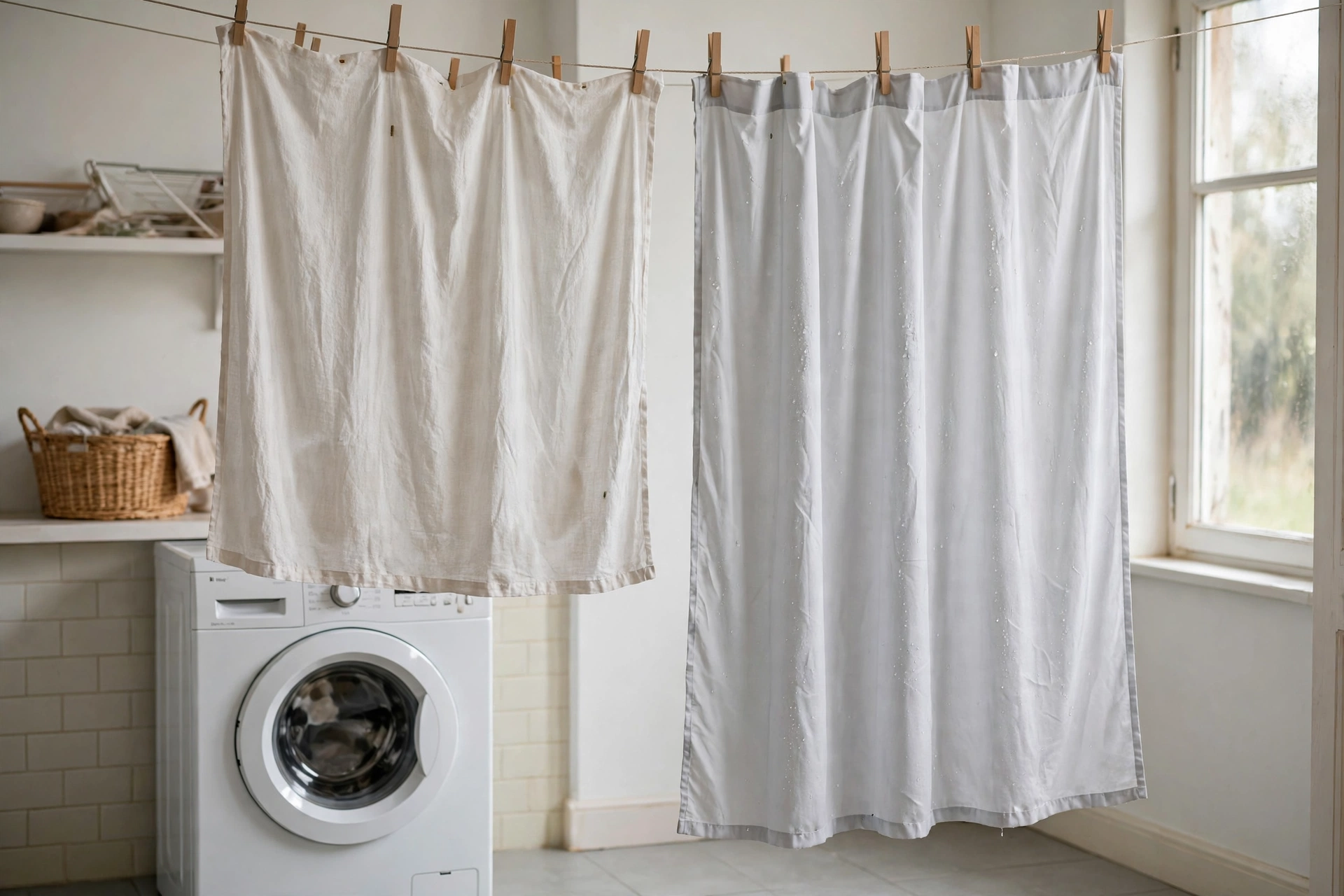
Polyester washes easily and forgives more mistakes than cotton. Wash polyester in cool to warm water on a gentle cycle, dry it fast, and it comes back to the rod with almost no creases and no shrinkage. Polyester's one washing rule is heat: never iron polyester hot and never tumble it on high heat, because high heat can melt and distort the fibers and leave a shine or a stiff patch that never comes out. A cool iron or a steamer is all polyester ever needs. Both fabrics should be washed by the care label, not by habit, because linings, backings, and blends change the rules: a blackout lining can crack in a hot wash, and a cotton-polyester blend follows the stricter of its two fibers.
Cotton has one more weakness worth knowing: it is susceptible to mildew, so a cotton panel in a damp room needs to dry fully between washes and should not be folded away damp.
Cost logic: what you pay for and what you keep paying for
Polyester costs less up front than cotton of the same size and weight, because the fiber is made in bulk and the weaving is fast, while cotton costs more up front because the fiber is grown, harvested, and woven with more steps. That up-front gap is real, but it is not the whole cost, because the two fabrics charge you differently over their lives.
Cotton charges in care: more steaming, more careful washing, earlier replacement on a sun-facing window where it fades.
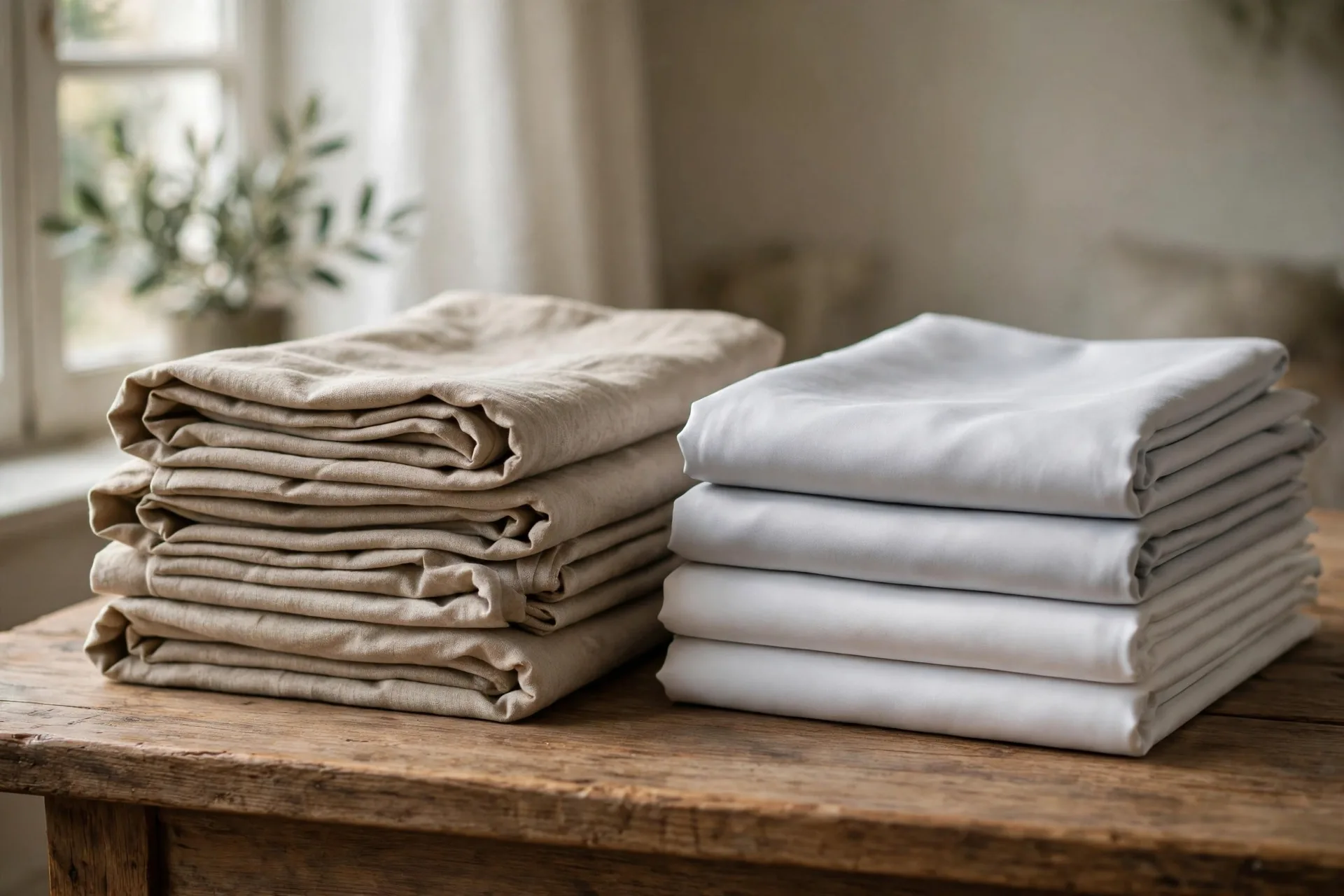
Polyester charges almost nothing in care, but it can charge in replacement where a cheap thin panel looks tired and needs swapping sooner than a good heavy one would. Compare panels of the same size, weight, and lining, and the value becomes clear: the better weave in either fiber usually outlasts the cheapest panel in the cheaper fiber.
The environmental angle is worth weighing too: polyester is petroleum-derived, non-biodegradable, and sheds microfibers every wash, while cotton is biodegradable but water- and pesticide-intensive, and organic cotton is an option where the growing method matters.
Cotton vs polyester by room
Each room asks a different job of its curtains, and the room table below gives the fabric that fits each job, with the reason beside it so the choice can be checked rather than trusted blindly.
| Room | Better fabric | Why |
|---|---|---|
| Bedroom | Cotton, or polyester for blackout | Cotton breathes for sleep; polyester carries the blackout lining |
| Living room | Cotton for daily use, polyester for kids and pets | Cotton feels best where you sit; polyester survives hands and paws |
| Dining room | Cotton | Soft matte cotton suits meals and plain walls |
| Kitchen | Polyester | Steam, splashes, and frequent washing favor polyester |
| Kids room | Cotton for feel, polyester for washing | Cotton is gentle on skin; polyester washes fast after messes |
| Bathroom | Polyester | Humidity and damp favor polyester over cotton |
| Home office | Either, by light job | Match the light job first; fabric follows the room |
| Rental | Polyester | Durable, cheap to replace, easy to move |
| Sun-facing window | Polyester | Holds color longer under strong sun |
| Formal room | Cotton, or heavy matte polyester | Cotton reads richer; heavy matte polyester can match it |
For room-wide bedroom advice, see Best Curtains for Bedroom, and for living room direction, see Best Curtains for Living Room.
The blend in the middle: cotton-polyester mixes
A cotton-polyester blend takes the middle path, mixing the natural feel of cotton with the easy care of polyester, and for many windows it is the best answer of the three. A blend with more cotton than polyester feels close to cotton, breathes better than pure polyester, and wrinkles less than pure cotton. A blend with more polyester than cotton washes like polyester, holds its color like polyester, and feels softer and more natural than pure polyester. The exact balance is on the label, so read the fiber percentages before ordering: a panel that is mostly cotton behaves mostly like cotton, and a panel that is mostly polyester behaves mostly like polyester.

Blends suit the rooms where neither pure fabric quite wins. A living room with kids and pets gets a blend that survives the mess without looking synthetic. A dining room that needs a natural look and an easy wash gets a blend that holds its shape after dinner-party washing. A rental that needs to look good and last gets a blend that does both. The blend's weakness is that it inherits a little of each parent's trouble: it can still shrink slightly on a hot wash, it can still build a little static, and it can still fade sooner than pure polyester on a sun-blasted window. Wash a blend cool and gentle, the way you would wash cotton, and it keeps the best of both fibers.
Which fabric suits your way of living
Choose cotton if your household is calm, your rooms are used gently, and you enjoy the feel of natural fabric enough to steam a panel now and then. Cotton suits the reader who notices texture, who sits near the window every evening, who washes on a slow schedule and does not mind a crease or two between washes. It suits the bedroom where sleep matters, the living room where the curtains are part of the furniture, and the dining room where meals deserve a soft matte backdrop. If you choose cotton, buy pre-shrunk where you can, wash cool, steam after washing, and keep cotton off the sun-blasted window unless you accept the fading.

Choose polyester if your household is busy, your windows are hard to reach, or your curtains must keep their shape between washes with almost no effort. Polyester suits the kitchen, the kids room, the rental, and any sun-blasted window where easy care matters more than a natural hand, and it suits a home where washing happens fast and steaming never does. If you choose polyester, pick a heavier matte weave over a thin shiny one, wash cool, and keep it clear of high heat.
Choose the blend if you want most of cotton's feel with most of polyester's care, and read the fiber percentages so you know which parent dominates. Most homes end up mixing: cotton where the room is gentle, polyester where the room is hard, and a blend where the room is both.
Frequently asked questions about cotton and polyester curtains
Most cotton and polyester questions come down to feel, care, and which room each fabric suits.
Is cotton or polyester better for curtains?
Neither fabric is better in every room. Cotton is better where feel and breathability matter most, in bedrooms and living rooms used gently every day. Polyester is better where easy care, sun resistance, and blackout matter most, in kitchens, kids rooms, rentals, and sun-facing windows. Most homes use both, cotton where the room is gentle and polyester where the room is hard.
Do cotton curtains shrink?
Cotton curtains can shrink, especially on the first wash and especially on a hot wash. Buy pre-shrunk cotton where the listing says so, wash in cool water on a gentle cycle, and dry out of direct sun, and the shrinkage risk drops sharply. Polyester holds its size in the wash, so a polyester panel that fits on day one still fits after a year of washing.
Which fades faster in sun, cotton or polyester?
Cotton fades faster in direct sun, because sunlight breaks down natural fibers and bleaches natural dyes. Polyester holds its color longer under the same sun, which is why it suits sun-facing windows. A lining behind either fabric slows fading, and rotating panels where one window gets far more sun than the other helps both fabrics last.
Does polyester look cheaper than cotton side by side?
Side by side, a thin polyester with a shiny face looks cheaper than cotton, especially beside wood and plain walls. A good polyester with a heavier weight and a matte or textured face looks close to cotton at a normal distance. Check a swatch before ordering, and choose body and texture over the lowest price.
Are cotton curtains good for a bedroom?
Cotton curtains suit a bedroom well, because cotton breathes and feels soft beside the bed, and a cotton panel helps a warm bedroom feel less stuffy. A bedroom that needs real darkness should layer cotton over a polyester blackout lining, or use a polyester blackout panel behind a cotton sheer, because cotton alone does not block light.
Can polyester curtains go in a kitchen?
Polyester curtains suit a kitchen window well, because steam, splashes, and cooking smells reach the fabric and polyester washes fast, dries fast, and resists stains. Cotton in a kitchen needs more washing and holds cooking smells, so polyester is the easier choice there. Keep any curtain clear of the stovetop and out of reach of an open flame.
What is a cotton-polyester blend, and is it worth it?
A cotton-polyester blend mixes the two fibers in one fabric, and it is worth it where neither pure fabric quite wins. A blend with more cotton feels close to cotton and wrinkles less than pure cotton; a blend with more polyester washes like polyester and feels softer than pure polyester. Read the fiber percentages on the label, because a mostly-cotton blend behaves mostly like cotton.
Which fabric is better for allergy sufferers?
Cotton has a small edge for allergy sufferers, because it builds almost no static and dust brushes off it without clinging, so less dust is disturbed when the curtains move. Either fabric works when it is vacuumed gently between washes and washed on the schedule the room demands, because the cleaning habit matters more than the fiber.
For the full curtain range, see Best Window Curtains.
This guide is research-based curation: we compared maker specifications, published reviews, and current prices. Read how we choose.