 Best
Best Curtains for Kids Room
A kids room curtain has to darken the room for sleep, survive sticky hands, and stay safe around a child who pulls on everything. This guide sorts sleep, safety, and washing by age.
The best curtains for a kids room are the ones that darken the room enough for sleep, stay safe around a child who pulls on everything, and wash clean after sticky hands, paint, and juice, because a kids room curtain is pulled, tugged, and wiped far more than any curtain in the house. Choose the light level for the child's sleep first, the safety of the hanging second, and the color and pattern last, and the window will work for years instead of one birthday.
This guide is for older kids, from around four up to the early teens, when the child sleeps in a bed, plays in the room, and outgrows themes fast. Babies and toddlers up to age three need a different setup, focused on nap darkness and cordless safety around a crib, so this guide starts at around age four. What follows covers sleep need by age, cordless and safe hanging, washable fabrics, blackout against room-darkening against a sheer layer, length and the trip risk, colors and patterns that last, and a measuring and hanging checklist.
Kids room curtain picks by sleep and play job
The picks below are sorted by the sleep and play job each one does, from darkening a bedroom for naps to surviving sticky hands in a playroom. Sizes below are the listing sizes at the time of checking; confirm the size on the listing before you order. Check the light level, the lining, the finished length, and the care label on the listing for the panel you choose.
As an Amazon Associate, we earn from qualifying purchases.
| Pick | Type | Light job | Best for |
|---|---|---|---|
| 1 | Blackout kids panels with playful pattern | Blackout | A school-age child who wakes at dawn in summer |
| 2 | Room-darkening cotton-blend kids panels | Room darkening | A child who fears a fully dark room |
| 3 | Washable polyester kids panels in a solid color | Light filtering | An older child's playroom |
| 4 | Blackout panels with a sheer day layer | Blackout plus sheer | A street-facing room that needs day privacy and night darkness |
| 5 | Short sill-length washable kids panels | Light filtering, short length | A small room with a desk or toy storage under the window |
| 6 | Thermal-lined blackout kids panels | Blackout with thermal lining | A cold or street-facing kids room |
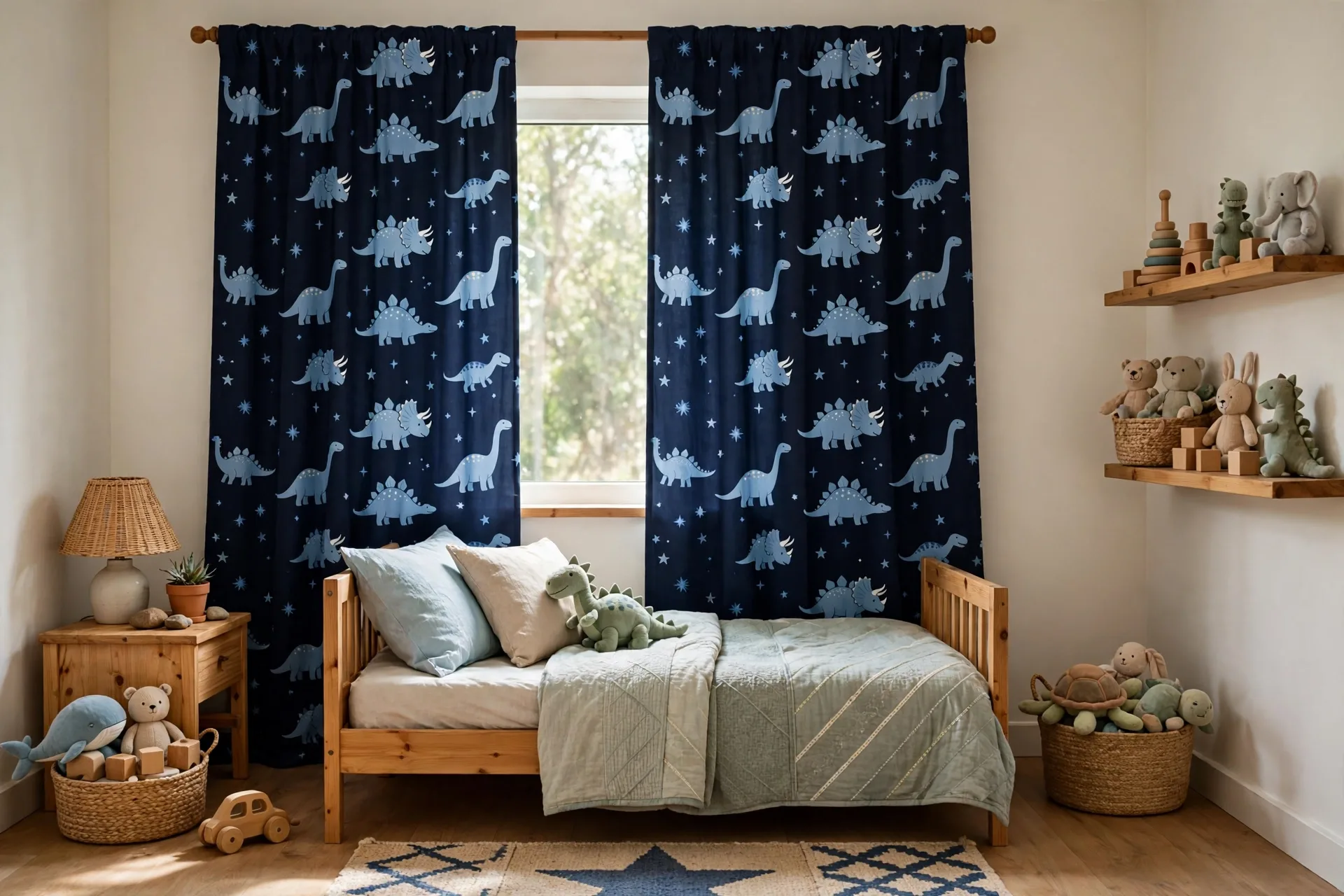
1. Blackout kids panels with playful pattern: best for a school-age child who wakes at dawn in summer
Best for: A school-age child whose room catches early morning sun in summer, where sleep matters more than daylight and the pattern keeps the room playful.
Key features: Triple-weave blackout fabric behind a dinosaur and star pattern, blocking 90% or more of light as the seller states, navy face, grommet heading, 52 by 63 inches, 2 panels, machine washable.
Pros: Strong darkness for sleep and lie-ins, pattern gives the room character without a separate decoration, good night privacy, washes easily.
Cons: A fully dark room can frighten a child who fears the dark, so test it first, the grommet heading leaves small gaps at the top where light can leak, so hang the rod high and wide, heavier than unlined panels, so the rod and brackets must suit the weight.
2. Room-darkening cotton-blend kids panels: best for a child who fears a fully dark room
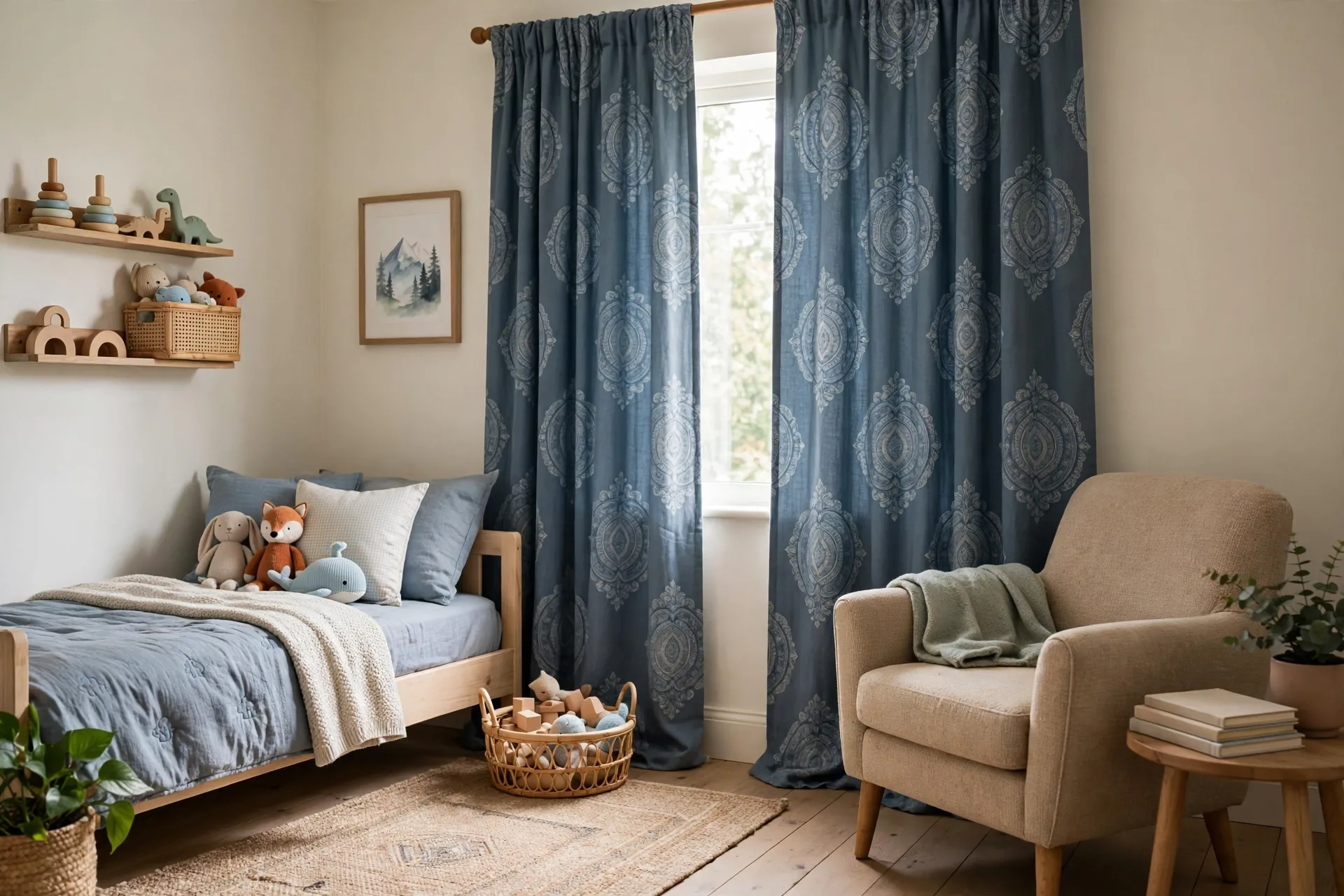
Best for: A child who needs the room dimmed for sleep but is frightened by full darkness, where a softer dimming plus a night light works better than blackout.
Key features: Cotton-blend face, 45% cotton, 40% polyester, 15% linen, in a Smokey Blue medallion print, room-darkening weave the seller states blocks 93 to 97.9% of light, grommet heading, single panel, 52 by 84 inches, machine wash cold.
Pros: Dims the room close to blackout without full darkness, so a night light still works, cotton blend feels soft, near-blackout dimming for sleep.
Cons: Sold as a single panel, so order two for a pair, near-blackout, not full blackout, so early summer sun can still show, wash cold, because a cotton blend can shrink if washed hot.
3. Washable polyester kids panels in a solid color: best for an older child's playroom
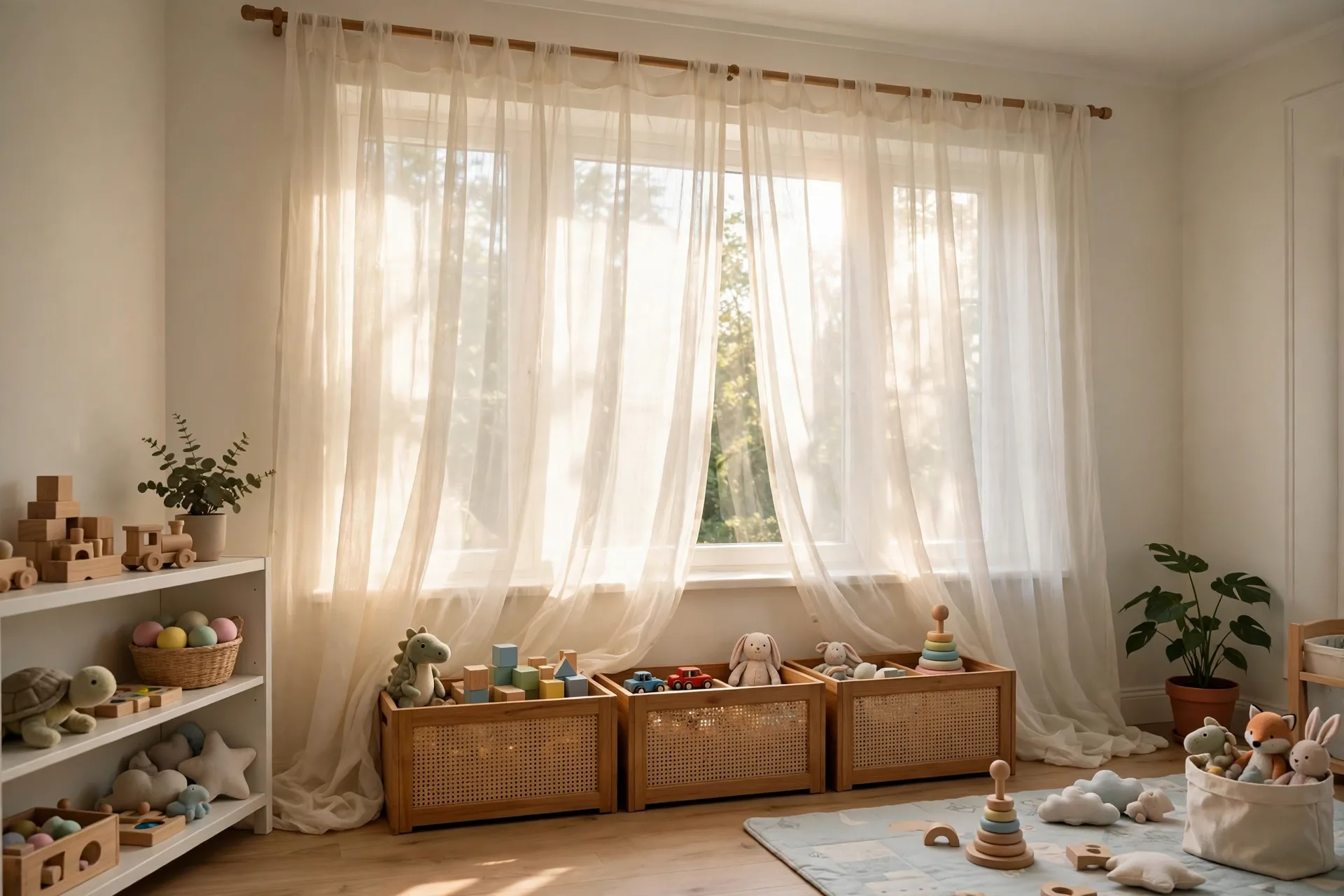
Best for: An older child's playroom or shared kids room where the curtains are touched, wiped, and stained weekly, and washing matters more than darkness.
Key features: Solid ivory sheer voile in 100% polyester, light-filtering, grommet heading, 54 by 63 inches, 2 panels, machine washable, tumble dry.
Pros: Washes often without fading fast, solid color suits changing bedding and posters, light fabric draws easily.
Cons: Little darkness alone, so pair it with a blind or a liner where sleep needs darkness, a sheer voile is delicate, not a sturdy weave, so it suits an older child better than a rough playroom, a flat shiny polyester can look cheap, so check the texture first.
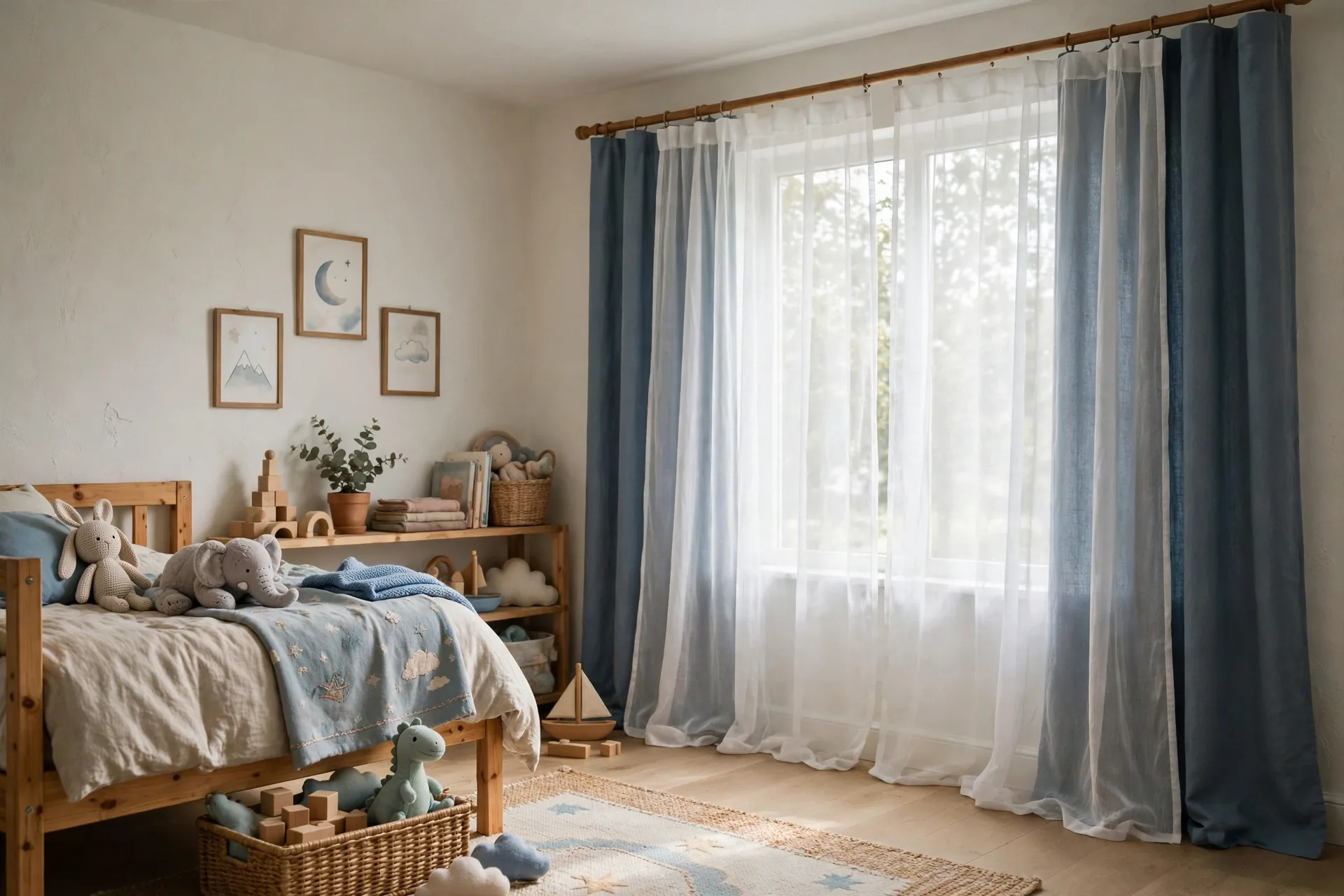
4. Blackout panels with a sheer day layer: best for a street-facing room that needs day privacy and night darkness
Best for: A street-facing kids room where the child plays by day behind a sheer and sleeps behind blackout at night, without choosing between privacy and light.
Key features: Blackout panel with a sheer overlay sewn onto the same panel, so the two layers hang together on a single rod, thermal-insulated, Stone Blue, grommet heading, 52 by 96 inches, 2 panels, tiebacks included.
Pros: Day privacy from the sheer and night darkness from the blackout on one rod, with no double rod to fit, the sheer softens the room by day.
Cons: The layers are sewn together and cannot be drawn separately, so the sheer cannot stay closed while the blackout opens, 96-inch length suits a tall window, so measure the drop first, heavier than unlined panels.
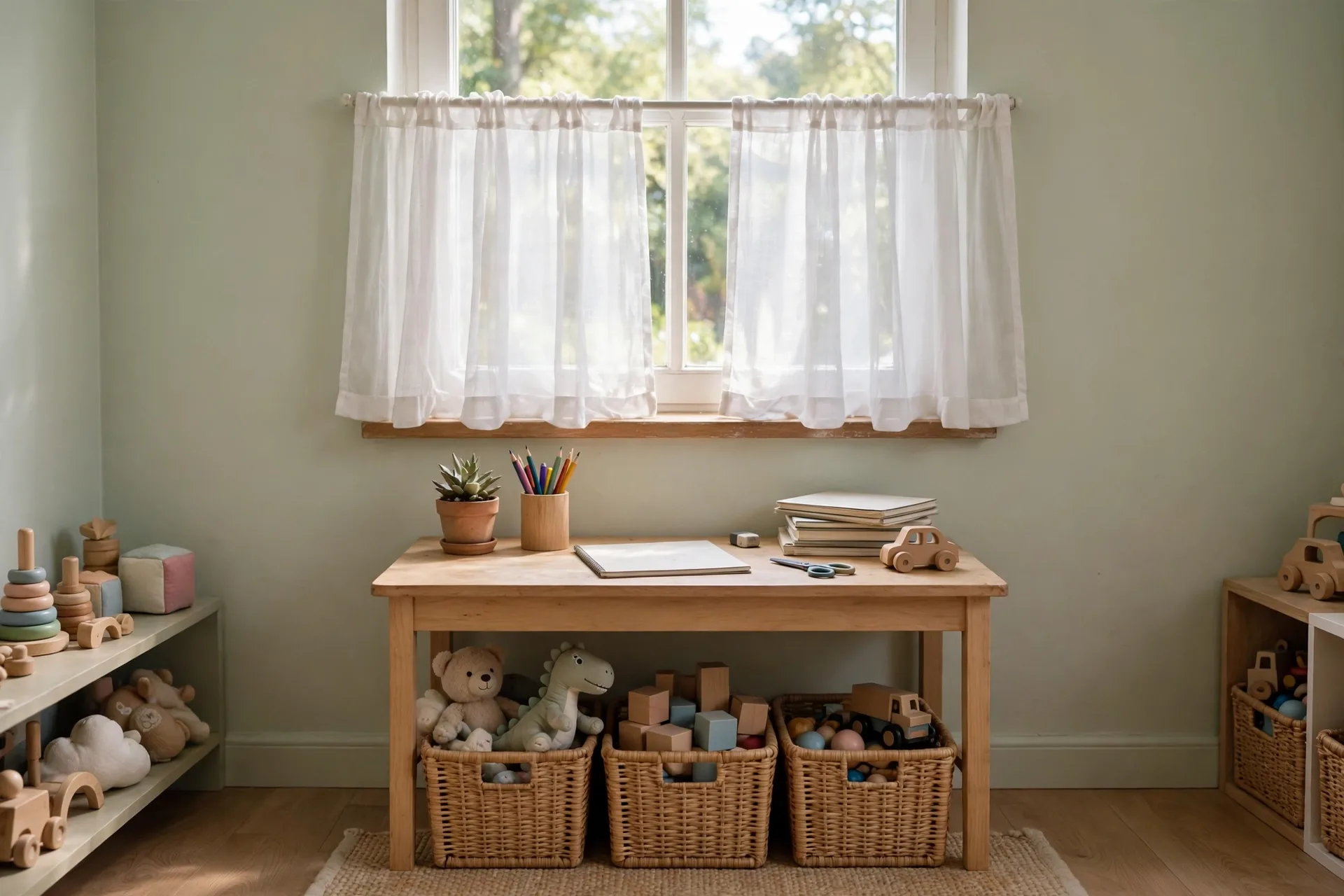
5. Short sill-length washable kids panels: best for a small room with a desk or toy storage under the window
Best for: A small kids room where a desk, a toy box, or a radiator sits under the window, and a floor-length panel would trail, snag, or block the furniture.
Key features: Short white sheer panels, 52 by 45 inches, 2 panels, rod pocket heading, 100% polyester, light-filtering, machine washable.
Pros: Nothing to trip over or pull down, leaves the sill and the desk free, easy to wash and quick to dry.
Cons: Sheer, not opaque, so little privacy at night once indoor lights are on and no darkness alone, short panels suit casual rooms better than formal ones.
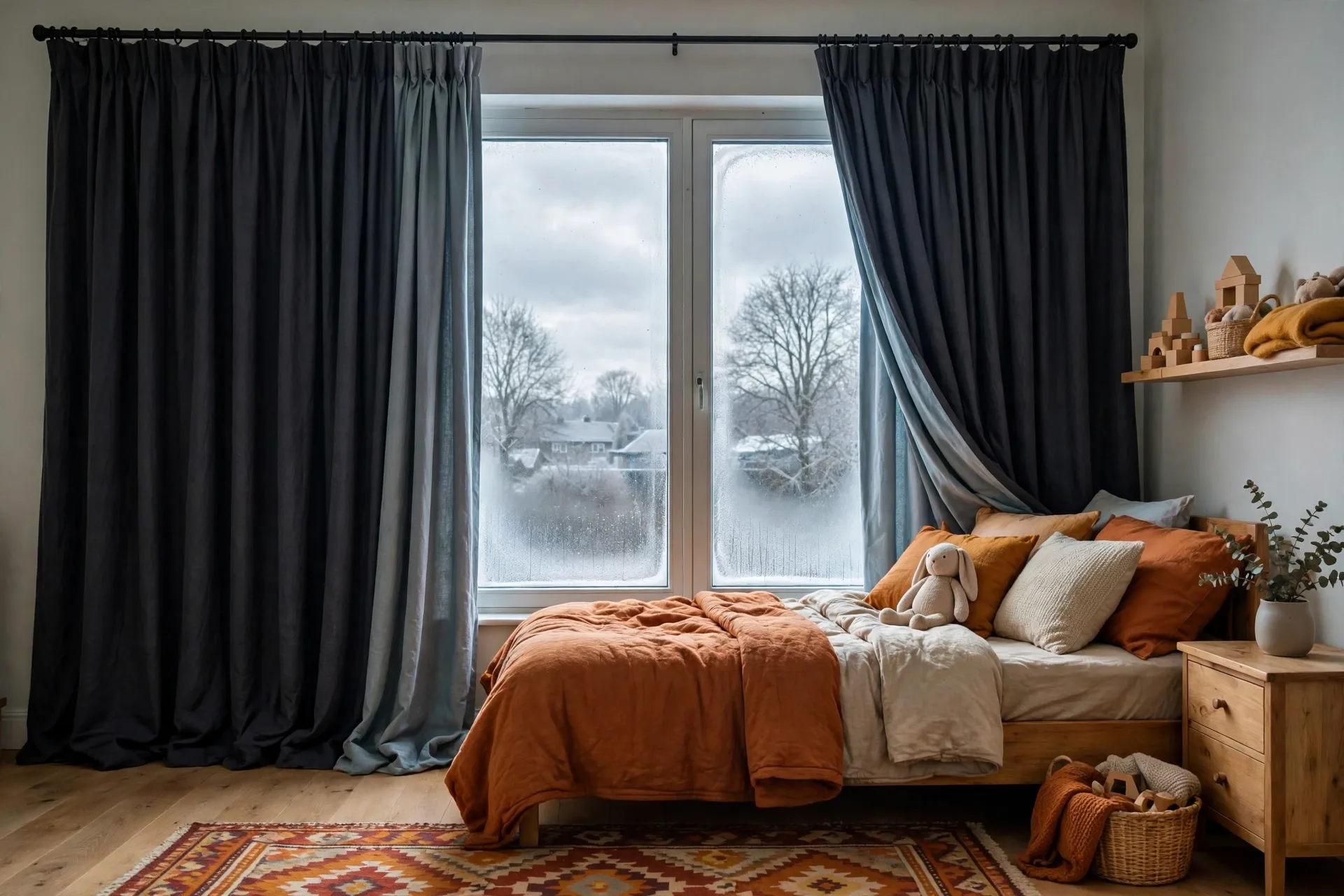
6. Thermal-lined blackout kids panels: best for a cold or street-facing kids room
Best for: A kids room with a cold window or a street-facing wall, where the curtain must darken the room and soften cold air and street sound together.
Key features: Grayish Blue panels, 52 by 84 inches, 2 panels; the blackout layer is a triple-weave lining behind the face fabric; thermal-insulated for a cold window; seller-stated 100% blackout for sleep.
Pros: Strong darkness for sleep plus warmth help at a cold window, fuller drape, good night privacy.
Cons: Heavier than unlined panels, so check the rod rating, the lining is the blackout layer, so follow the care label for the lined fabric.
Sleep need by age: from naps to school mornings
Sleep need changes with age, and the curtain job changes with it. A four or five year old still naps in the afternoon and goes to bed while it is light in summer, so darkness matters most at this age: a blackout or strong room-darkening panel, hung wide and high to close the gaps at the sides and top, gives the dark room that helps a young child settle.
A child of seven to ten still needs a dark room to fall asleep, but the fear of the dark starts to matter as much as the light.
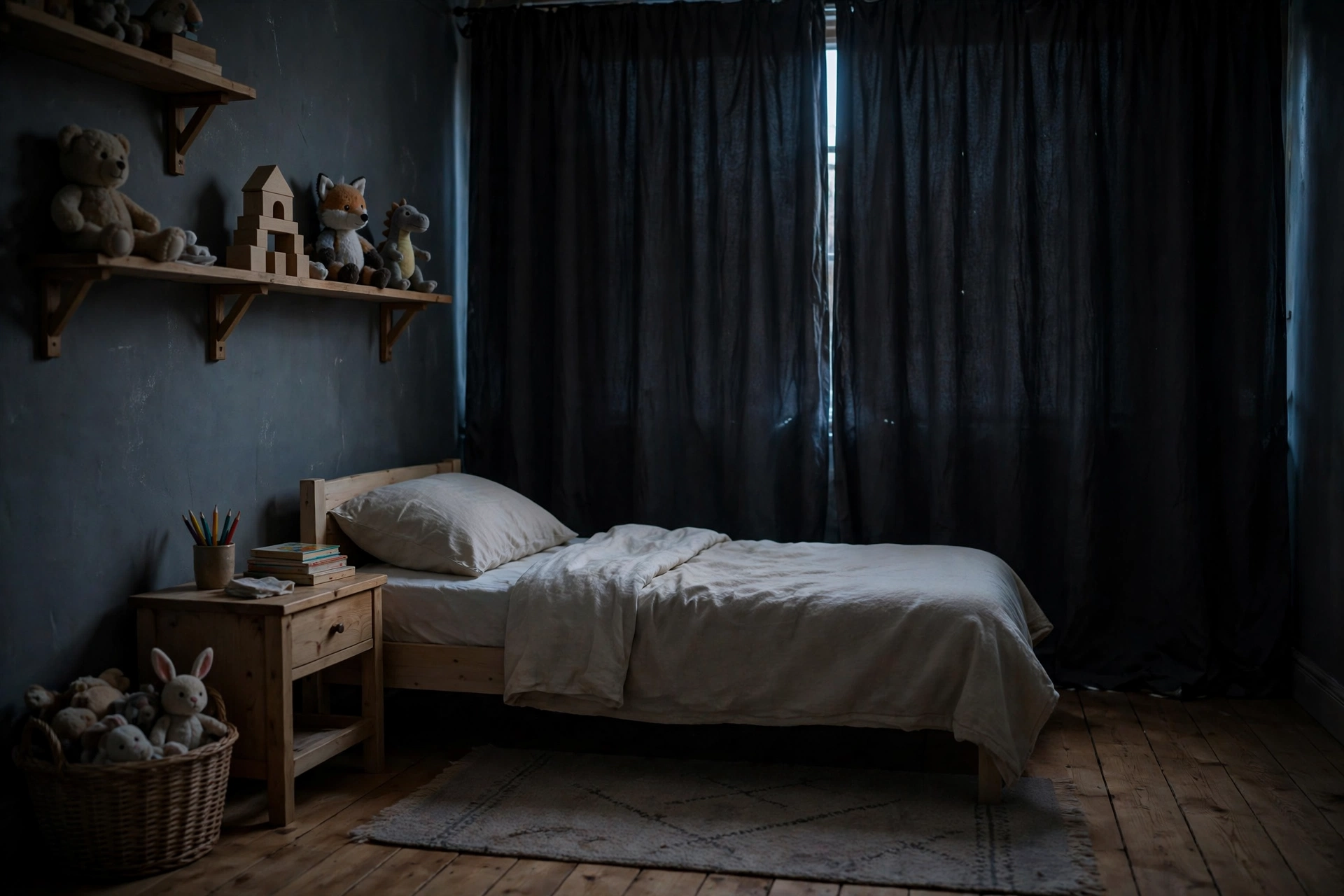
Some children in this age group sleep better with the room dimmed rather than fully black, and a room-darkening panel plus a small night light suits them better than a blackout panel that turns the room into a cave.
An older child of eleven or twelve needs darkness less for naps, which have mostly stopped, and more for a steady bedtime and a school morning that does not start at dawn. A blackout panel still helps in summer, but the child now has opinions about the room, so let them choose between two or three parent-approved options, because a curtain they chose gets closed at night and a curtain imposed on them gets left open.
Cordless safety and hanging that holds when pulled
Cordless safety is the first rule of a kids room window, because a child pulls on everything in reach and a looped cord or a beaded chain is a hazard that does not need explaining twice. Choose curtains with no cords at all, or with cords that are concealed, shortened, and fixed well out of reach with the safety device supplied, and keep any blind cord or chain in the same room secured with a cleat or cord tidy fixed high on the wall.
Hanging must hold when pulled, because a child will pull.
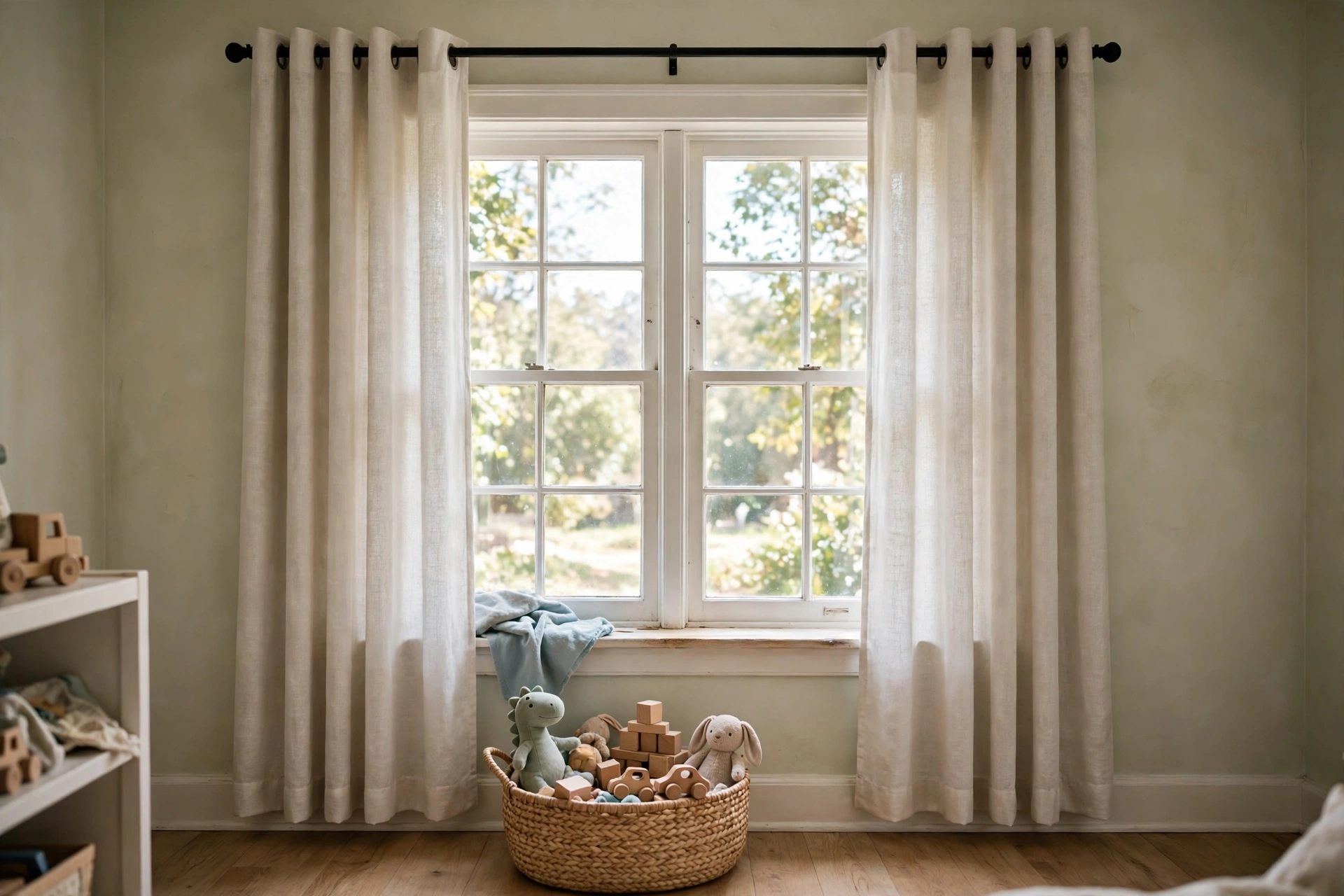
Fix the rod or track firmly into the wall with anchors that suit the wall, not just the plaster, and avoid tension rods in a kids room, because a firm yank can bring a tension rod down with the curtains. Run the rod well past the window on both sides so the panels stack clear of the glass, and mount it high enough that the top of the curtain is out of easy reach. Check the brackets every few months by giving the rod a firm tug yourself, because a bracket that loosens slowly is the one that fails on the day a child swings on the curtain.
Whimsical hardware suits a kids room if it is sturdy: rods in star, moon, and cloud shapes, animal and character finials, in durable wood or sturdy plastic, while fragile finials and easily bendable rods should be avoided. Choose stiff, tightly woven fabrics that will not gather into hazardous loops, with enclosed weights instead of dangling beads or rings, and use safety clips or ties to gather excess cord and prevent loops. Do not place cribs, beds, furniture, or toys near windows or drapes where cords pose a risk. Cordless cellular shades suit lower windows within reach of kids, because there is no cord to reach at all.
Washable fabrics that survive sticky hands
Washable fabric is not a nice extra in a kids room, it is the fabric decision, because sticky hands, paint, juice, and mud reach the curtains weekly and a panel that cannot be washed becomes a panel that stays stained. Cotton and cotton blends wash well, feel soft, and suit a kids room where the curtains are touched all day, but they shrink if washed hot, so follow the care label and wash cool. Polyester and polyester blends wash most easily of all, resist wrinkles, hold color in sun, and survive repeated washing without fading fast, which suits a busy playroom where the curtains wash monthly. For natural fabric behavior, see Best Linen Curtains, and check the care label on the listing before ordering.
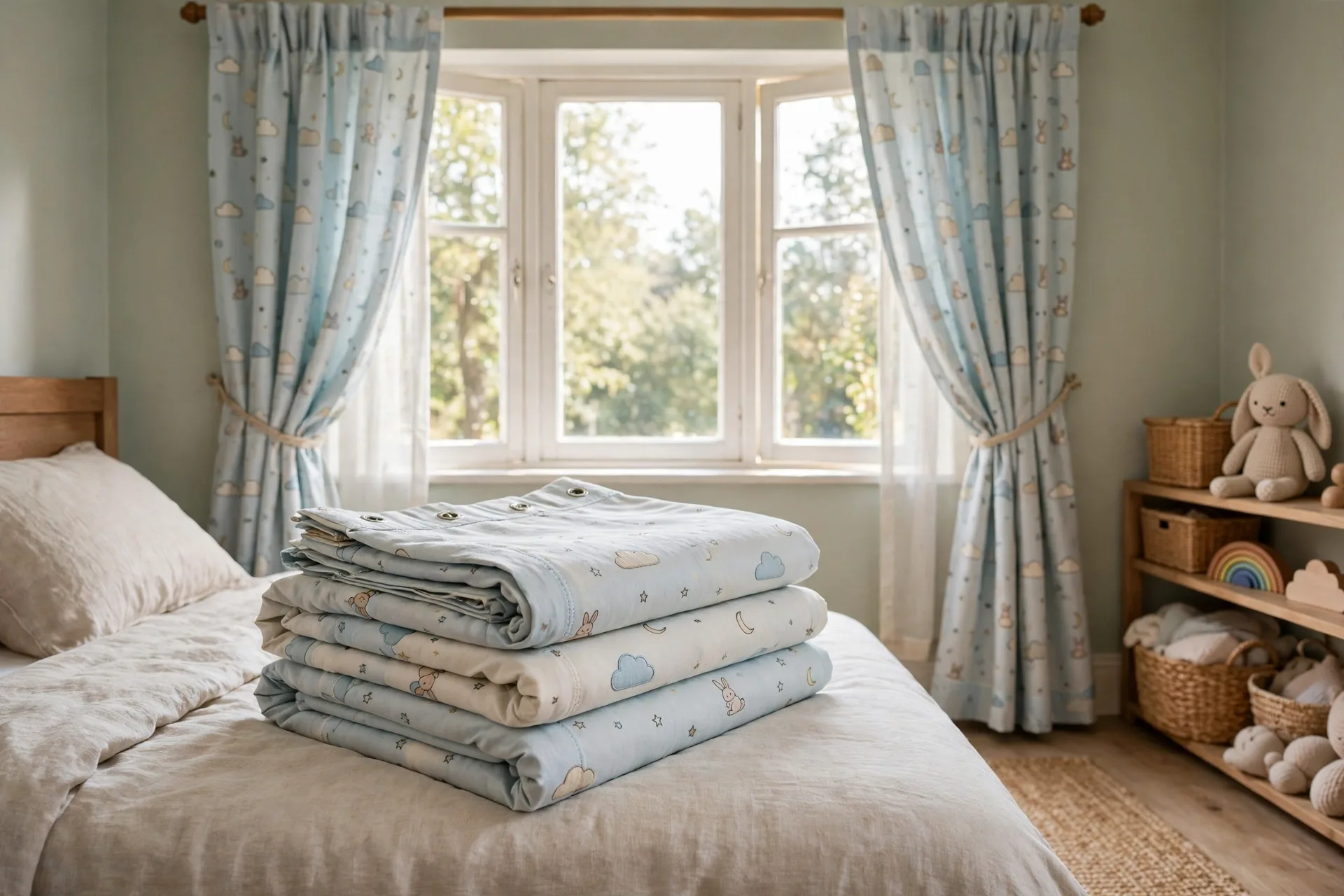
Microfiber is another strong kids room fabric, because its tight weave resists stains, feels soft, and washes repeatedly without pilling. Avoid delicate sheers as the only layer in a kids room, because a sheer tears easily under a firm pull, and avoid velvet and silk here, because velvet traps dust and needs gentle care while silk marks and fades in sun. The fabric must survive the child, not just the room.
Washing routine matters as much as fabric. Vacuum the panels gently with a soft brush head between washes, because dust dulls pale colors fast, and blot spills at once rather than rubbing them, because rubbing spreads a mark across the fabric. Wash by the care label, not by habit, and dry out of direct sun where you can, because sun and heat yellow pale panels over time.
Hypoallergenic cotton and linen suit sensitive skin: natural fabrics that feel gentler and breathe better for allergy-prone children. Cotton-linen blends keep cotton's breathability with a crisper drape and less creasing than pure linen. Soft vinyl or PVC is another option where wiping matters: it is waterproof and wipes clean, which suits kitchens, bathrooms, and play spaces, but mildew can form if moisture gets trapped behind it. The materials compare like this:
| Material | Light blocking | Cleaning | Safety | Designs |
|---|---|---|---|---|
| Cotton | Moderate | Easy | High | Many |
| Polyester | Moderate (varies by weave and lining) | Easy | Moderate | Many |
| Linen | Low | Not easy | High | Some |
| Velvet | Very high | Not easy | Moderate | Many |
Blackout, room-darkening, and sheer layers compared
Blackout, room-darkening, and sheer are three different light jobs, and a kids room often needs two of them rather than one. Blackout blocks nearly all light when closed, which suits a child who wakes at dawn or naps in the afternoon, and it gives full night privacy. Its cost is a room that feels dark and closed by day if it is the only layer, and a heavier panel that needs a stronger rod. Room-darkening cuts most daylight without full blackout, which suits a child who fears a fully dark room or a room that needs dimming rather than darkness, and it keeps the room softer by day. Its cost is that early summer sun still shows through, so it fails the dawn-waking child.
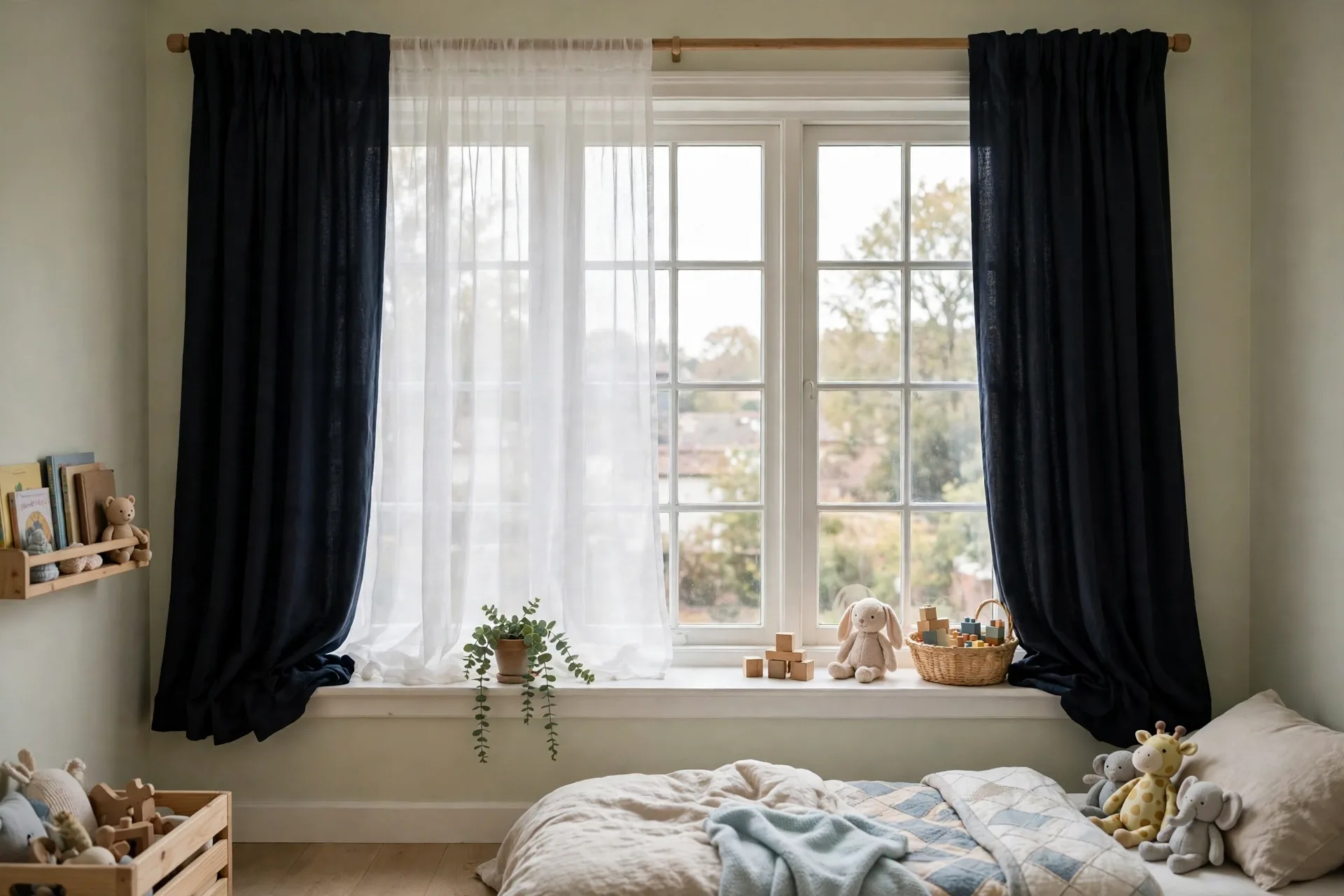
A sheer layer does a different job entirely: it softens daylight, gives daytime privacy, and keeps the room bright, but it gives almost no darkness and almost no night privacy once indoor lights are on. In a kids room the sheer works as a day layer behind a blackout or room-darkening panel, on a double rod, so the child plays behind the sheer by day and sleeps behind the dark panel at night. For the sheer job in full, see Best Sheer Curtains, and for the darkness job, see Best Blackout Curtains.
Choose the light job by the child's sleep, not by the look of the fabric. A child who wakes at dawn needs blackout, whatever the pattern, a child who fears the dark needs room-darkening plus a night light, a street-facing room needs a sheer day layer for privacy while the child plays. Match the lining to the sleep first, then choose the face fabric and pattern, because a beautiful panel in the wrong light job fails the room every night.
A blackout lining converts any curtain to blackout: a sewn-in lining in white, beige, or gray behind any face fabric, so the choice of pattern is not limited to blackout face fabrics. The lining also muffles sound and helps keep the room temperature steady. A chain weight along the sheer hem helps it hang straight and fall neatly back into place after it is moved. Blackout retains more heat than regular curtains, and blackout may not be necessary at all if the room already has good blinds or shades. In a playroom, pair sheers with blinds or shades for privacy at nap time, because sheers alone do not darken enough.
Sill length or floor length: the trip test
Length in a kids room is a safety decision before it is a style decision, because a child runs, trips, and pulls, and a panel that pools on the floor is a panel a child will trip over or swing from. Sill length, ending at or just below the sill, is the safest drop for a young child's room: nothing trails, nothing pools, the child cannot catch a foot in it, and the sill stays free for toys and books. It also suits a room with a desk, a radiator, or toy storage under the window, where a floor-length panel would snag or block the furniture. For the length reference, see Curtain Sizes.
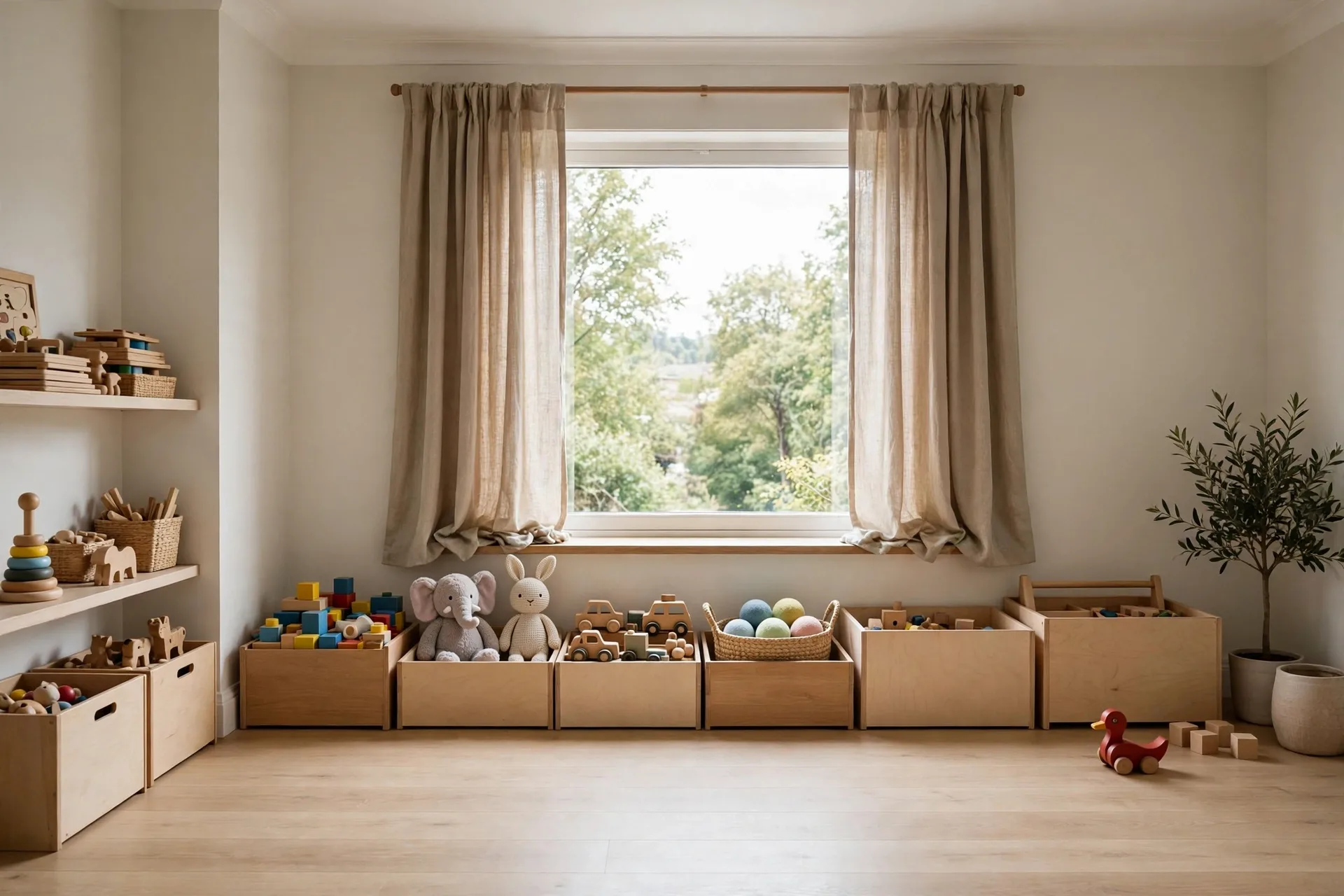
Floor length suits an older child's room where the child no longer runs into the curtains and the room is dressed more formally, but it must stop just above the floor, never puddle, because pooled fabric on the floor is a trip hazard at any age. Measure the drop from the rod to the sill or to just above the floor, and order that finished size, because a panel ordered too long cannot be made safe by tying it up. Where floor length is chosen, the hem sits about 2 cm above the floor, never puddled.
Tie-up cafe curtains suit a play area: half-height panels give privacy while light streams in above, and they are easy for home sewing.
Colors and patterns that last past one birthday
Colors and patterns that last are the ones the child will still like in two years, because a kids room theme changes fast and a curtain printed with a single cartoon character dates the moment the child moves on. Timeless motifs suit a kids room best: soft florals, gentle geometrics, stripes, stars, animals drawn simply, and ombre blends all feel playful now and still suit an older child later, while a character print feels babyish within a year or two. Neutral grounds with a colorful pattern give the longest life, because the bedding and posters can change around them without the curtains fighting the new theme.
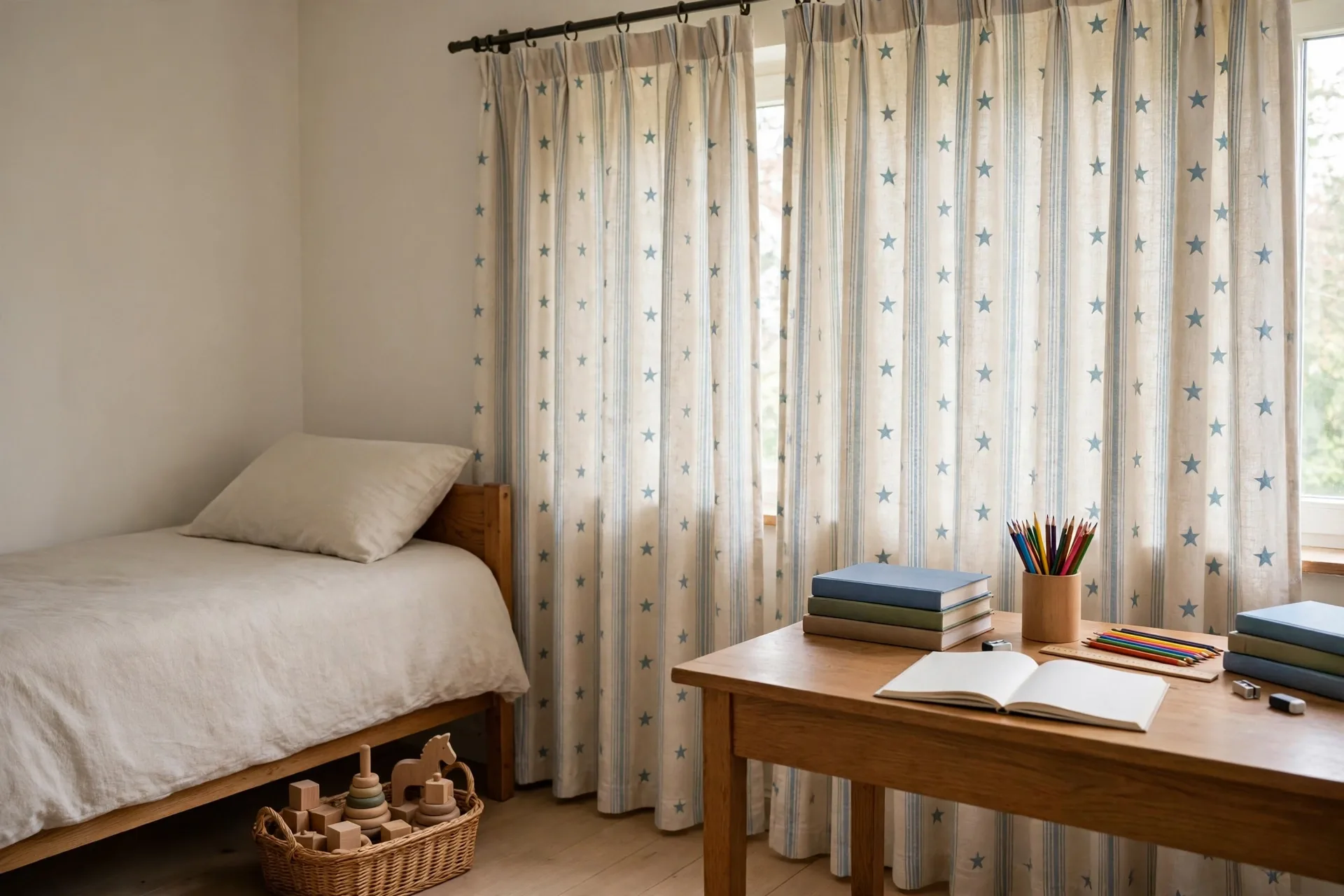
Color choice should follow the child's sleep as well as their taste. Calming colors such as soft blue, green, and lavender suit a bedroom, because they settle the room at bedtime, while warm yellow and orange energize a playroom but can overstimulate a child who needs to settle at night. Lighter and brighter colors suit kids rooms better than bold intense shades, because a bold shade dominates a small room and tires the eye. Keep the expensive part neutral and let bedding, posters, and tiebacks carry the current theme, because those swap cheaply when the child's interest changes.
In a small room, curtains close to the wall color create visual continuity, make the space feel larger, and mask a small window's size, while contrasting curtains highlight the smallness. Gender-neutral pastels such as orange, green, and yellow are an alternative to baby blue and pastel pink. Trims follow age: flat braids and ribbons for babies and toddlers, because there is nothing to pull off or mouth, and pompoms, tassels, and fringe for older children who have outgrown mouthing. Personalize plain cotton curtains with the child's name, initials, or iron-on patches, or with fabric paint, fabric markers, or iron-on vinyl lettering, and choose timeless additions, because interests shift as the child grows. Themed tie-backs change the theme cheaply: swap the tie-backs instead of replacing the whole curtain. Two-tone color blocking adds height in a low-ceiling room. Old bedsheets can be turned into patchwork curtains for a play area, which is environmentally friendly, budget-friendly, and fully customizable, though durability can suffer. Refresh the curtains every 3 to 5 years, or sooner if damaged or the child's interests change. Adjustable telescoping rods, about 18 to 48 in, and expandable grommets let the same hardware grow with the child instead of being replaced.
Measuring and hanging checklist for a kids room window
Measure before you order, because a kids room curtain that is too short leaves light gaps and a curtain that is too long trails on the floor. Measure the rod width first, running the tape from bracket to bracket and adding room on both sides so the panels stack clear of the glass when open. Measure the drop from the rod to the sill for a short panel, or to just above the floor for a floor-length panel, and measure both sides, because windows are rarely perfectly level. For the full measuring steps, see How to Measure for Curtains, and for the hanging steps, see How to Hang Curtains.
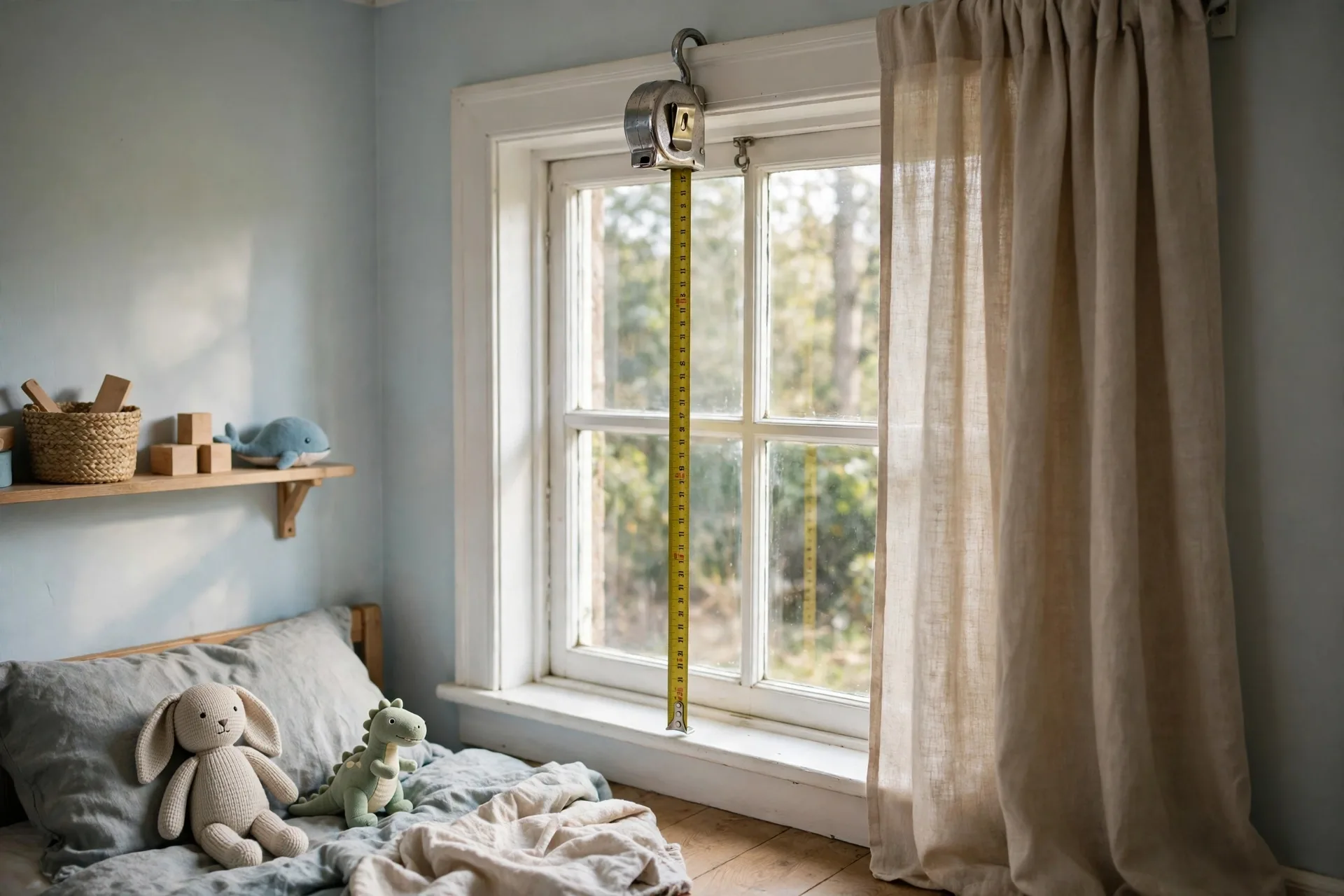
The hanging checklist for a kids room runs in this order. Fix the rod firmly into the wall with anchors that suit the wall material, and test it with a firm tug before hanging anything. Mount the rod high and wide, past the window on both sides, so the panels close without gaps at the sides or top. Choose a heading with no gaps across the top (grommet headings leave small gaps, so hang the rod high and wide to cover them), such as a pinch pleat, rod pocket, or flat panel top. Avoid a tab top, because it leaves gaps between the tabs where light leaks in at naptime. Keep cords secured, keep the bed away from the window, and run the trip test once the panels are hung.
Check the finished job at naptime, not at noon. Close the curtains in the afternoon, stand in the room, and look for light leaking at the sides, the top, and the center where the panels meet. A gap at the top means the rod is too low or the heading leaves gaps, a gap at the sides means the rod is too narrow, a gap at the center means the panels are too narrow for the window.
Run the rod about 8 to 12 inches past the trim and mount it 4 to 6 inches above the window, to cut light leaks at the sides and above.
Kids room curtain mistakes that cost sleep or safety
The most common kids room mistake is buying a sheer alone for a bedroom, which darkens nothing and leaves the child waking at dawn. The second is buying a character print the child outgrows in a year, which dates the room and wastes the cost of a full window. The third is hanging a tension rod in a room where a child pulls, which brings the rod down with the curtains. The fourth is ordering floor length that puddles, which trips the child who runs past it. Each of these is avoidable at the ordering stage, which is why sleep, pattern life, hanging strength, and length all come before the color is chosen.
Other mistakes follow from the fabric. Choosing velvet for a kids room traps dust and needs gentle care a busy room will not give it. Choosing a delicate sheer as the only layer tears under the first firm pull. Washing a cotton panel on a hot cycle shrinks it, and hanging a pale panel in a sunny window without a lining yellows it within a season. Keep the bed away from the window, fix the rod firmly, and choose a washable fabric, and the room stops fighting you.
Frequently asked questions about kids room curtains
Most kids room questions come down to darkness, safety, and washing.
Are blackout curtains good for a kids room?
Blackout curtains suit a kids room where the child wakes at dawn or naps in the afternoon, because they block nearly all light and give full night privacy. They do not suit a child who fears a fully dark room, where a room-darkening panel plus a night light works better. Test the darkness with the child before ordering, because a curtain that frightens the child will be pulled open every night.
What is the safest curtain length for a kids room?
Sill length is the safest drop for a young child's room, because nothing trails on the floor to trip over or swing from, and it leaves the sill free. Floor length suits an older child where the hem stops just above the floor and never puddles. Measure the drop from the rod to the sill or to just above the floor, and order that finished size.
What fabric is best for kids room curtains?
Cotton blends and polyester blends suit a kids room best, because both wash well, resist wrinkles, and survive pulling, while polyester holds color in sun and washes most easily. Microfiber is another strong choice, because it resists stains and washes repeatedly without pilling. Avoid delicate sheers as the only layer, and avoid velvet and silk, which need gentle care a kids room will not give them.
How do I make kids room curtains child-safe?
Choose curtains with no cords, or secure any cord or chain with the safety device supplied, fixed well out of reach. Fix the rod firmly into the wall with anchors that suit the wall, avoid tension rods, keep the bed and climbable furniture away from the window, and keep hems off the floor. Check the brackets every few months with a firm tug.
What colors last longest in a kids room?
Solid colors and timeless motifs such as stripes, stars, soft florals, and gentle geometrics last longest, because they still suit an older child when the current theme fades. Character prints date fastest, because the child outgrows them within a year or two. Keep the curtain neutral or subtly patterned and let bedding, posters, and tiebacks carry the current theme, because those swap cheaply.
Should nursery curtains and kids room curtains be the same?
Nursery curtains and kids room curtains are not the same job: babies up to age three need nap darkness and cordless safety around a crib, while older kids need washable durability, a pattern that lasts, and a length that passes the trip test.
For the curtains themselves, see Best Window Curtains.
This guide is research-based curation: we compared maker specifications, published reviews, and current prices. Read how we choose.