 Best
How to Measure for Sliding Door Curtains
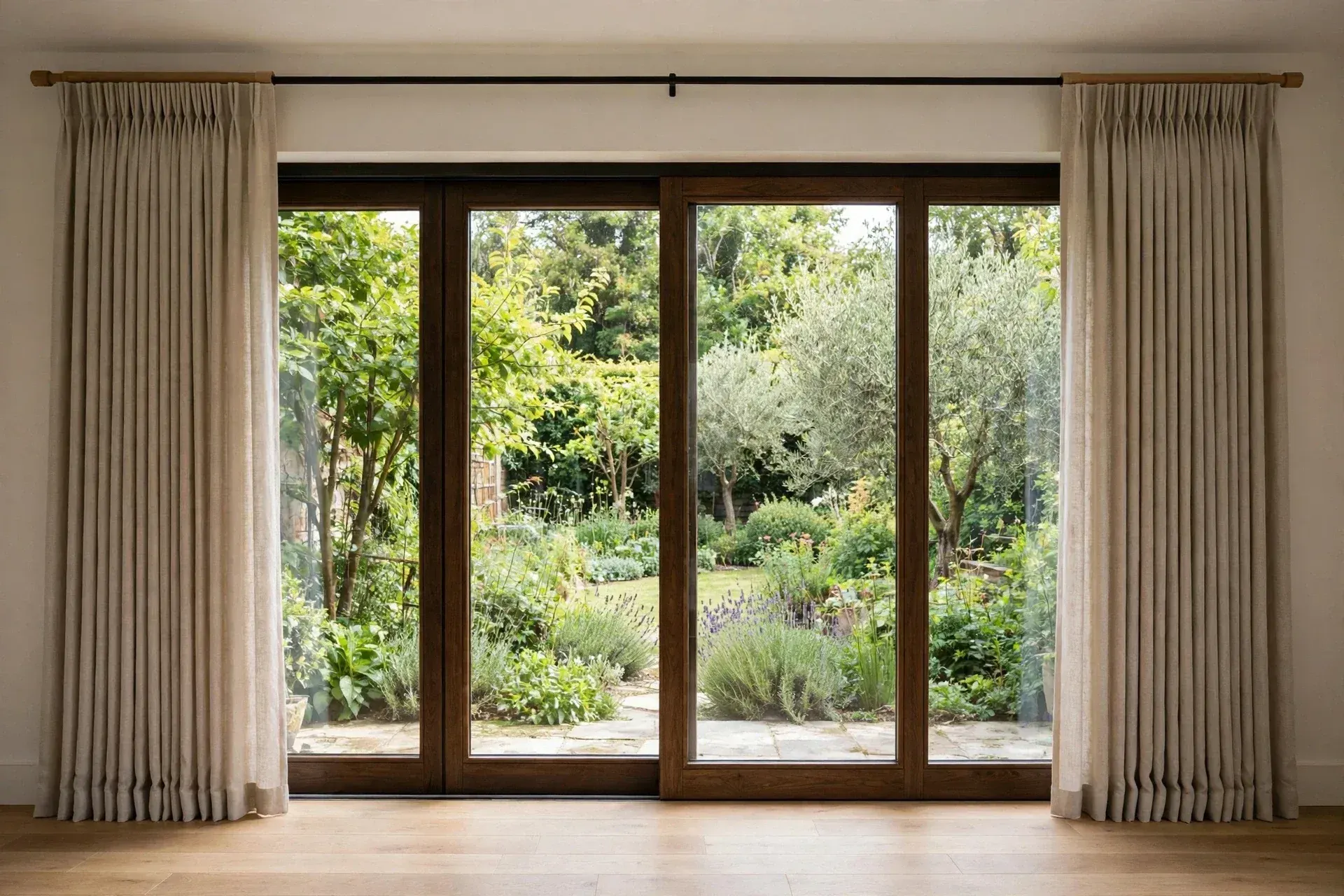
A sliding door is a doorway first and a window second, so its curtains must clear the handle, stack off the glass, and float above the track. This guide measures it that way.
To measure for sliding door curtains, measure the door frame from outer edge to outer edge, add stack space of 12 to 15 inches on each side for the gathered fabric to rest on the wall, check that the handle and the door track clear the fabric, and hang the panels so the hem floats about half an inch to one inch above the floor. A sliding door is a doorway first and a window second, so every number in this guide is judged by whether the door still opens, closes, and lets people through without pushing fabric aside. The general measuring steps stay in the general guide, so for those steps see How to Measure for Curtains.
Sliding door width: frame, rod, and stack space in one line
The width of a sliding door curtain starts with the frame, not the glass. Measure the door frame from its outer edge on one side to its outer edge on the other, at the widest point, and write that number down. A standard sliding door is about 60 to 72 inches wide and about 80 inches tall, but doors vary enough that no standard number is safe to order from, so measure your own door before anything else. If a rod is already installed, measure it end to end from bracket to bracket, leaving the decorative finials out of the number, because the finials hold no fabric and add nothing to the coverage.
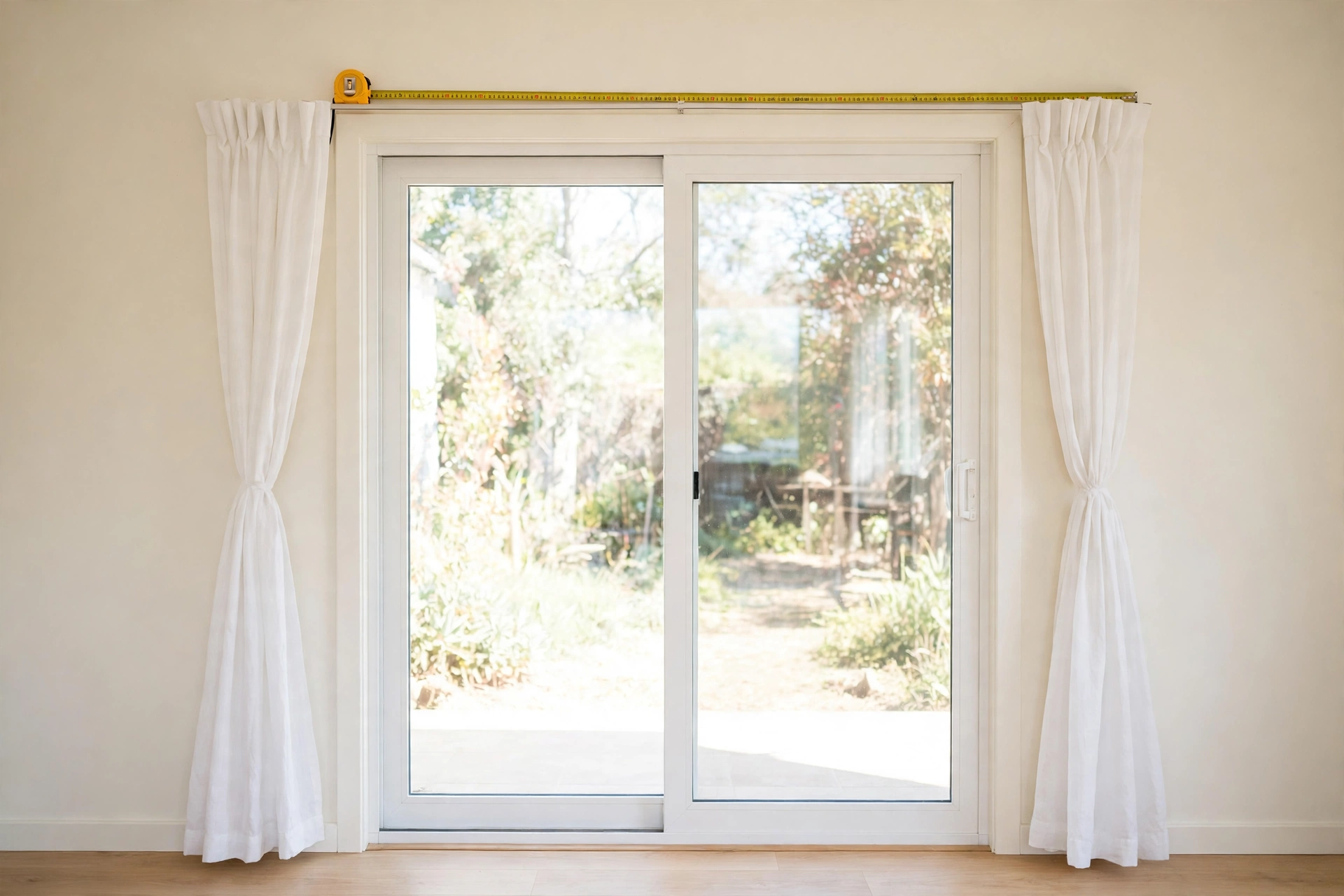
Then add the stack space. Stack space is the wall on either side of the frame where the open panels gather, and without it the open curtains sit across the glass and block the doorway. Add 12 to 15 inches on each side of the frame width for a center-open pair, which gives a rod roughly 24 to 30 inches wider than the frame. A 72-inch door therefore wants a rod of about 96 to 102 inches. Less than 12 inches a side leaves the panels hanging over the glass when open, and the door reads as half dressed even when the curtains are fully drawn back.
The total fabric width follows from the rod, not from the frame. For a full, pleated look when closed, the total flat width of all the panels together should be about twice the rod width, so a 96-inch rod wants about 192 inches of fabric. That fabric is what makes the closed curtains look like curtains instead of a flat sheet stretched across the door. To turn that total into a panel count, divide it by the finished width of one panel and round up.
Where two panels meet in the middle, add extra width for a center overlap so no light gap shows when they are closed. For blackout on a slider, overlap the panels 2 to 4 in at the center. Allow a return as well: the return is the distance from the rod to the wall, and it lets the panels wrap around the rod ends and block the edge light that would otherwise leak in at the sides.
Use a steel tape, not a cloth tape, because a steel tape stays straight and gives an accurate figure across a wide door. A telescoping rod should be picked so the width falls near the middle of its range, not at the maximum, because telescoping rods sag most at maximum extension. Finials add 2 to 4 inches near a wall or corner, so allow for them where the rod runs close to a corner, and a long rod needs a center bracket at around 60 in. Double-width panels, about 100 in per panel, suit a wide window or a sliding door: two double-width panels can replace four standard ones and give a cleaner line with fewer seams.
Stack space on one side or both: the one-way and center-open choice
Stack space goes on one side or both, and the choice is decided by how the door opens. A center-open pair splits in the middle and stacks half the fabric on each side, which suits a door you open from either side and a room where the view matters from the middle of the glass. A one-way draw gathers all the fabric on one side, which suits a door where one side is the walking side and the other side holds furniture, a wall, or a fixed panel that never moves.
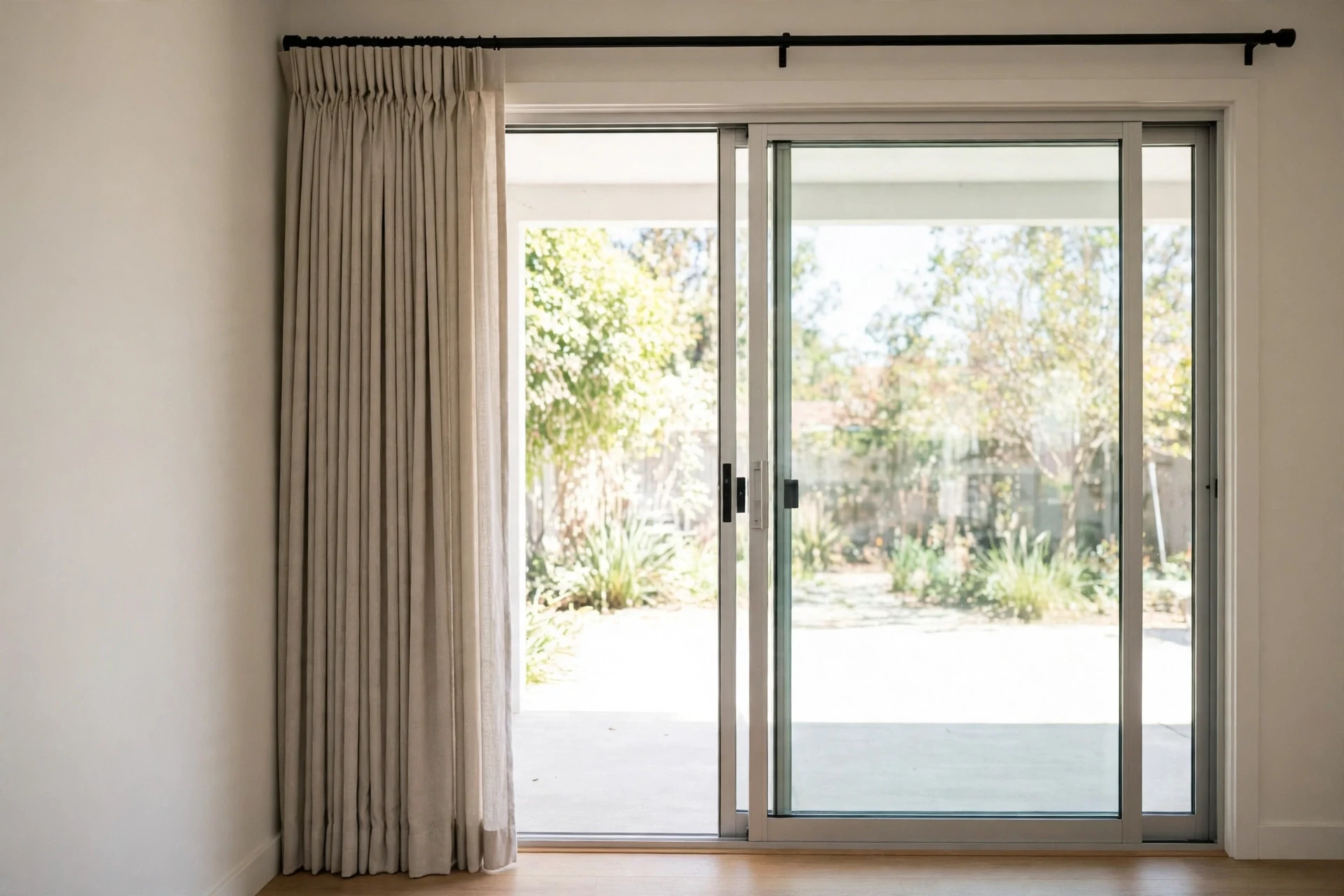
Before you choose, find out which side of the door slides. Stand inside the room, open the door, and watch which panel moves and where it ends up. The sliding panel is the one people walk through, and the stack must never sit on the walking side in a way that forces people to push fabric aside with every step. For a one-way draw, put the whole stack on the fixed-panel side, the side that never opens, so the walking side stays clear. For a center-open pair, split the stack evenly, and check that each side has enough wall for its half of the gathered fabric.
The rod length changes with the choice. A center-open pair needs stack space on both sides, so the rod runs about 12 to 15 inches past the frame on each side. A one-way draw needs the full stack on one side only, so the rod runs about 24 to 30 inches past the frame on the stack side and only a few inches past on the other side, just enough for the panel to close past the frame edge and meet the wall. Measure the wall on the stack side before you commit to a one-way draw, because a short wall there is the most common reason a one-way plan fails.
Stack-back follows a simple rule: a gathered panel compresses to about one eighth of its flat width. The worked example below shows it in numbers, with a 96-inch rod gathering to about 24 inches of stack, and the rule is what lets you check any other rod width before you order.
Handle and track clearance: measuring the parts that catch fabric
The handle is the part of a sliding door that catches fabric every day. A sliding door handle stands proud of the glass by an inch or more, and a curtain that hangs flat against the glass will snag on it, bunch behind it, and wear a shiny patch where it rubs. Measure how far the handle sticks out from the face of the door, from the glass to the outer edge of the handle, and then make sure the rod and the fabric sit further out from the wall than that number.
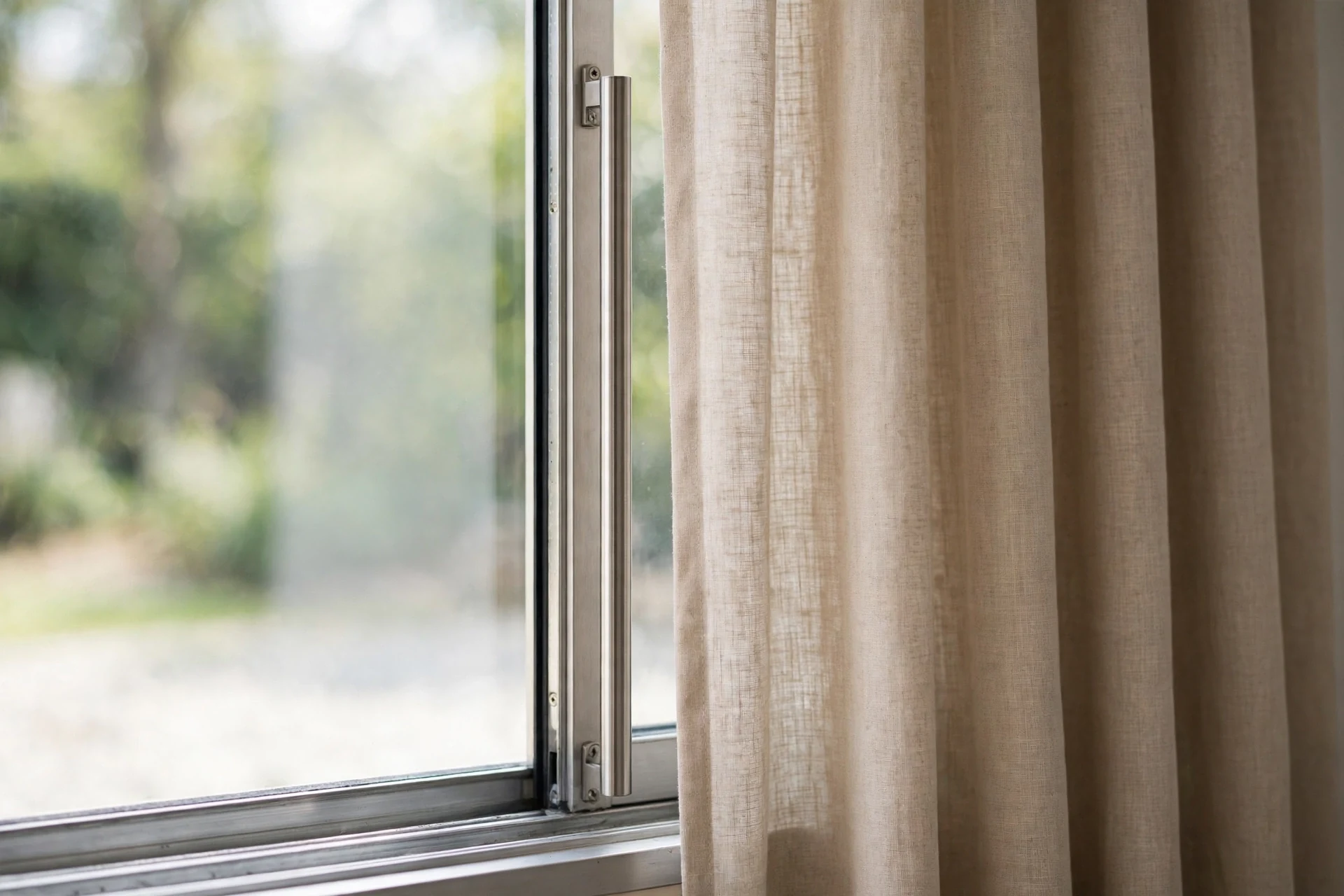
Rod projection is the distance from the wall to the center of the rod, and it is set by the brackets. Standard brackets hold the rod about 3 to 4 inches from the wall, which clears most handles, but a deep handle or a handle with a lever needs more. If the handle sticks out further than the bracket projection, order deeper brackets or a bracket with an extension, and test the clearance by holding a panel at the rod line and sliding the door open and shut before you order the full set. A curtain that clears the handle when still will still catch it if the fabric swings, so test with the door moving, not with the door shut.
The door track needs the same thinking at the bottom. The track is a raised rail on the floor that the door slides on, and a hem that touches it will drag, pick up dirt, and fray. If the track sticks out into the room further than the rod line, the panels will brush it every time they move, so check the track depth against the rod projection in the same way you checked the handle.
Floor clearance for a door you walk through every day
The hem of a sliding door curtain should float about half an inch to one inch above the floor. That float is the length that works for a door you walk through every day: it looks clean, it keeps the hem out of the door track, it stays clear of feet and pet paws, and it does not pick up dirt from the floor with every step. Measure from the bottom of the rod, or from the bottom of the rings if the panels hang from rings, down to the floor, then take off half an inch to one inch for the float. Write the finished length as the rod-to-floor number minus the float, and order that length.
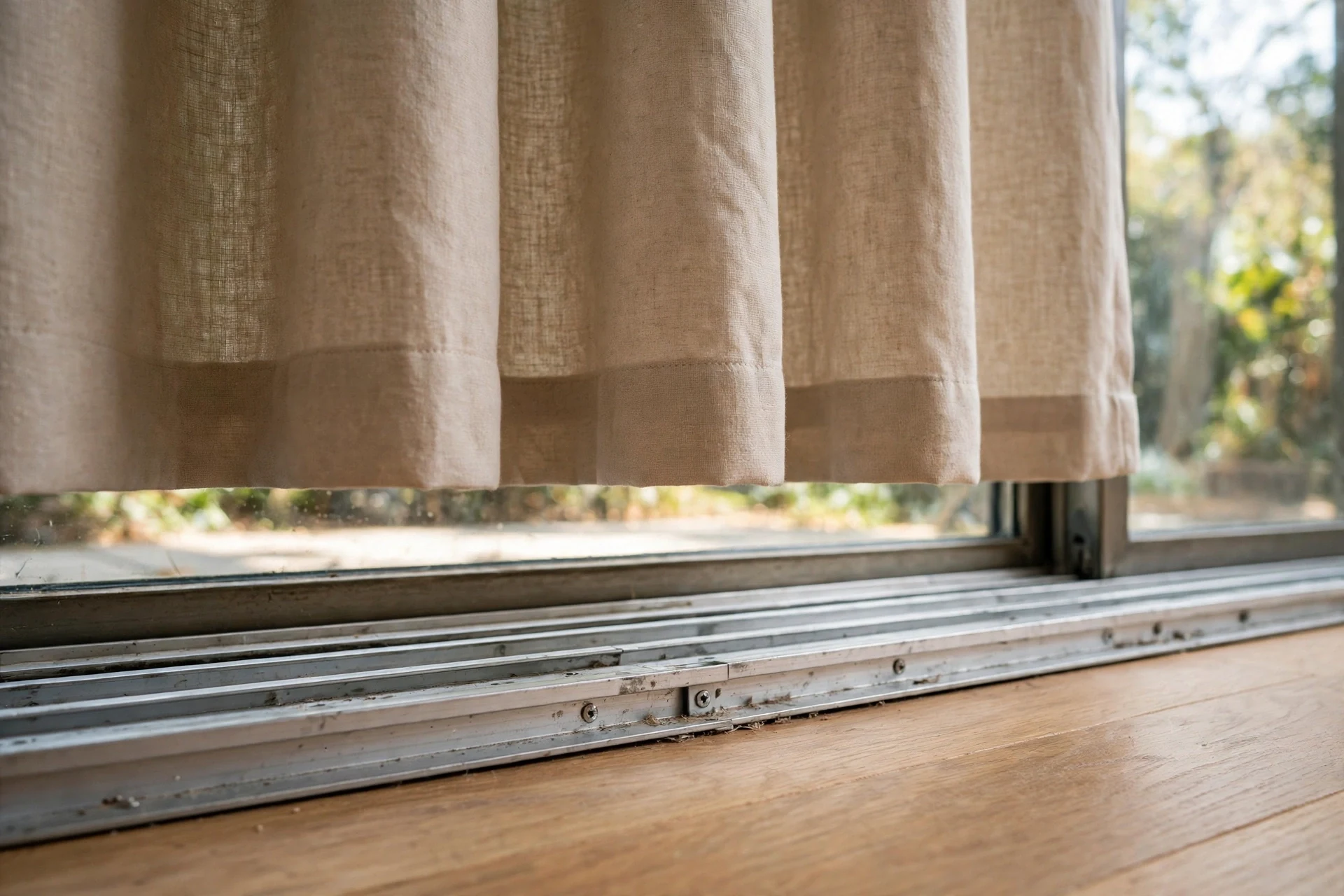
Longer lengths fail on a sliding door in ways they do not fail on a still window. A hem that kisses the floor will catch on the raised door track, drag across it, and wear thin at the exact line where the track runs. A hem that puddles on the floor is worse: it pools across the walkway, trips feet, collects dirt, and gets stepped on every time someone carries something through the door. Save puddle lengths for still windows in formal rooms, and keep the sliding door hem floating.
The float also protects the hem from the door itself. A sliding door opens by sliding one panel across the other, and the moving panel passes close to the curtain line. Measure the floor at both ends of the door, not just the middle, because floors slope and a hem that floats by an inch on one side can drag on the other. If the two ends differ, use the higher floor reading for the length so the hem clears everywhere. Measure the floor in three places, at both ends and in the middle, and use the shortest drop, which is one more check on the same rule.
Between the float and the puddle sits a third finish worth naming: the break length, which adds 1 to 2 in past the floor so the hem just kisses it. A break suits a door where a float looks too short but a puddle would trip feet. If a ready-made length lands a little short, moving the rod 1 to 3 in is often simpler than hemming: a small shift in rod height moves the hem by the same amount.
Fabric behaves after hanging, so allow for it before you order. Linen and cotton shrink, and fabric relaxes and lengthens after hanging, especially in humid climates. Choose longer and hem after the first wash, or use a break length that absorbs the change.
Grommet and ring tops against track glides for daily door use
The header is how the panel attaches to the rod or track, and on a door you open daily the header decides whether the curtain glides or fights you. Grommet tops and ring tops slide easily along a rod, because the large rings roll over the rod with little friction, and they are the easiest headers for a sliding door you open and close many times a day. They also give a clean, even wave when the panel is closed, which suits a wide door where the fabric has a long way to travel. Their weakness is the center support bracket: on a rod wider than about 60 inches there is usually a center bracket, and rings cannot pass it, so a grommet panel cannot slide past the middle of a wide rod.
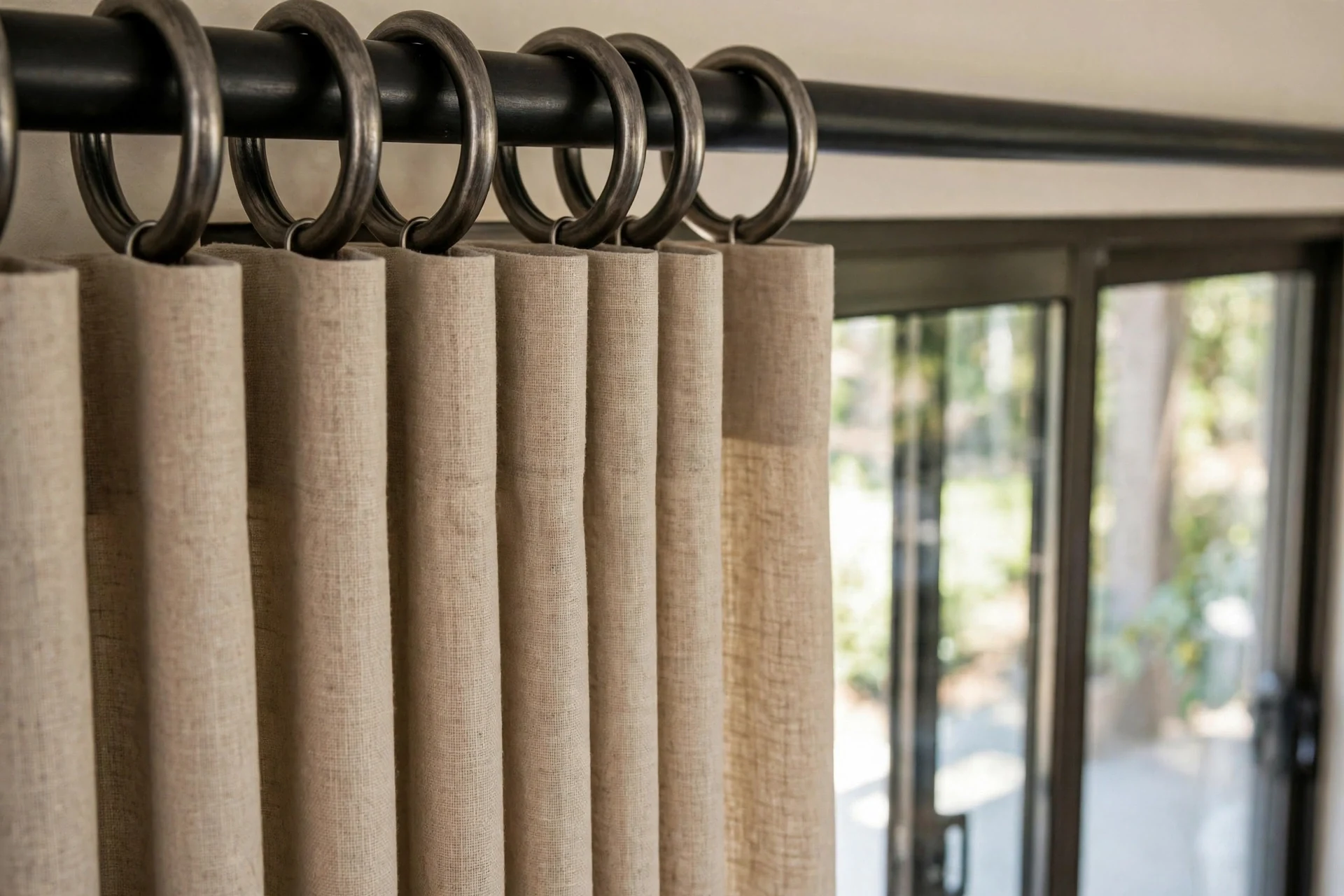
Track glides are the other answer, and they suit a sliding door better than a rod in several ways. A ceiling or wall track carries the panels on small carriers that run inside a channel, and the carriers pass the support points without stopping, so a track can span a wide door without a bracket blocking the middle. A track also sits closer to the ceiling, which keeps the top of the panel tight to the wall and cuts the light gap above the door. The trade is that a track is fixed in place once fitted, it needs its length cut to the door, and its carriers must match the panel heading, so check the carrier type against the heading before you order.
Rod pocket and back tab headers are the poor choice for a daily door. A rod pocket grips the rod along its whole width, so the panel drags instead of sliding, and opening the door becomes a two-handed pull. Pinch pleats work well on a traverse rod, the kind with a cord or wand that draws the panels, because the pleats are built to travel on carriers, and a traverse rod suits a wide door where hand-drawing heavy panels is tiring. Whatever header you choose, test the glide with one panel before ordering the full set, because a header that sticks on a short rod will stick far worse across a ten-foot span.
The drop is measured from a different point for each header, so use the point that matches the header you will hang:
| Header | Measure the drop from |
|---|---|
| Grommet | Top of the rod, plus 1 to 3 inches |
| Rod pocket | Top of the rod |
| Tab or back tab | Top of the rod |
| Ring clips or hooks | Bottom of the ring |
| Pinch pleat on a track | Bottom of the glider or hook |
A ring drop adds 1 to 3 inches to the length, so allow for it where the panels hang from rings.
Layering suits a slider too. A sheer or semi-sheer day layer with a blackout panel gives soft light by day and darkness at night, and blackout protects floors and furniture from fading, not just the room from light. Hang the sheers at 2 to 2.5x on a double rod, and measure each rod separately, because the two rods sit at different heights and different projections from the wall.
When the wall beside the door is short
Many sliding doors sit in a corner or beside a fixed window, and the wall on one or both sides is too short for the full 12 to 15 inches of stack space. A short wall does not make curtains impossible, but it changes the plan, and the change must be made at the measuring stage, not after the panels arrive. First, measure the actual wall on each side, from the frame edge to the corner, the window trim, or the furniture that cannot move. That number is the real stack space available, and it decides the draw.
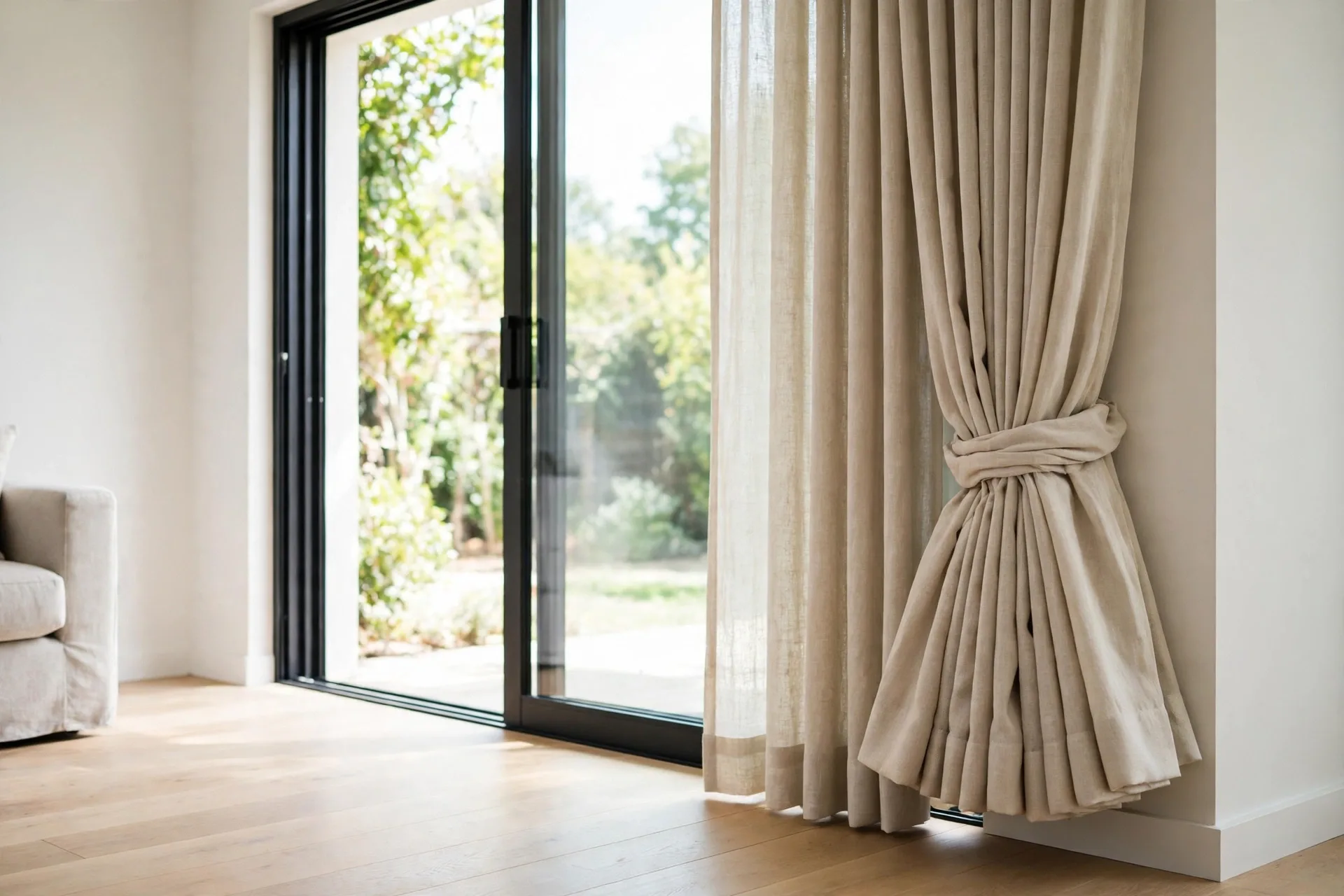
If one side is short and the other is long, use a one-way draw and put the whole stack on the long side. The rod then extends the full stack distance on the long side only, and the panel on the short side needs only enough rod to close past the frame edge. If both sides are short, use a center-open pair with the smallest workable stack, and accept that the open panels will cover a little of the glass at the edges. That is better than a one-way draw with nowhere to stack, which would leave the whole panel hanging across the doorway.
A third answer for a short wall is a slimmer stack. Lower fullness gathers into a narrower stack, so a 1.5x fullness panel stacks tighter than a 2x panel on the same rod, and a light fabric stacks tighter than a heavy lined one. A ripple fold or wave fold heading also stacks narrower than a pinch pleat, because its folds are shallow and even. If the wall is shorter than the gathered stack by more than a few inches, the honest answer is that curtains are the wrong dressing for that door, and a blind or a shade that stacks inside the frame is the better fit.
The room itself can limit the extension too. In a bedroom a headboard or a dresser can block the extension on one side, so measure the furniture as well as the wall. Where soundproofing is the job, extend the rod 8 to 12 in past the frame on each side, or run it wall to wall, with floor length and a slight break and the rod close to the ceiling.
Other windows beside the door need their own answers, briefly. A bay or bow window takes a panel at each end, with one at each angle if the bay is wide. A corner window takes two rods with a corner connector, with the stack at the outer ends. A French door needs the rod high enough that the doors swing beneath it, and the handles must not catch the fabric. An arched window takes a rod above the highest point of the arch. A radiator under the window calls for sill or apron length with an air gap. A floor-to-ceiling or double-height window is measured from ceiling or track to floor in three places, usually needs custom lengths, and suits a ceiling track that handles long heavy panels.
A worked sliding door example from frame to finished numbers
Take a standard sliding door 72 inches wide and 80 inches tall, in a living room where the door is used every day and the wall on each side is clear. Measure the frame outer edge to outer edge: 72 inches. Add 12 inches of stack space on each side, which is the low end of the 12 to 15 inch range and suits a 2x fullness panel: the rod is 72 plus 24, which is 96 inches from bracket to bracket, excluding finials. Mount the rod 4 to 6 inches above the frame, so the top of the frame is covered and the door reads taller.
Now the fabric. Total flat panel width at 2x fullness is twice the rod width: 96 times 2 is 192 inches of fabric. Split across two panels for a center-open pair, that is 96 inches of fabric per panel before heading, so each panel covers its half of the rod with full folds when closed. When open, each panel gathers into about 12 inches of stack on its side of the frame, which is exactly the stack space the rod provides, so the glass stands clear and the doorway is open.
Now the length. The rod sits about 86 inches above the floor on this door, measuring from the bottom of the rod to the floor. Take off three quarters of an inch for the float, and the finished panel length is about 85 inches. Ready-made panels come in 84, 96, and 108 inch drops, so an 84-inch panel would hang an inch short of the float on this door, and a 96-inch panel would need hemming. This is the point where made-to-measure earns its keep on a sliding door: the door is wide, the rod is long, and a ready-made drop rarely lands on the float.
Measuring mistakes that leave a sliding door half covered
The most common sliding door mistake is measuring the glass instead of the frame. The glass is narrower than the frame by the width of the stiles, so a rod sized to the glass leaves the frame edges bare and the closed curtains short of the wall on both sides. Measure the frame outer edge to outer edge, and add the stack space on top of that, not on top of the glass.
The second mistake is forgetting the stack space entirely, or adding only a few inches. A rod that ends at the frame edge gives the open panels nowhere to go, so they hang across the glass, block the light, and narrow the doorway. Adding only 5 to 8 inches for the whole door is far too little for gathered panels at 2x fullness: a 96-inch rod of fabric gathers into roughly 24 inches of stack, and 5 inches of wall cannot hold it. Use 12 to 15 inches a side, and check the gathered stack width before you order.
The third mistake is measuring the length to the floor and ordering it exact. A panel ordered to the exact floor measurement will touch the floor once it is hung, because fabric stretches a little under its own weight and the rod settles on its brackets. Take off the float before you order, and measure the floor at both ends of the door. Other mistakes follow the same pattern: ordering a single panel for a wide door, which cannot pass the center bracket and bunches on one side; choosing a rod pocket header for a door opened ten times a day; and forgetting the handle, which catches the fabric on the first opening and never stops. Each of these is caught at the tape stage, which is why the handle and the stack space are measured before anything is ordered.
Four more mistakes are worth naming. Measuring the length before the rod is installed leaves the drop wrong, because the rod height is what the length hangs from. Forgetting the ring drop leaves the hem short by the drop of the rings. Rounding too early, before the last number is in, throws the finished length off by the rounding. And confusing panel widths with pair widths doubles or halves the count, because a pair width is two panels and a panel width is one.
Frequently asked questions about measuring sliding door curtains
Most sliding door measuring questions come down to the rod width, the stack space, and the hem height, and to what happens when the wall is short.
How wide should the curtain rod be for a sliding door?
Add 12 to 15 inches of stack space on each side of the frame width. A 72-inch door wants a rod of about 96 to 102 inches, and a 60-inch door wants a rod of about 84 to 90 inches. A one-way draw puts the stack on one side instead, so the rod runs about 24 to 30 inches past the frame on the stack side.
How do I measure the stack space for a sliding door?
Measure the stack space from the frame edge to where the open panel ends: allow 12 to 15 inches of stack space on each side for the gathered fabric at 2x fullness. For a one-way draw, run the rod about 24 to 30 inches past the frame on the stack side, and only a few inches past on the other side, so the open panel clears the glass and the doorway stays open.
Should sliding door curtains touch the floor?
No, not on a door you walk through every day. Hang the hem about half an inch to one inch above the floor, so it floats clear of the door track, stays clean, and never trips anyone.
How do I measure the length for sliding door curtains?
Measure from the bottom of the rod, or from the bottom of the rings if the panels hang from rings, down to the floor, then take off half an inch to one inch for the float. Measure the floor at both ends of the door, because floors slope, and use the higher floor reading so the hem clears everywhere.
What if the door handle sticks out and catches the curtain?
Measure how far the handle sticks out from the glass, and make sure the brackets hold the rod further from the wall than that number. Standard brackets hold the rod about 3 to 4 inches from the wall, which clears most handles, but a deep or lever handle needs deeper brackets. Test the clearance with the door moving before you order.
Can I use a single panel on a sliding door?
Only on a narrow door with a short, bracket-free rod. On most sliding doors a single panel bunches on one side and leaves the door half covered when closed.
Do I measure the glass or the frame?
Measure the frame, outer edge to outer edge. The glass is narrower than the frame, so a rod sized to the glass leaves the frame edges bare and the closed curtains short of the wall on both sides.
What header works best for a sliding door I open every day?
Grommet and ring tops glide easiest on a rod, because the large rings roll with little friction. Track glides suit a wide door even better, because the carriers pass the support points without stopping. Rod pocket headers drag and are the poor choice for a daily door.
What size rod and fabric does a 60-inch sliding door take?
A 60-inch door takes about an 84 to 90-inch rod, which at 2x fullness calls for about 168 to 180 inches of fabric. Curtain sizes are written width by length.
For the general measuring steps, the rod height rule, and the standard length tables, see How to Measure for Curtains, and for standard lengths by room see Curtain Sizes.
This guide is research-based curation: we compared maker specifications, published reviews, and current prices. Read how we choose.