 Best
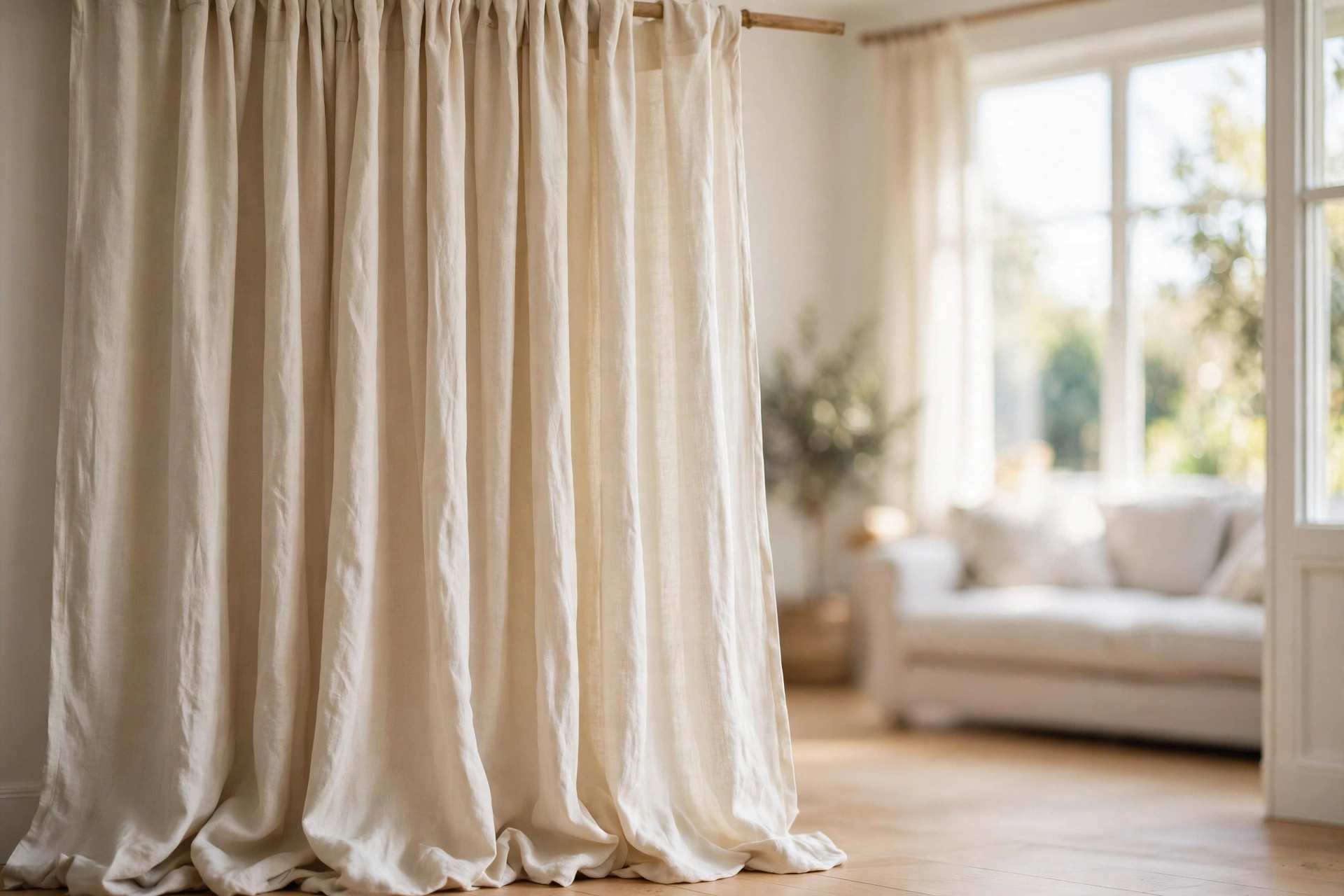
Curtain Fullness Explained
Fullness is how much fabric is gathered onto the rod, and it decides whether curtains look tailored, standard, or full. This guide explains each ratio and what changes it.
Curtain fullness is the ratio between the total flat width of your curtain fabric and the width of the rod it covers, so 2x fullness means the fabric is twice as wide as the rod, and that extra fabric is what gathers into folds instead of hanging flat like a sheet. A higher ratio means deeper folds and a richer look, a lower ratio means a flatter, more tailored look, and the right ratio depends on the heading, the fabric weight, and the room. This guide explains each ratio, what changes it, and the width trap that catches buyers who order by the headline number.
What curtain fullness means in one sentence
Fullness is how much fabric is gathered onto the rod, expressed as a multiple of the rod width. If the rod is 100 inches wide and the total flat width of the panels is 200 inches, the fullness is 2x. If the total flat width is 150 inches, the fullness is 1.5x. If it is 300 inches, the fullness is 3x. The number is always measured against the rod width, not the window width, because the rod is what the fabric has to cover when the curtains are closed, and the rod usually runs wider than the window itself.
Fullness matters because it is what makes curtains look like curtains. With no extra fabric, a panel pulled across a rod hangs flat, and the window looks like it has a sheet pinned over it. With the right extra fabric, the panel falls in soft, even folds, and those folds catch the light, give the window depth, and hide the rod line behind a finished drape. Too little fullness looks thin and stretched, and too much fullness looks bulky and wastes fabric, so the choice is a balance between the look you want and the fabric you are willing to buy.
One more measure is worth knowing, because it appears on wave fold and ripple fold tracks. Ripple fold and wave fold fullness is often given as a percentage of the track width instead of a multiple: 60 percent fullness is about 0.6x, 80 percent is about 0.8x, 100 percent is about 1x, and 120 percent is about 1.2x. These tracks control the fold spacing with carriers, so the fabric falls in even waves at lower ratios than a pleated heading needs. Do not mix the two scales: 100 percent fullness on a ripple fold track is not the same look as 1x fabric on a grommet rod.
A second percentage scale is also in use, where 100 percent fullness means the fabric is twice the rod width, so 100 percent on that scale is 2x. The two scales do not agree, so check which scale a maker or a calculator is using before you compare numbers.
Curtains and drapes are two words for the same job with a difference in weight and length. Curtains are lighter and usually run to the sill or just below it, while drapes are heavier, lined, and floor length. This guide uses curtain for both, and says lined or heavy where the weight matters.
1.5x fullness: the tailored look
At 1.5x fullness the fabric is half as wide again as the rod, and the result is a tailored, restrained look with gentle folds and little bulk. The folds are shallow and the panel reads as a flat, clean drape rather than a gathered one, which suits a modern room, a small window, or a curtain that is mostly decorative and rarely closed. It is also the ratio that suits heavy fabrics best, because a heavy cloth makes its own presence at a lower ratio and does not need extra fabric to look substantial.
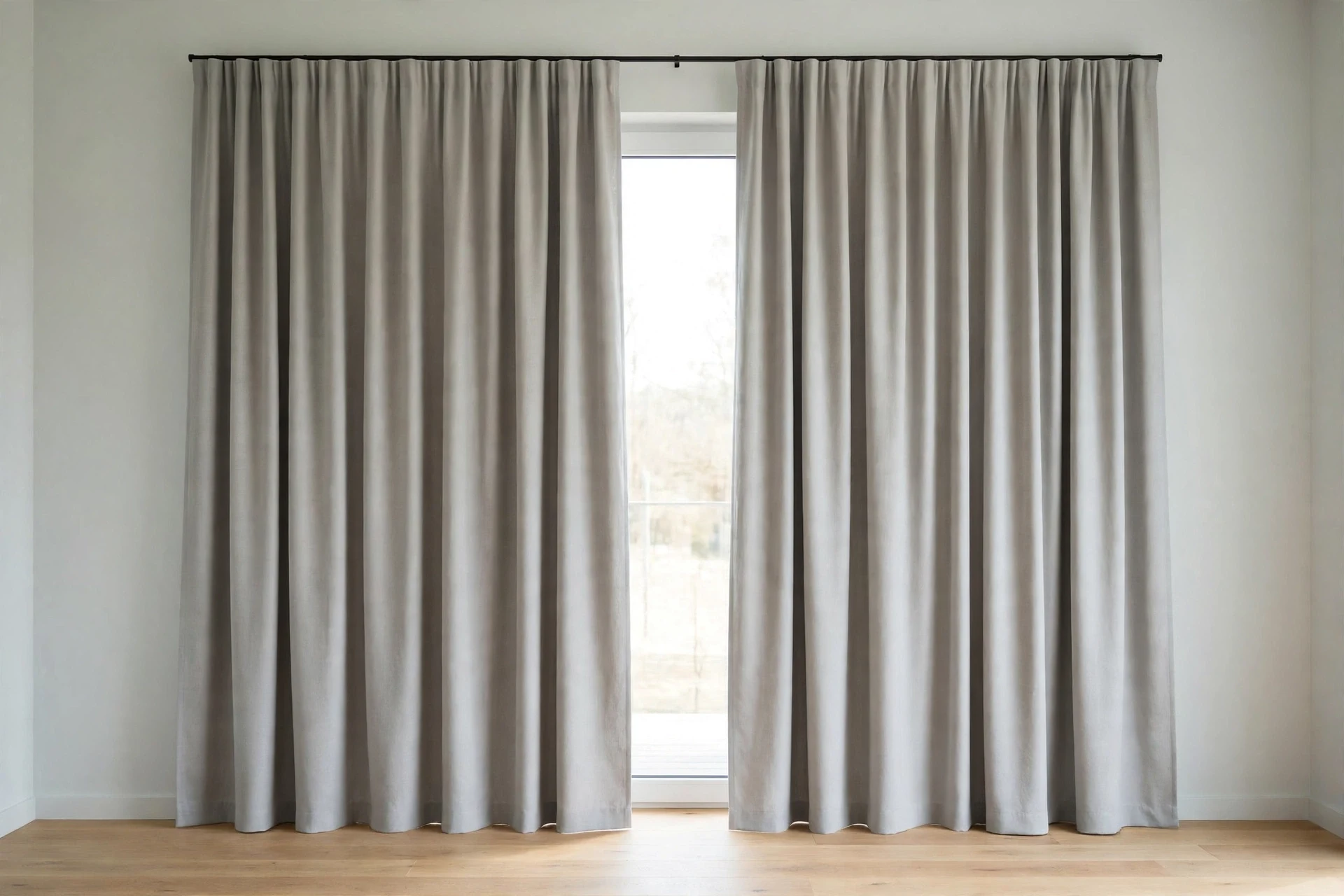
The risk at 1.5x is that the panel looks thin when closed. On a wide window the folds stretch out and the fabric can look pulled tight across the rod, especially in a light fabric or a sheer, where 1.5x leaves the panel nearly transparent and flat. Treat 1.5x as the minimum acceptable ratio: below 1.5x the curtain stops looking like a curtain at all, and at 1.5x it looks intentional only where the fabric is heavy or the style is deliberately flat. For sheers, 1.5x is too little, because a sheer needs density to give privacy and to soften light, and a thin sheer at 1.5x does neither well.
Use 1.5x where the fabric is heavy, the room is modern and spare, the window is small, or the panels are decorative and stay open most of the time. Do not use it where the curtains must close every night for privacy or darkness, because the shallow folds leave gaps at the edges and the panel will not sit evenly across the rod.
2x fullness: the standard look most rooms use
At 2x fullness the fabric is twice as wide as the rod, and the result is the standard look most rooms use: soft, generous folds that read as professional and intentional without looking formal or heavy. From 2x to 2.5x the look turns full, with deeper folds that fill the window. The folds are deep enough to catch light and shadow, the panel closes evenly across the rod, and the fabric drapes in a way that suits nearly every fabric weight and heading style. 2x is the starting point this guide recommends unless a specific heading, fabric, or room pushes the choice up or down.
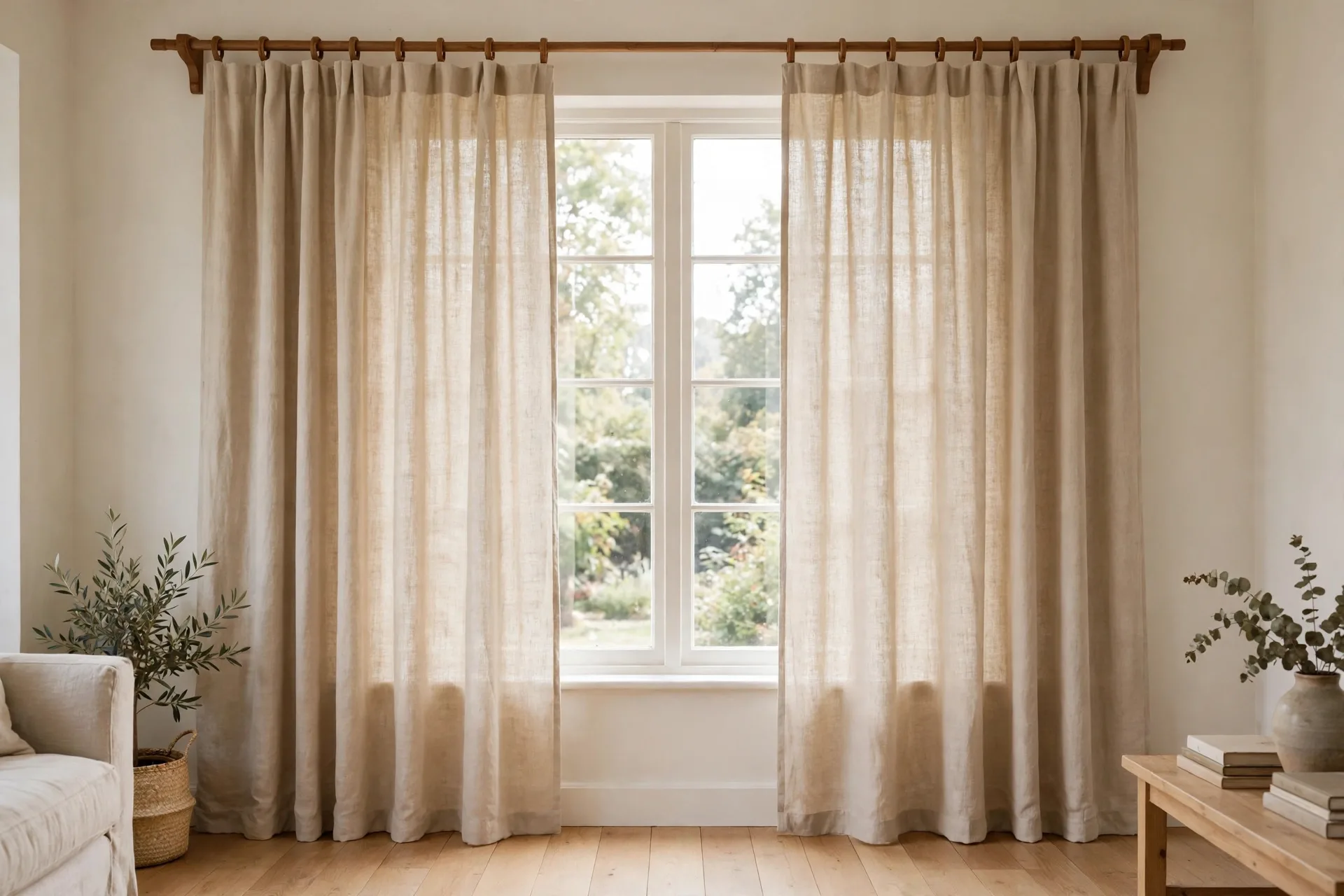
The reason 2x works so widely is that it balances the two things fullness has to do: cover the rod when closed, and gather neatly when open. At 2x the closed panel has enough fabric to fold without stretching, and the open panel gathers into a stack that fits the wall space beside most windows. Linen and cotton sit well at 2x, because their natural texture shows in the folds without needing extra fabric to make the point. Mid-weight fabrics, the everyday workhorses of a home, look their best here, and a 2x panel in a plain fabric is the hardest curtain choice to get wrong.
2.5x to 3x fullness: the formal look
At 2.5x to 3x fullness the fabric is two and a half to three times as wide as the rod, and the result is a formal look with deep folds, rich texture, and a sense of weight that fills the window. The folds are close together and deep, the panel looks lush even when it is only half closed, and the window reads as dressed rather than covered. This is the ratio for a formal living room, a grand window, a hotel-style bedroom, and any room where the curtain is meant to be a feature in itself.
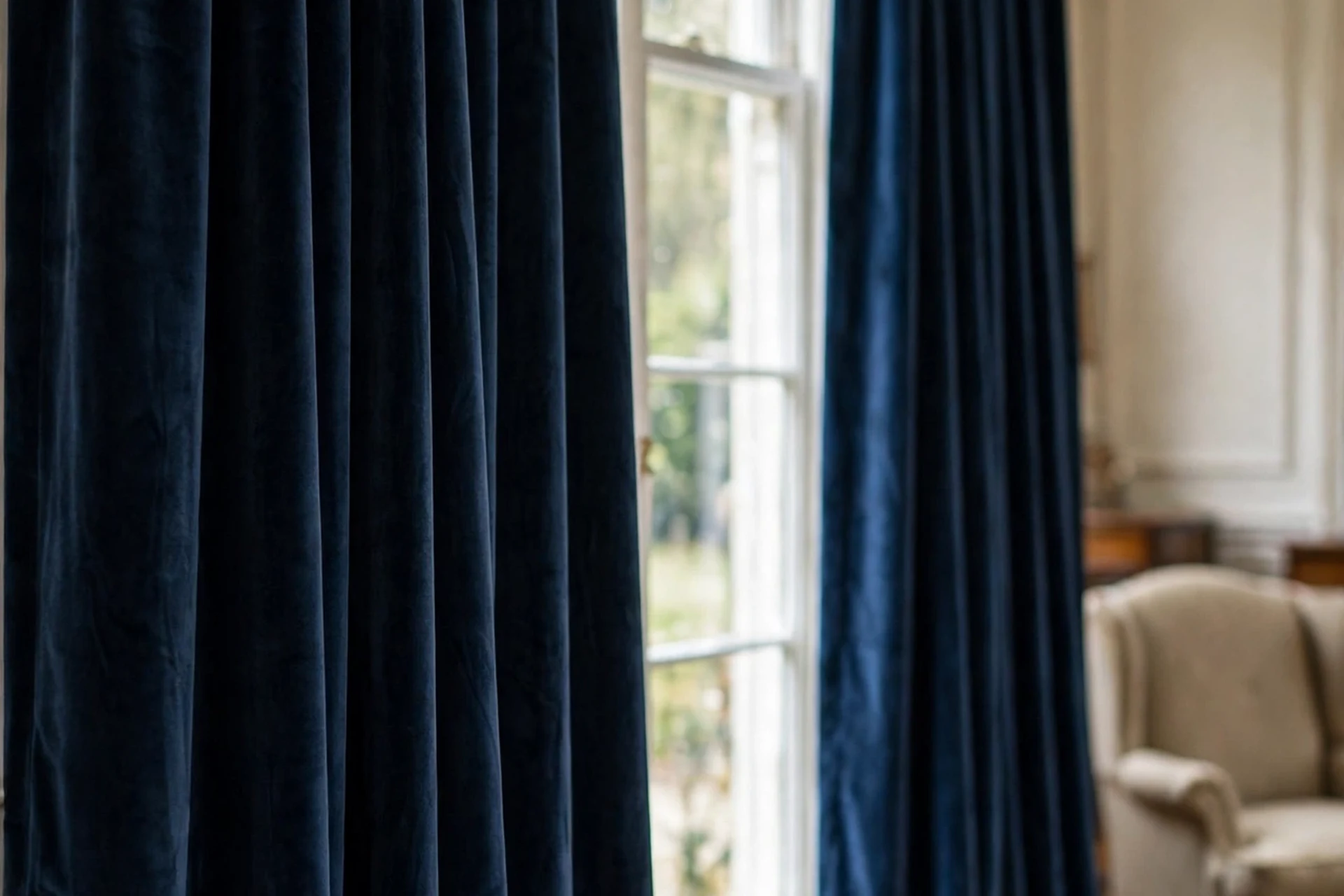
The fabrics that need this ratio are the light ones. Sheers and voiles need 2x to 2.5x to look like anything at all, because a sheer at 1.5x is still thin and see-through, while a sheer at 2.5x gathers into soft, layered folds that give daytime privacy and diffuse the light properly. Lightweight linens and cottons also benefit, because their folds are soft and need extra fabric to hold their shape. Heavy fabrics do not need it: a velvet or a jacquard at 3x looks bulky and overstuffed, and the extra fabric adds weight the rod must carry for no visible gain.
The cost of high fullness is real, and it is paid twice. First in fabric: a 3x panel on a 100-inch rod needs 300 inches of fabric, which is half as much again as a 2x panel on the same rod. Second in bulk: the open panel gathers into a wide, deep stack that covers more of the wall and more of the glass at the edges, and on a small window that stack can swallow the window entirely. Use 2.5x to 3x where the room is formal, and 2x to 2.5x where the fabric is light, and accept the stack. Do not use it where the wall beside the window is short, where the fabric is heavy, or where the curtains must open fully every day to clear a door.
Fullness by heading: pinch pleat, grommet, rod pocket, and wave fold
The heading changes how much fullness a panel needs, because the heading is what builds the folds. A pinch pleat heading needs 2.5x to 3x, because the pleats are sewn in and each pleat consumes fabric to make its shape. A pinch pleat at 2x looks starved: the pleats pull tight, the spaces between them flatten, and the structured look the heading is chosen for disappears.
A grommet heading needs less, because the rings themselves make the wave.
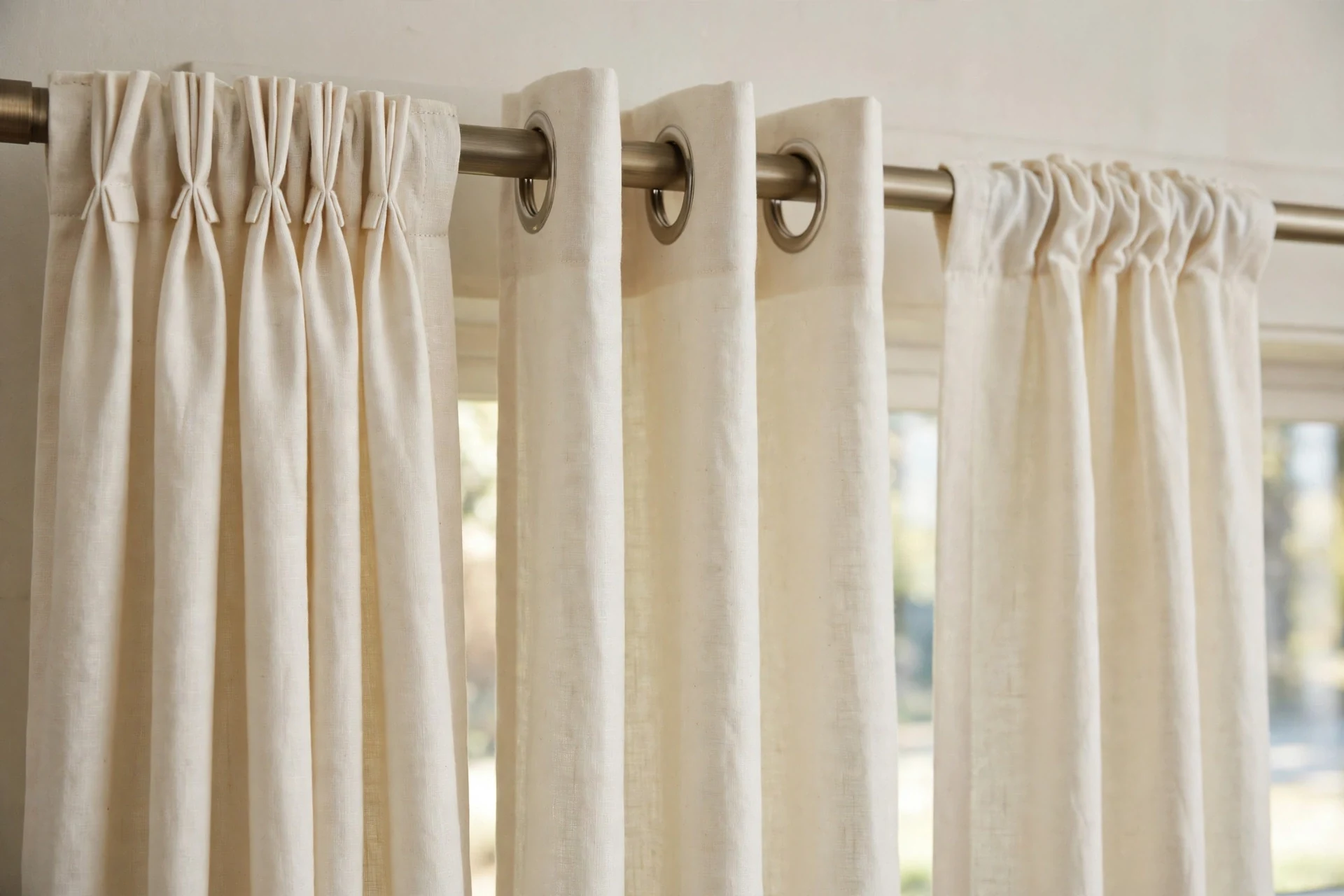
Grommet panels look best at about 1.75x to 2.25x, with 2x as the safe center. Below that the waves flatten and the panel looks stretched between rings; above it the waves crowd and the panel looks busy. A rod pocket heading needs more, because the pocket gathers the fabric tightly onto the rod and the folds have to come from the fabric alone: 2x is the minimum, and 2.5x to 3x is often needed to keep the panel from looking stretched thin across the rod. Back tab and tab top headings sit near the grommet range, about 1.5x to 2x, because the tabs hold the pleats in place and the fabric does less work.
Wave fold and ripple fold headings are the exception, because the track sets the fold spacing. Their fullness is given as a percentage of the track width, and 80 to 100 percent is the usual range for a tailored look, with 120 percent for a richer drape. Do not apply the 2x rule to a wave fold track: the carriers space the folds evenly, so the fabric needs far less extra width to look finished, and 2x on a wave fold track would pile fabric the track cannot carry neatly. For the general measuring steps see How to Measure for Curtains.
Some calculators list ripple fold at 2 to 2.5x, which disagrees with the percentage scale above. This guide keeps the makers' scale, 80 to 120 percent, because the carriers space the folds and the fabric needs far less extra width on a wave fold track than a pleated heading needs.
Pinch pleats also come in types that change the fabric need. Two-finger, three-finger, goblet, box, and inverted pleats each consume fabric differently, and French pleats, double or triple, suit medium to high fullness. A box pleat is a structured, formal, deep pleat that holds its shape. This guide keeps the 2.5x minimum above, because a pinch pleat at a lower ratio looks starved.
Of all the headings, tab top and back tab need the least fabric, 1.5 to 2x, because the tabs already hold the pleats in place. Grommet sizing follows the rod: grommets run 1.5 to 2 inches in diameter, at least half an inch larger than the rod, and tabs are spaced 4 to 6 in apart.
Fullness by fabric weight: heavy cloth needs less, light cloth needs more
Fabric weight is the second thing that changes the fullness number, after the heading. Heavy fabrics, velvet, jacquard, and lined blackout cloth, make deep folds at a lower ratio, because the cloth is thick enough to hold its shape and the weight pulls the folds straight. A velvet at 1.5x to 2x looks rich and structured, and at 3x it looks bulky and overstuffed. A lined blackout panel at 1.5x to 2x closes well and blocks light, because the lining adds body and the folds sit close together without gaps.
Light fabrics need the opposite. Sheers, voiles, lightweight linen, and thin cotton make soft, shallow folds that need extra fabric to read as folds at all. A sheer at 1.5x looks like a flat sheet; at 2x to 2.5x it gathers into the soft layers that give it its purpose. A lightweight linen at 2x looks relaxed and natural, while at 1.5x it looks thin and underdressed. Mid-weight fabrics, plain cotton and linen blends, sit in the middle at 2x, which is why 2x is the default: it is the ratio that suits the fabrics most homes actually buy.
Pattern adds a further wrinkle. A bold pattern needs room to show, and too much gathering can break the pattern into fragments that read as noise. A large print at 3x loses its design in the folds, while the same print at 2x keeps its shape. A small, regular pattern survives high fullness better, because the repeat is small enough to read across the folds. For linen behavior in particular see Best Linen Curtains.
A lining needs less fullness than the face fabric, and it can drop to 1.5x, so buy less lining yardage. Fullness is also a working choice, not only a look: 2x is ideal for thermal drapes, because the extra fabric enhances insulation, velvet dampens noise, and more fabric blocks more light and insulates better.
The finished width trap: pre-heading width is not the width you hang
The most expensive fullness mistake is ordering by the wrong width. Panels are sold by a headline width, and that headline width is often the width before the heading is made, not the width the finished panel covers on the rod. A panel listed at 54 inches wide may finish at 48 to 50 inches once the grommets, pleats, or pocket are sewn in, because the heading takes about 4 to 6 inches. Count by the headline width and you will order too few.
Always use the finished width, the width the panel actually covers when hung, for every fullness calculation. The finished width is the number that matters, and it is printed on the listing or the packet as the finished or hanging width. If the listing gives only one width and does not say which it is, treat it as the pre-heading width and ask, or measure a panel you already own from the same maker.
The trap works the other way too. A pleated panel is sometimes listed by its finished width, which is the width it covers when the pleats are closed, and that number already includes the pleating. That is the honest number to use. The rule is simple: find the finished width, use it, and ignore the headline width until you know which one it is. A panel bought on the wrong width cannot be fixed by gathering it harder, because the fabric is not there, and the only fix is another panel.
Making your own panels adds cutting allowances on top of the drop. Allow a hem of 4 to 8 in, double-folded, or a 4-in bottom hem made as a double 2-in hem; a header allowance of 4 in; a header ruffle of 1 to 3 in above a rod pocket; and a rod pocket half an inch to 1 in larger than the rod diameter. Add a seam allowance of about 1 in per side join to the finished width, and a puddle adds 1 to 6 inches of fabric on the floor, with 3 inches a stylish puddle and 4 to 6 inches a glamorous one.
Cut length is the drop plus the hem plus the header, for example 94 in, and yardage is the number of panels times the cut length divided by 36. Standard fabric widths are 54 in (137 cm) or 45 in (114 cm), and wider fabric, for example about 59 in against 54 in, or 110 in double width, reduces the number of widths, seams, and waste.
Open or closed: what fullness looks like through the day
Fullness is usually judged with the curtains closed, but the curtains spend most of the day open, and the open look is where the ratio shows its other side. A high fullness panel open on the rod is a deep, soft stack of fabric that frames the window and softens its edges. A low fullness panel open on the rod is a slim, flat column that barely shows. Neither is wrong, but they are different looks, and the room should be judged on the open look as much as the closed one, because that is the look you live with.
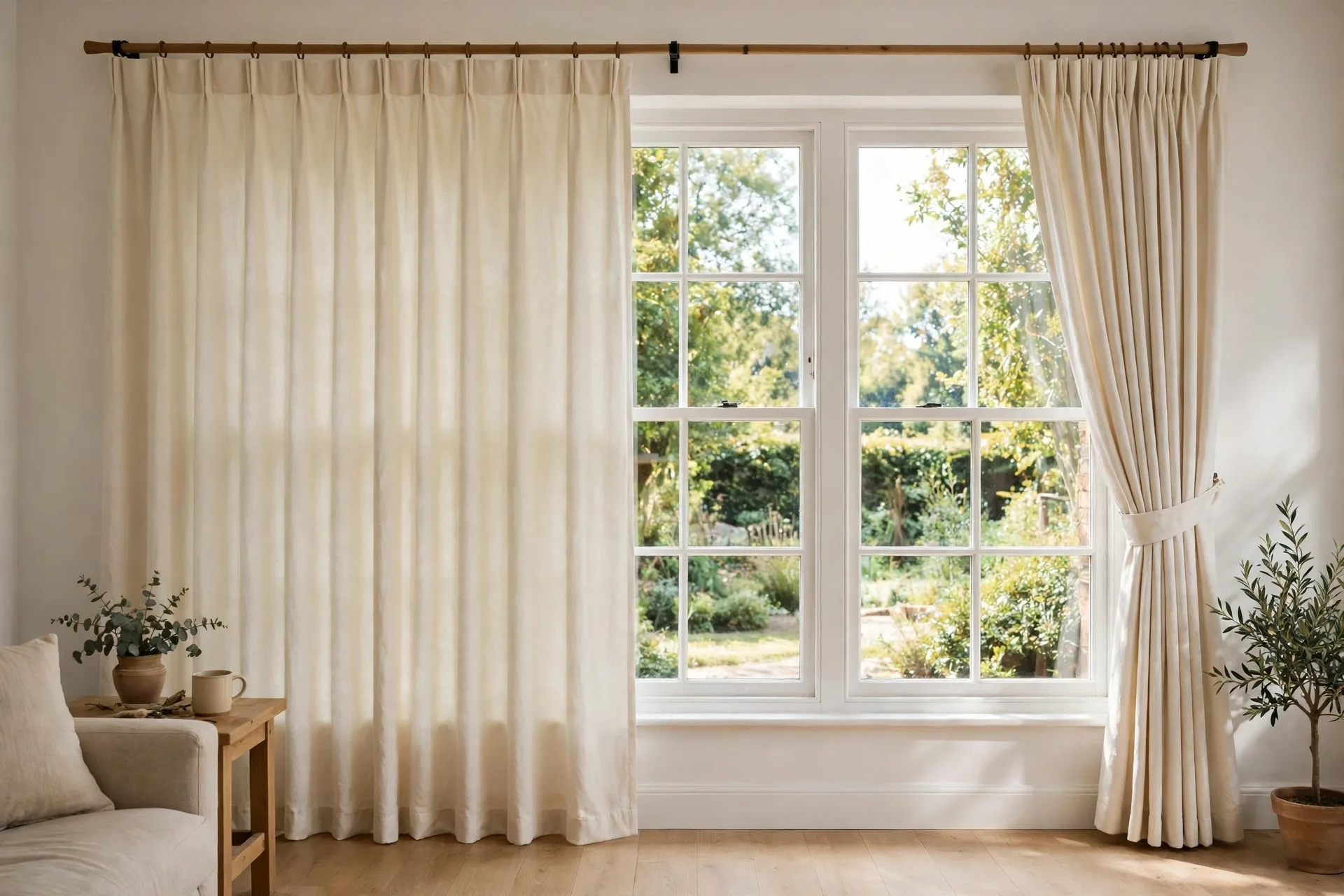
When open, the differences are about the stack. A 3x panel gathers into a stack roughly twice as wide as a 1.5x panel on the same rod, and that stack covers more wall and more glass at the edges. On a wide window the stack frames the view; on a narrow window it can cover a third of the glass and darken the room. Judge the ratio by both states: the folds when closed and the stack when open.
Train the folds once the panels are hung: tie them loosely with ribbon for 1 to 2 days so the folds set, steam out the wrinkles, and add weights to lightweight bottom corners so they hang straight. Tiebacks sit about one third up from the bottom. Lower fullness suits curtains that are opened often, because there is less bulk to move, while stationary panels that rarely close can handle more fullness. Long drapes stretch over time, so install them a half inch above the floor to allow for the settling.
Stack bulk: what high fullness costs when the curtains are open
Stack bulk is the space the open curtains occupy on the rod, and it grows with fullness. Every extra multiple of fabric has to go somewhere when the curtains are drawn back, and it goes into the stack at the sides of the window. A 2x panel on a 100-inch rod gathers into a stack of roughly 20 to 25 inches across both sides, while a 3x panel on the same rod gathers into a stack of roughly 30 to 35 inches. Those inches come off the glass and off the wall, and on a small window they matter.
The cost shows up in three places.
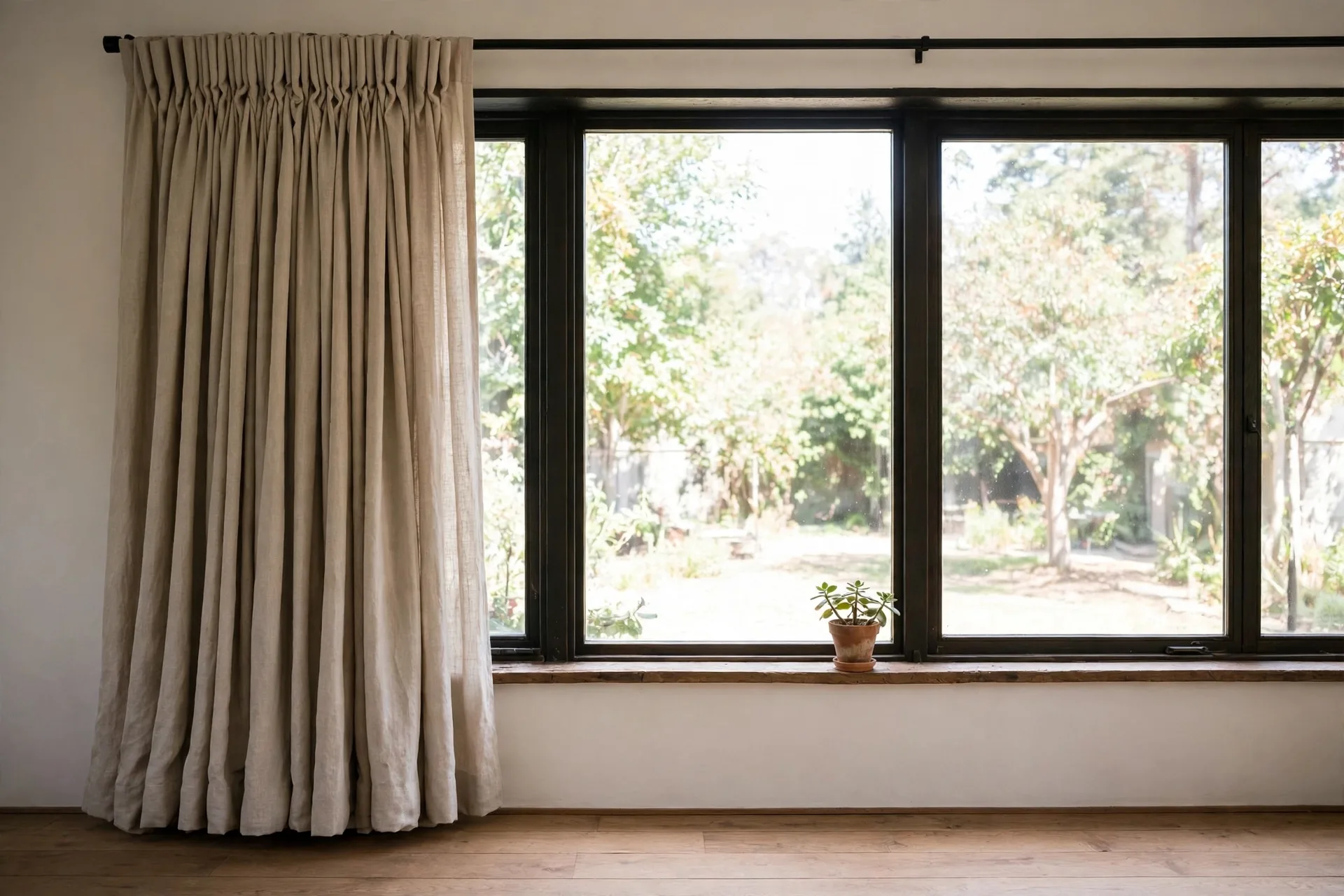
First, light: a wide stack covers the edges of the glass and cuts the daylight, so a room with high fullness curtains can feel darker even with the curtains open. Second, view: the stack narrows the clear glass, so a window bought for its view loses part of that view to fabric. Third, access: on a sliding door the stack can block the doorway itself, which is why stack space is measured before anything is ordered.
Lower fullness is the fix where the stack is the problem. A 1.5x panel stacks into a slim column that leaves the glass clear, which suits a small window, a room that needs every inch of light, and a door that must stay clear. A wave fold heading also stacks narrower than a pinch pleat at the same fullness, because its folds are shallow and even. If the stack is the deciding factor, choose the lowest fullness that still looks finished when closed, and check the stack width against the wall space before you order.
Choosing your fullness for your room and your fabric
Choose fullness in this order: fabric first, heading second, room third. Start with the fabric, because weight decides the range: heavy cloth 1.5x to 2x, mid-weight cloth 2x, light cloth and sheers 2x to 2.5x. Then check the heading, because it moves the number: pinch pleat 2.5x to 3x, grommet 1.75x to 2.25x, rod pocket 2x to 3x, wave fold by percentage on the track. Then check the room, because it decides whether the stack and the formality fit: a formal room takes more fullness, a small room takes less, and a door takes the lowest fullness that still closes well.
A living room with mid-weight linen and grommet tops is a 2x room: the fabric is mid-weight, the heading is happy at 2x, and the room wants a balanced look. A bright room with sheers is a 2x to 2.5x room: the sheer needs the density, and the stack is the price of the privacy.
Pattern matching changes the yardage. Add one full repeat to every cut except possibly the first, and the cutting length must be an exact multiple of the repeat, so the pattern lines up across panels. Add 10 to 15 percent for pattern matching, and buy 5 to 10 percent extra for shrinkage and cutting mistakes.
The room and the ceiling set the last check. Keep the same rod height in all rooms along the same wall, so the line runs true from room to room, and when in doubt, go longer. An 8-ft ceiling suits 84- or 96-in panels.
Frequently asked questions about curtain fullness
Most fullness questions come down to which ratio to pick, what the heading changes, and how the finished width works.
What is curtain fullness?
Curtain fullness is the ratio between the total flat width of your curtain fabric and the width of the rod it covers. At 2x fullness the fabric is twice as wide as the rod, and the extra fabric gathers into folds. At 1.5x the folds are shallow and tailored, and at 2.5x to 3x they are deep and full.
What fullness do most curtains need?
Most curtains need 2x fullness, which is the standard for a balanced, professional look across most fabrics and headings. Heavy fabrics can use 1.5x, formal drapes often need 2.5x to 3x, and sheers need 2x to 2.5x. Start at 2x and move only if the fabric or the heading pushes you.
Is 1.5x fullness enough?
It is enough for heavy fabrics, small windows, modern rooms, and decorative panels that rarely close. It is not enough for sheers, which look flat and thin at 1.5x, or for curtains that must close every night for privacy, where the shallow folds leave gaps. Below 1.5x a curtain stops looking like a curtain.
How much fullness do sheer curtains need?
Sheers need 2x to 2.5x fullness to look finished and to give daytime privacy. A sheer at 1.5x is thin and see-through, because the fabric is too light to make folds at a low ratio. The extra fabric is what gives a sheer its soft, layered look.
Does fullness change with the heading?
Yes. Pinch pleats need 2.5x to 3x, grommets need about 1.75x to 2.25x, rod pockets need 2x to 3x, and wave fold tracks use a percentage of the track width instead of a multiple. The heading builds the folds, so a heading that makes its own pleats needs more fabric than one that lets the rings make the wave.
What is the difference between finished width and pre-heading width?
The finished width is the width the panel covers on the rod once the heading is made. The pre-heading width is the flat fabric width before the heading is sewn, and it is about 4 to 6 inches wider. Always use the finished width for fullness and panel-count calculations, or you will order too few panels.
Does high fullness block more light?
Yes, when the curtains are closed, because the deeper folds overlap and leave fewer gaps at the edges. That is why high fullness helps blackout and privacy. When the curtains are open, high fullness blocks more light too, because the wider stack covers more of the glass.
How do I work out how many panels I need from the fullness?
Multiply the rod width by the fullness ratio to get the total fabric width, then divide by the finished width of one panel and round up. For example, a 72-inch rod at 2x fullness needs 144 inches of fabric, and with 50-inch finished panels that is 144 divided by 50, which is 2.88, rounded up to 3 panels.
For the standard lengths that go with these widths, see Curtain Sizes, and for the general measuring steps see How to Measure for Curtains.
This guide is research-based curation: we compared maker specifications, published reviews, and current prices. Read how we choose.