 Best
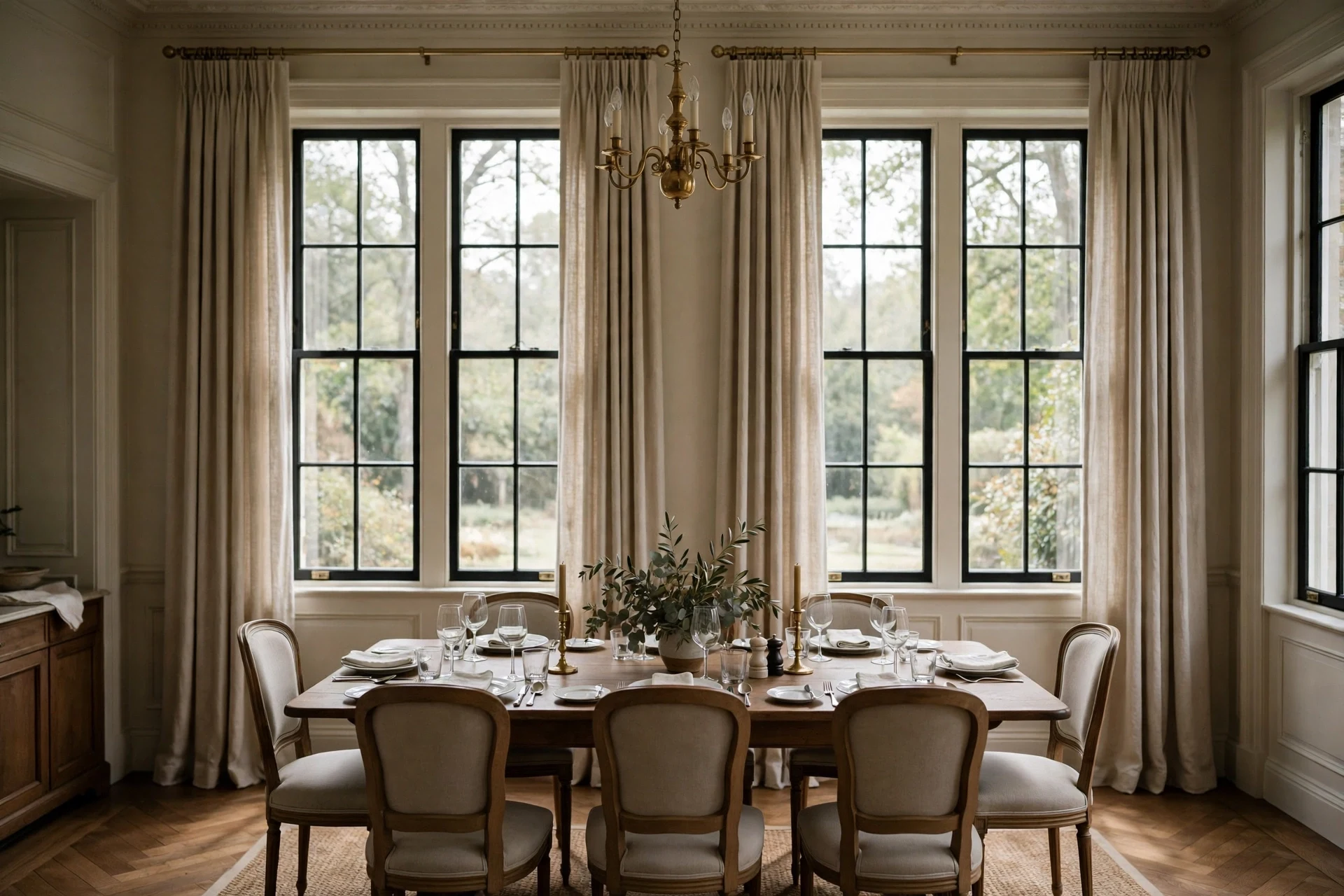
Best Curtains for Dining Room
A dining room guide to curtains that soften meal light, give evening privacy and suit the room without heaviness, with six picks by job.
The best curtains for dining room meals soften daylight at the table, give full privacy in the evening, and suit the room without making it feel heavy. Light-filtering linen and linen-look panels suit most rooms by day, with a closing layer for evening meals, while formal rooms suit heavier tailored drapes and everyday rooms suit washable fabric.
A dining room asks its curtains to do two opposite jobs in one day: soft daylight and a view at lunch, warmth and privacy at dinner. This guide covers formality, light, fabric, color, length, layering, measuring, hanging and care, and starts with six picks matched to dining jobs. For linen in more depth, see Best Linen Curtains. For the main guide as a whole, see Best Window Curtains.
Our dining room picks
The picks below cover six dining jobs: formal, casual everyday, linen-look day layer, evening privacy, easy care near a kitchen, and sun-facing. Read the best-for line first, then check panel count, size, lining and care label before you order.
As an Amazon Associate, we earn from qualifying purchases.
| Pick | Best for | Light by day | Evening privacy |
|---|---|---|---|
| 1. Tailored velvet drape | Formal dining | Soft, dimmed | Strong |
| 2. Washable linen-blend panel | Casual everyday dining | Filtered | Fair alone, pair for night |
| 3. Linen-look light-filtering panel | Daytime dining | Filtered, bright | Low alone, pair for night |
| 4. Room-darkening lined panel | Evening privacy | Dimmed when closed | Strong |
| 5. Washable polyester-blend panel | Easy care near a kitchen | Filtered | Fair alone, pair for night |
| 6. Lined light-filtering panel | Sun-facing dining | Filtered | Fair alone, pair for night |
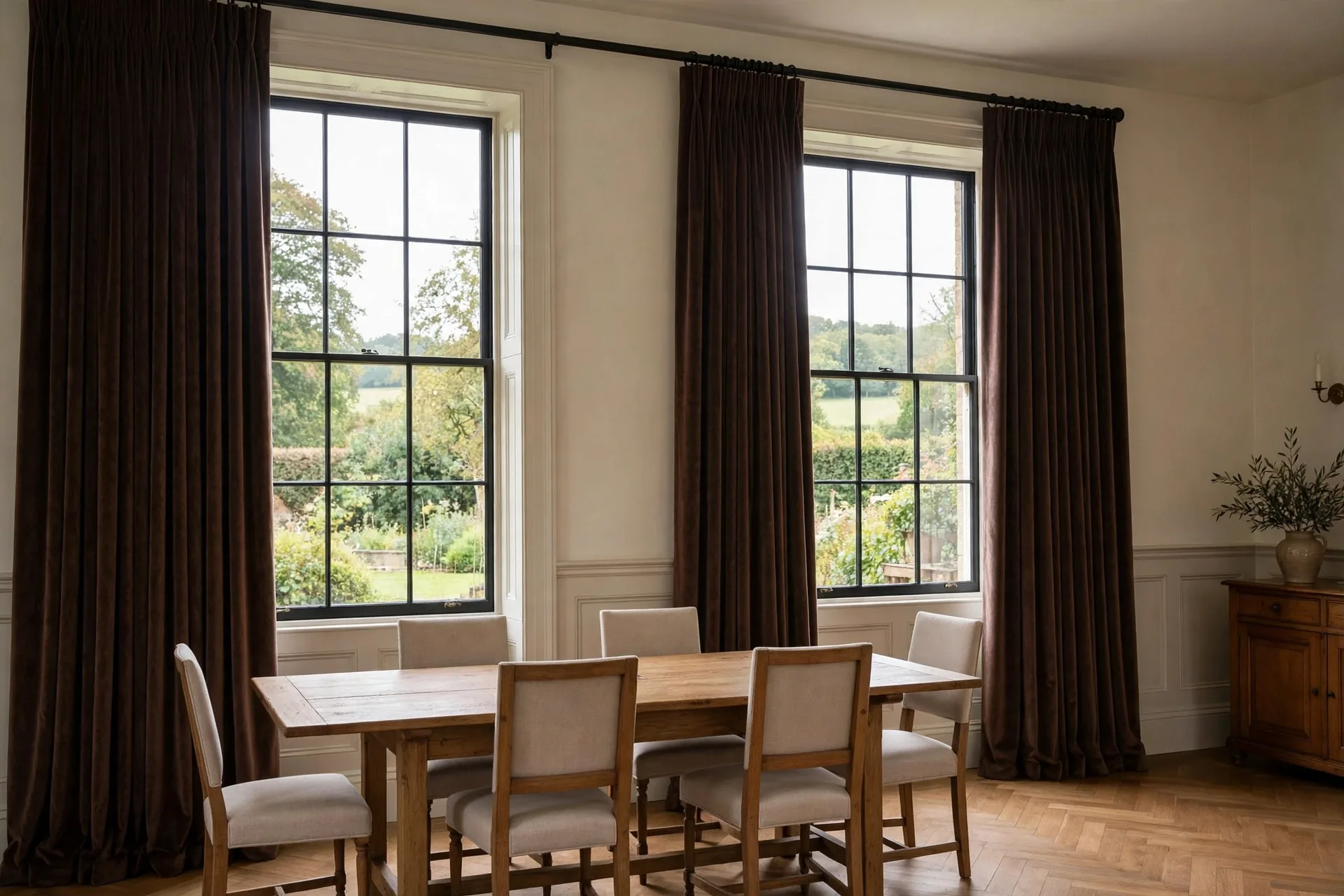
1. Tailored velvet drape, pinch pleat heading - Best for formal dining
- Best for: a formal dining room used for longer evening meals, where weight, structure and a finished look matter.
- Key features: velvet face fabric with a lined build, pinch pleat heading for a rod or track with rings and hooks, deep or warm neutral colors for lamplight.
- Pros: weight and drape suit a formal room, lining gives body, fuller folds soften sound.
- Cons: needs gentler washing or dry cleaning, heavy panels need a sturdy rod, velvet can hold food smells longer than a washable blend.
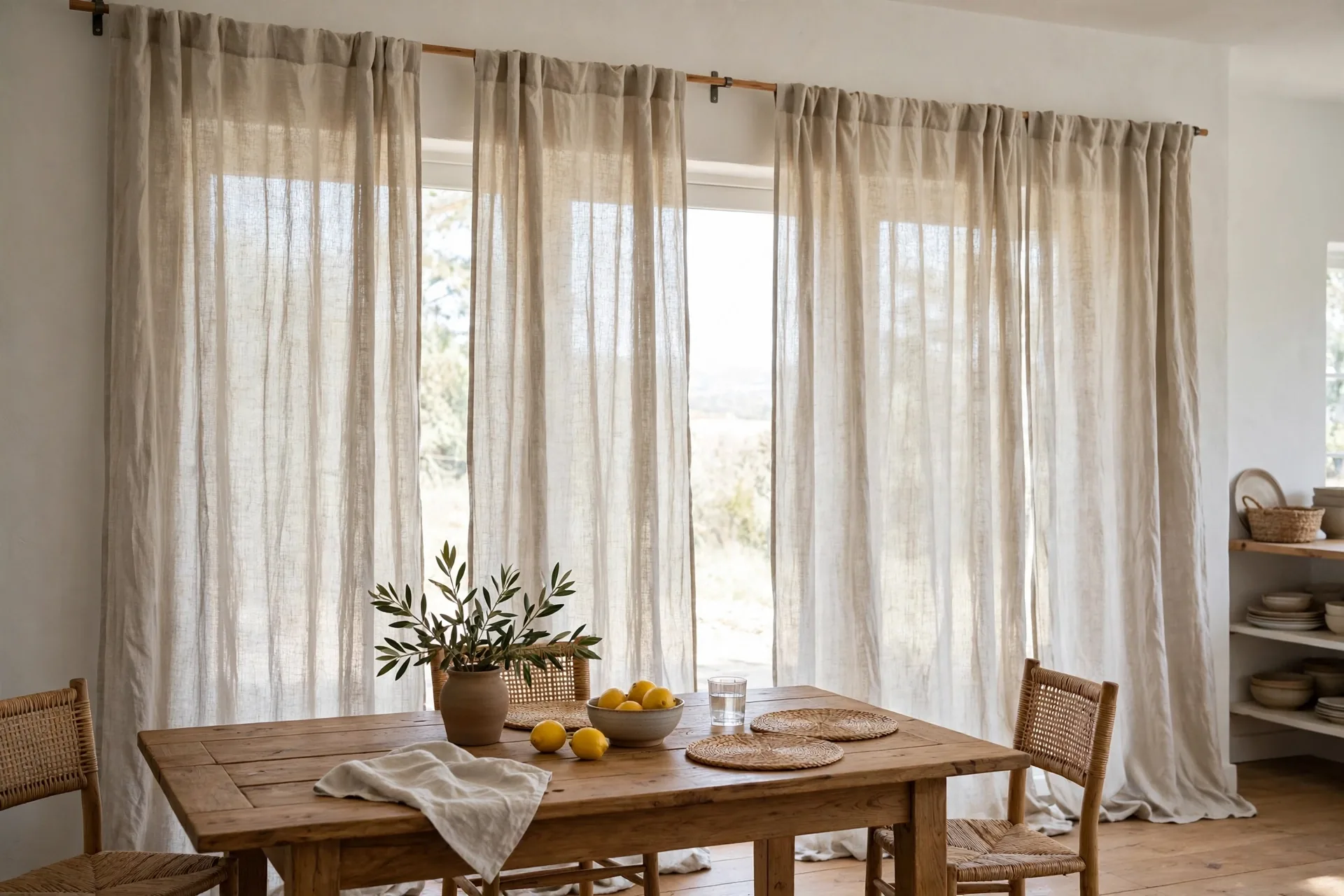
2. Washable linen-blend panel, simple heading - Best for casual everyday dining
- Best for: an everyday dining room used for breakfast, family meals and homework as well as dinner, where easy care matters as much as looks.
- Key features: linen-blend face fabric with a relaxed texture, simple grommet or rod pocket heading for daily use, soft neutral colors for wood tables and pale walls.
- Pros: linen look without the full creasing of pure linen, simple heading suits daily use, washable fabric suits spills.
- Cons: linen blends still crease and may need steaming, only fair evening privacy alone, so pair it with a closing layer.
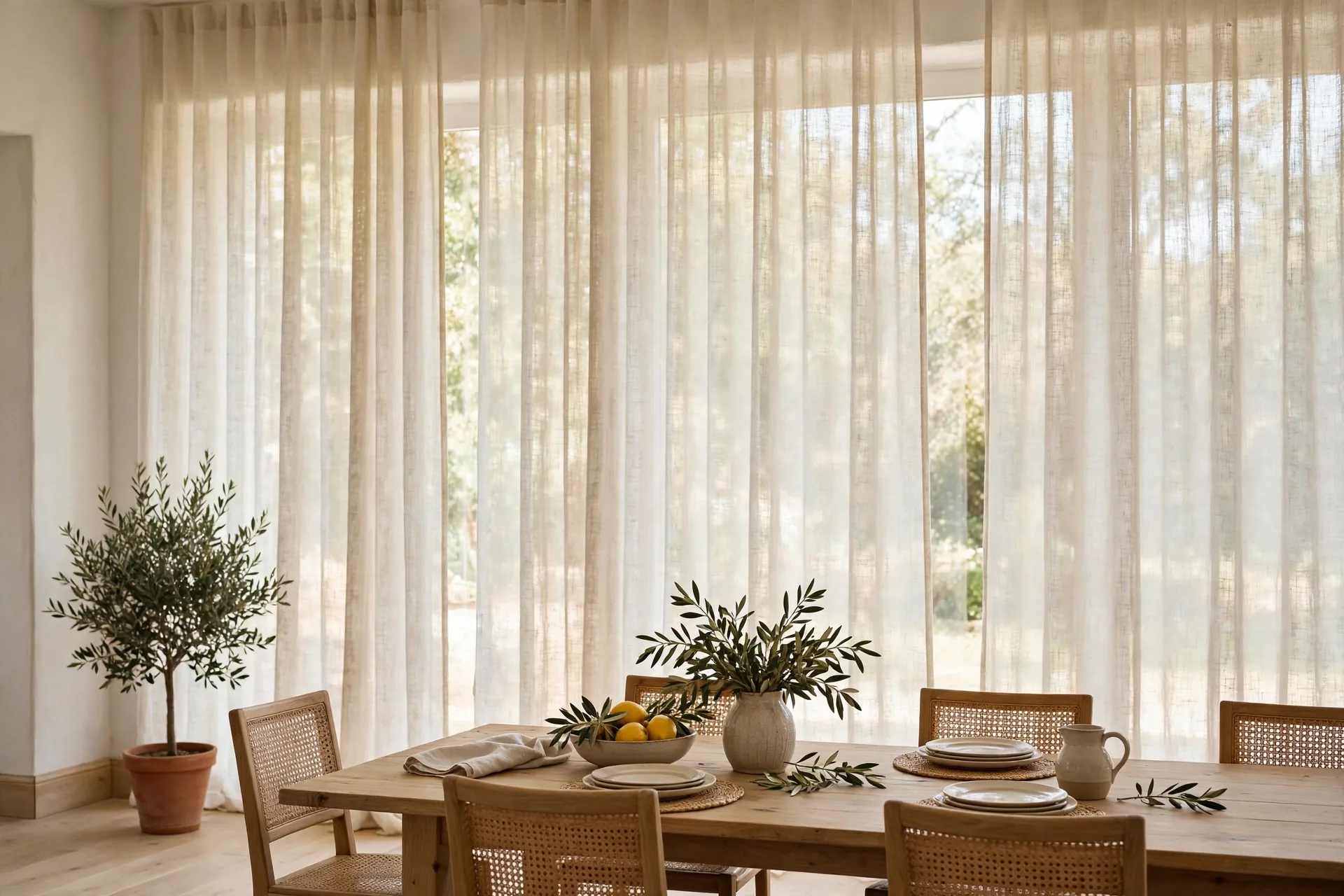
3. Linen-look light-filtering panel, day layer - Best for daytime dining
- Best for: a dining room used mainly by day, where soft daylight and a view matter more than full privacy.
- Key features: linen-look semi-sheer fabric that filters daylight into a soft glow, simple heading for a single or double rod, pale colors for a small room.
- Pros: bright, airy daylight without a bare window, soft texture suits a relaxed room.
- Cons: little privacy at night, so pair it with a closing layer, no glare control against low evening sun alone.
4. Room-darkening lined panel - Best for evening privacy
- Best for: a street-facing or evening-focused dining room where privacy and glare control at dinner matter most.
- Key features: solid face fabric with a room-darkening lining, simple heading for daily closing.
- Pros: full evening privacy when closed, cuts low evening glare, lining gives body.
- Cons: dims the room by day when closed, so open it fully for lunch, check lining for stiffness or peeling after washing, heavier than an unlined panel, so the rod must suit the weight.
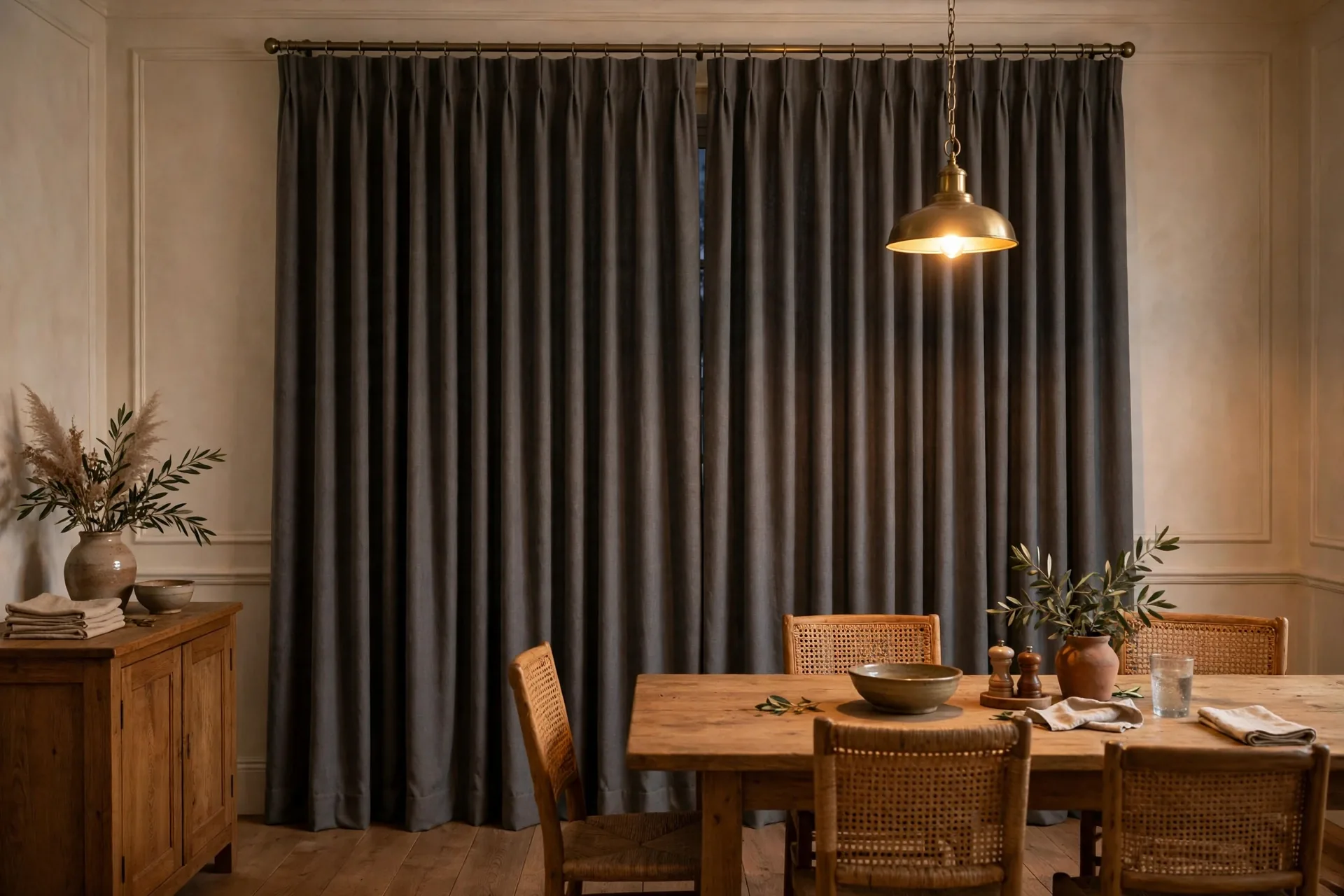
5. Washable polyester-blend panel - Best for easy care near a kitchen
- Best for: a dining room close to a kitchen, or a family dining room where spills, steam and food smells are a weekly fact.
- Key features: polyester-blend face fabric that resists creasing, simple heading for daily use, plain colors for most rooms.
- Pros: easy washing suits a room near food and steam, resists creasing better than linen.
- Cons: can look less natural than linen up close, so choose a textured blend, only fair evening privacy alone, so pair it with a closing layer, low-quality blends can trap smells.
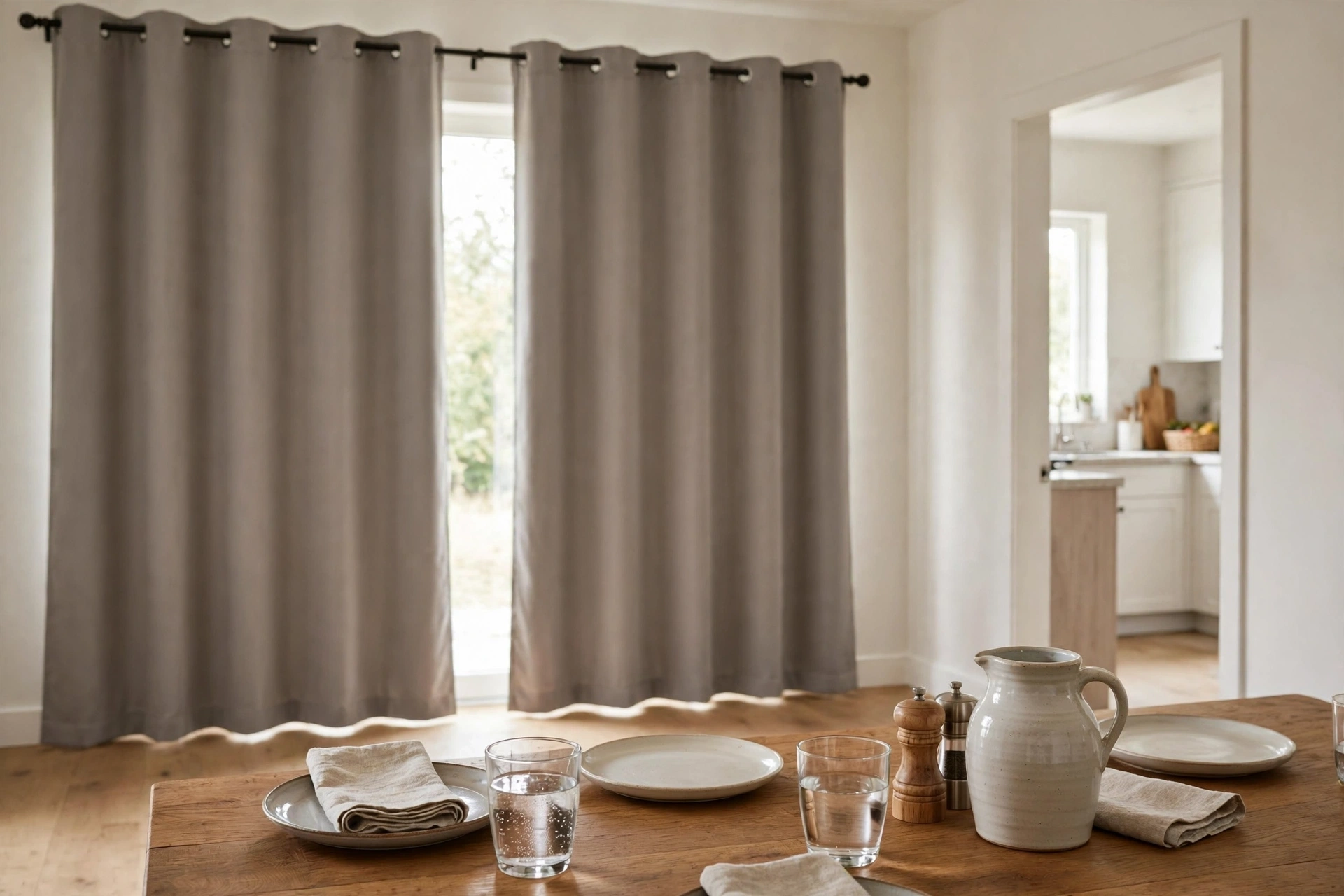
6. Lined light-filtering panel - Best for a sun-facing dining room
- Best for: a south- or west-facing dining room where strong sun fades fabric and throws glare across the table.
- Key features: light-filtering face fabric with a lining behind it, simple heading for daily use.
- Pros: lining helps shield the face fabric from sun, filters harsh daylight without shutting out the view.
- Cons: lining adds weight, so the rod must suit it, still needs a closing layer for full evening privacy, since it alone shows silhouettes at night.
What dining room curtains should do at mealtimes
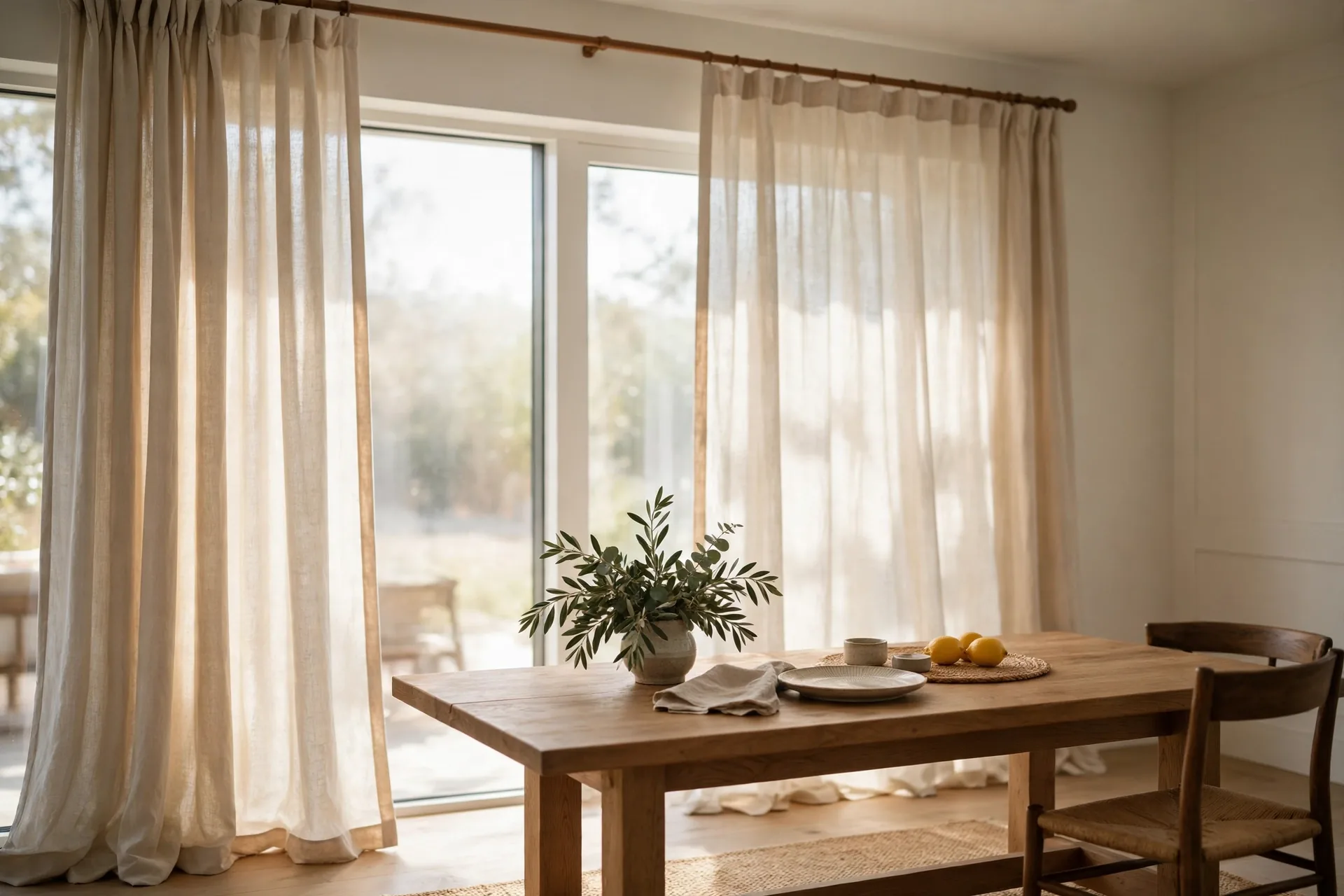
Dining room curtains should first soften the light on the table, then give privacy once the room lights are on, then frame the room without crowding it. A panel that does only one of those jobs will feel wrong at the other meal of the day.
Start with when the room is used most. A room used mainly for lunch and breakfast needs daylight first, so a light-filtering panel suits it. A room used mainly for evening meals needs privacy and mood first, so a closing panel matters more. A room used for both needs both layers, or one panel that filters by day and closes fully at night.
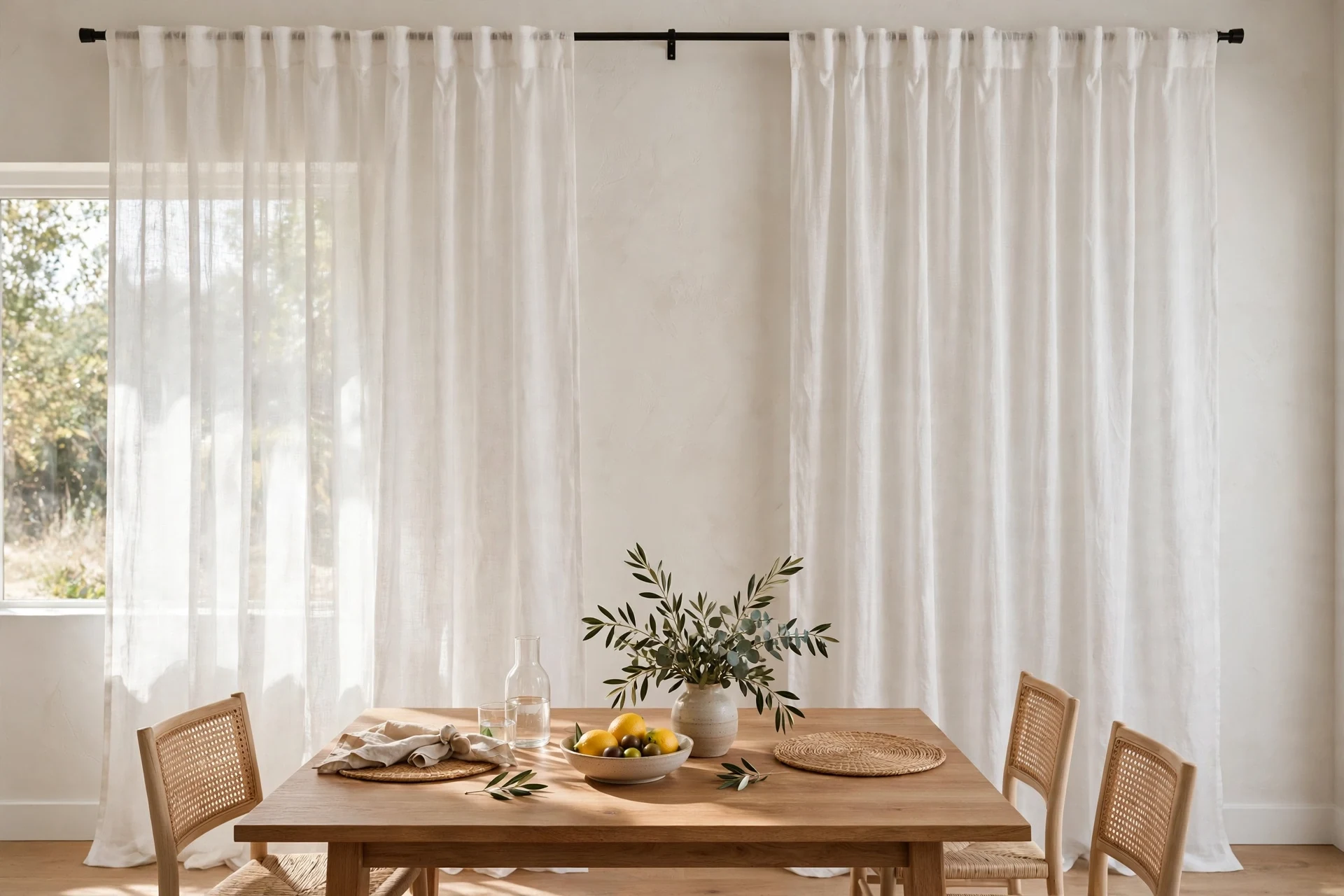
The third test is movement around the table. Chairs pull out and people stand up, so panels must hang clear of chair backs and feet. Floor length suits most rooms, but only when panels sit clear of pulled-out chairs, so check chair position before you order.
Formal dining or everyday dining: how the room changes the pick
A formal dining room suits heavier fabric, structured folds and a longer, more finished drop, while an everyday dining room suits lighter fabric, a simple heading and cloth that washes without fuss.
Formal rooms are used for longer seated meals, often in the evening, with a set table and lamplight. Velvet, jacquard or a lined linen drape in a deep or warm neutral suits that mood, and a pinch pleat heading gives the structured folds it expects.
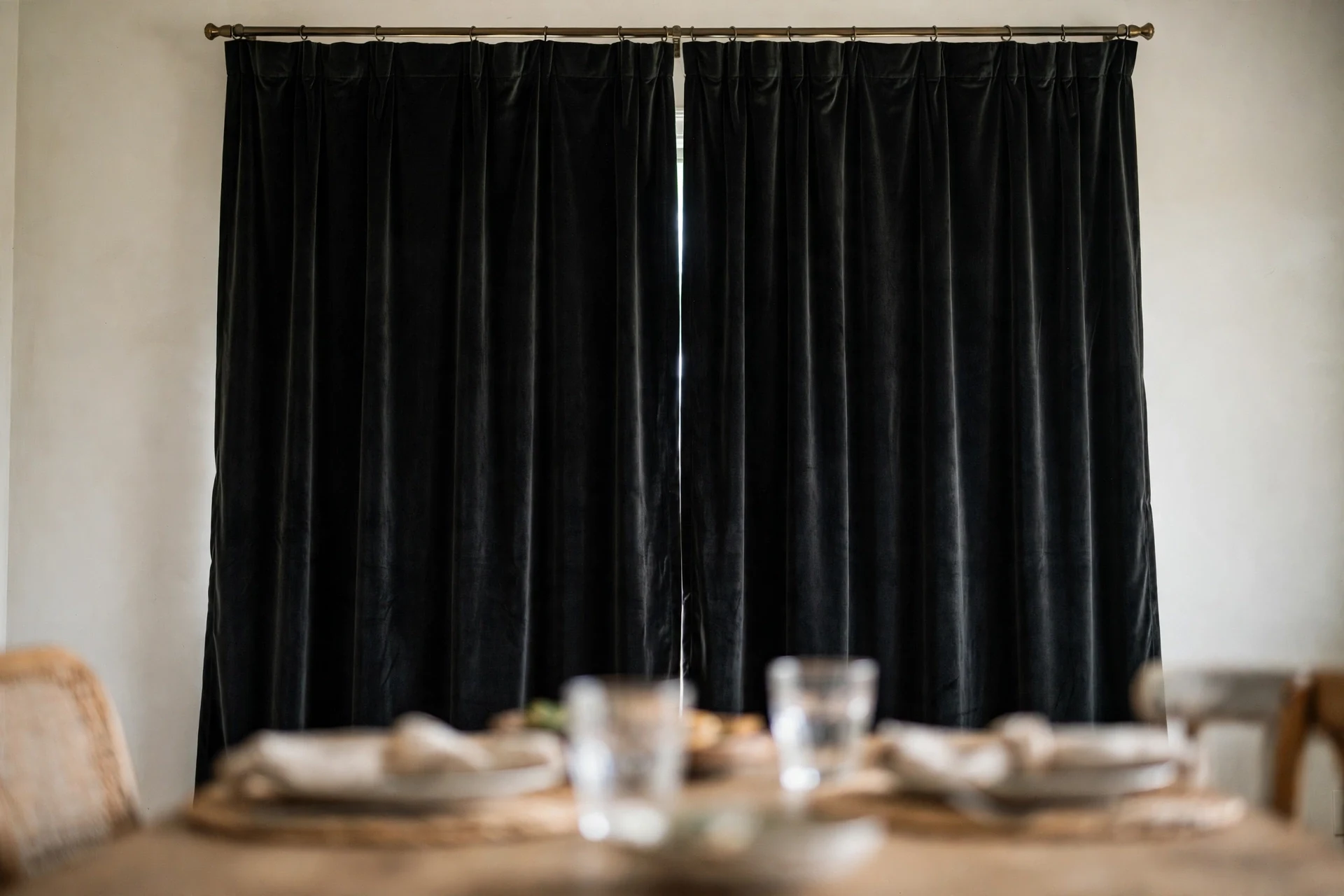
Everyday rooms are used for breakfast, homework, coffee and quick family meals as well as dinner. Linen blends, cotton blends and light-filtering panels suit that pace, and a grommet or rod pocket heading keeps daily use simple. Washable fabric matters here, since everyday rooms see more spills and steam than a room kept for occasions.
Heading choice changes both formality and how the panel moves, so match the heading to how often the panel is drawn as well as to the room.
| Heading | Formality | Fall | Glides or sits steady |
|---|---|---|---|
| Pinch pleat | Formal | Structured, even folds | Sits steady on rings and hooks, drawn by hand |
| Goblet pleat | Very formal | Rounded cups at the top, full folds below | Sits steady, best left dressed or drawn less often |
| Pencil pleat | Formal to everyday | Gathered, narrow folds | Sits steady on heading tape and hooks |
| Back tab | Everyday to smart casual | Clean, flat fall with the rod hidden | Slides less freely than a grommet, suits doors and windows opened less often |
| Flat panel | Casual | Simple, flat fall | Sits steady, best for panels rarely drawn |
| Grommet, also called eyelet | Everyday | Soft, even waves | Glides freely on a rod |
| Rod pocket | Casual | Soft, gathered fall | Grips the rod and sits steady, poor for daily drawing |
| Ripple fold | Modern, formal to everyday | Even, regular waves | Glides on track carriers |
Style mapping follows the same fabric, heading, and color choices. A traditional room suits velvet or jacquard with a pinch or goblet heading in a deep or warm neutral. A modern room suits a plain flat or ripple panel in a cool neutral with a simple rod. A farmhouse room suits linen or cotton with a back tab or grommet heading in a warm neutral. A coastal room suits a sheer or linen-look panel in a pale, airy color. A bohemian room suits a patterned or textured panel with a relaxed heading, kept to one bold element so the table stays the focus.
Light for meals without glare on the table
Soft, filtered light suits a dining table best, because harsh sun creates glare on plates and glassware and makes guests squint. A light-filtering panel spreads daylight across the room instead of letting one bright patch fall on the table.
Work out where the sun falls at mealtimes: afternoon sun throws low light across the table at dinner, morning sun is brightest at breakfast. A sheer or light-filtering linen layer handles most daytime glare on its own, since it diffuses the light without shutting out the view. For stronger evening sun, add a room-darkening closing layer that you draw only when the sun is low.
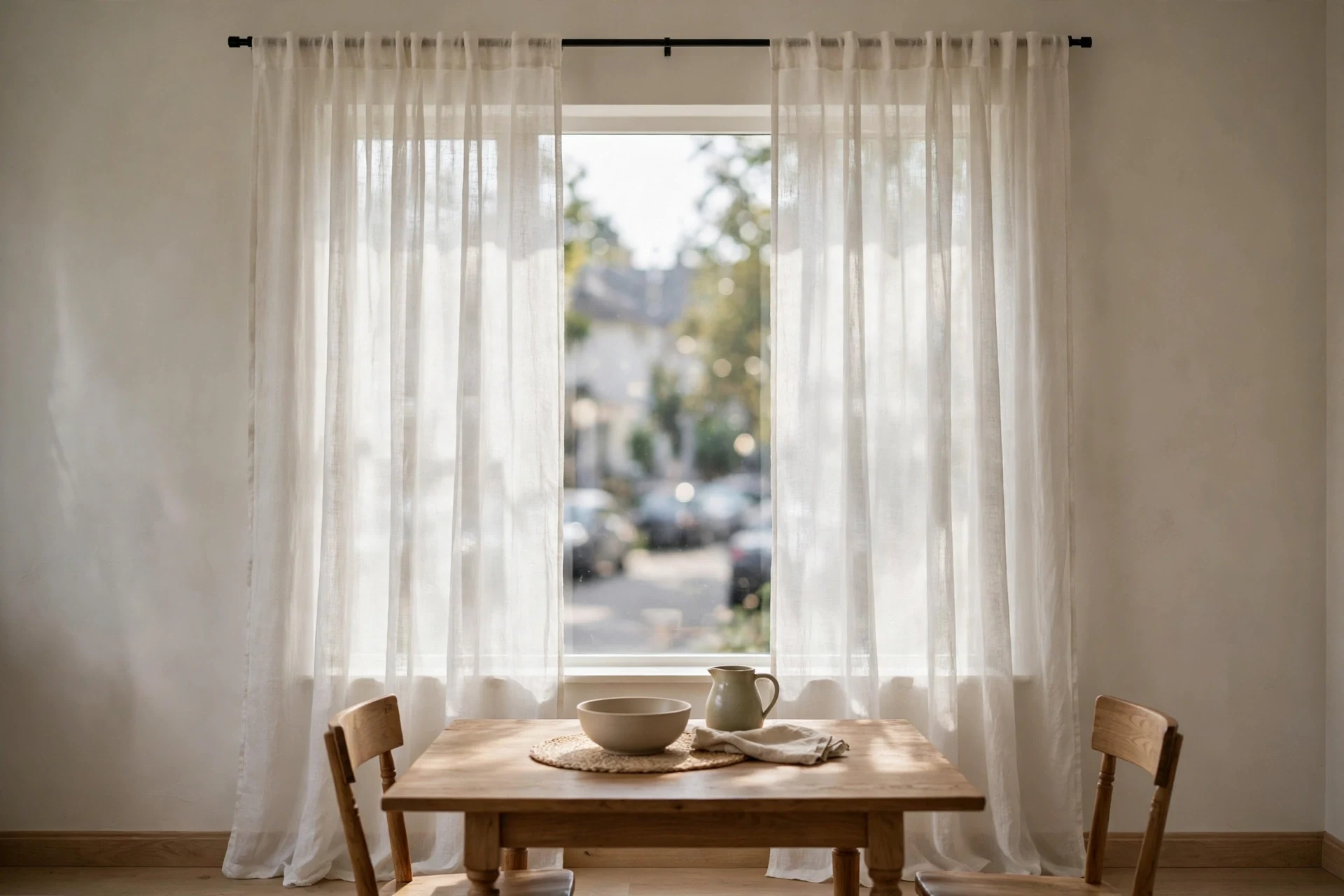
Color changes how the light feels. Warm neutrals such as ivory, oatmeal and warm white keep daylight soft and make food look natural under it. Test a swatch at the time you usually eat.
North-facing and east-facing rooms need a different light plan from the south- and west-facing rooms covered above. A north-facing window gives soft, diffused light through the day with less fading risk, so a sheer or light-filtering layer often carries the room on its own. An east-facing window is brightest at breakfast, so a light-filtering layer that handles morning glare matters most there, while evening privacy still needs a closing layer once the room lights are on.
Let the chandelier or pendant finish set the light tone for the room. Warm brass or bronze suits warm light and warm neutrals or deep jewel colors, while black or chrome suits cooler neutrals and crisper light. Under candlelight, heavier fabrics hold their color and glow, while pale sheers wash out, so test the fabric at dinner light, not only in daylight.
Evening privacy without shutting the room away by day
Evening privacy needs a solid closing layer, because a sheer alone shows silhouettes once the room lights are on. Daytime openness needs a light layer, so the answer for most rooms is two layers or one panel that can do both jobs at different times.
By day, close the sheer or light-filtering layer and leave the front panel open, so the room stays bright while the view in stays softened. In the evening, close the front panel for full privacy.
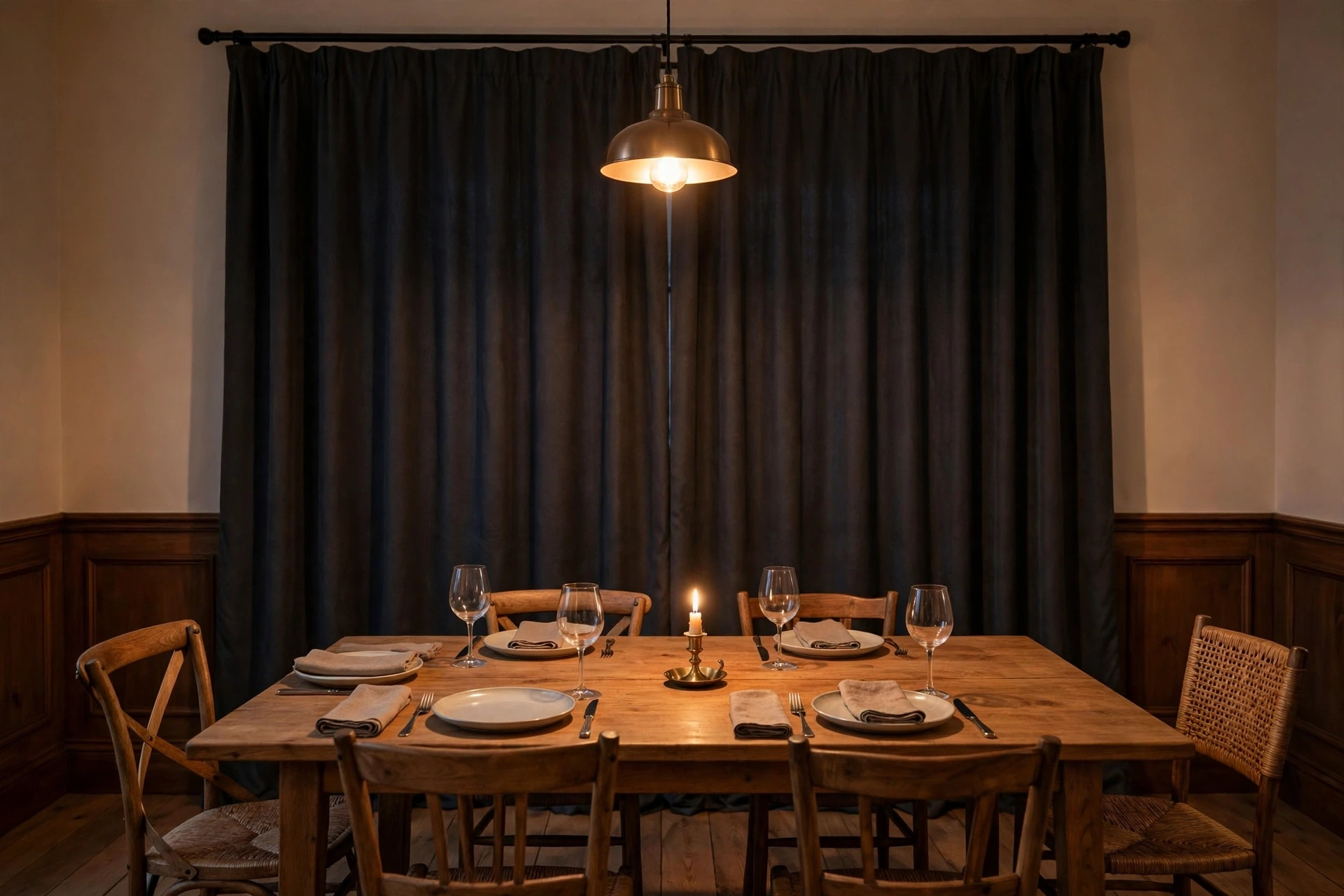
A single solid panel can work where privacy matters more than daylight. Choose a light-filtering solid panel rather than a heavy blackout panel, since full blackout can make the room feel closed at lunch. Street-facing rooms need the closing layer most, so plan it first and check closed panels after dark for a gap at the center join or sides.
Room-darkening and blackout are not the same job: a room-darkening panel dims the room and gives evening privacy, while a true blackout panel blocks almost all light when closed, with a lining and overlap that leave little light at the edges. A street-facing evening room used mainly at night is the case for the full-blackout branch, where a blackout closing layer over a sheer day layer gives the strongest evening privacy and blocks streetlight, as long as the layer is opened fully by day so the room does not feel closed at lunch.
Dining room fabrics: linen, cotton, velvet and sheer side by side
Linen and linen blends suit most dining rooms, cotton suits relaxed everyday rooms, velvet suits formal evening rooms, and sheer suits the day layer. No single fabric wins for every room, so match the fabric to how the room is used.
Linen has a natural texture that suits long meals and soft light, and linen blends hold their shape better and often wash more easily than pure linen, though linen creases and needs steaming after washing. For linen types, care and lining in full, see Best Linen Curtains.
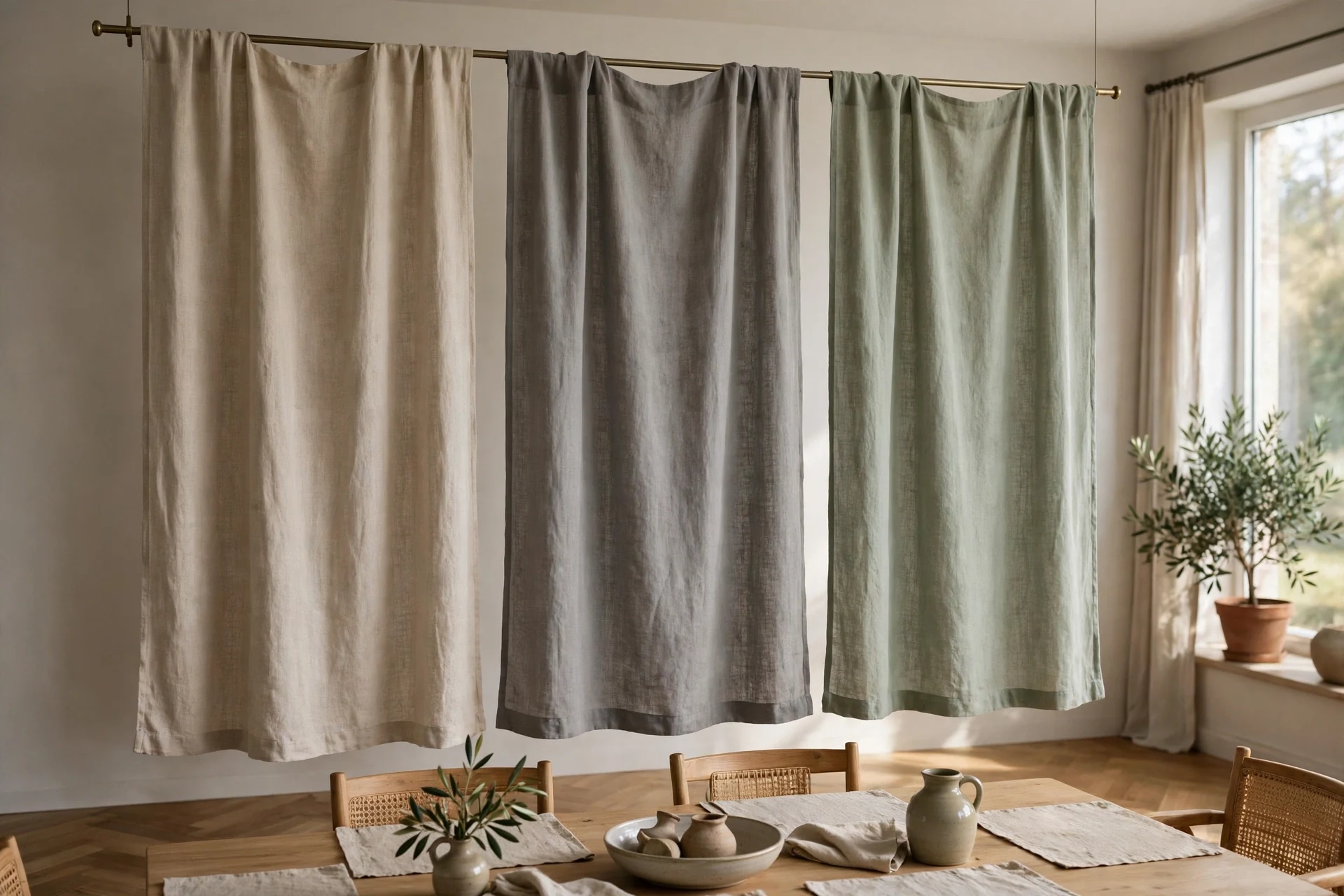
Cotton feels relaxed and familiar, and cotton blends are often washable, which suits daily use, though plain cotton lets in more light than a lined panel, so pair it with a lining or second layer for evening privacy. Polyester blends look like linen or cotton from across the room, wash easily, and resist creasing, so they suit rooms near a kitchen.
Velvet brings weight, warmth and sound softening to a formal room under lamplight, but it needs more care than linen or cotton, so check the label before daily use. Silk brings a soft sheen that glows under candlelight, but it fades fastest on a strong sun-facing window and usually needs dry cleaning, so save silk for a shaded or north- or east-facing window, or use it lined. Faux silk gives a similar sheen with easier care, though it still fades on a sun-facing window, so a lining suits it there too. For every fabric in more depth, see Curtain Fabric Types. Sheer fabric, such as voile or a linen-look sheer, filters daylight for the day layer, but gives little privacy at night alone, so pair it with a closing layer.
| Fabric | Formality | Light by day | Evening privacy | Care |
|---|---|---|---|---|
| Linen | Everyday to formal | Filtered, soft | Fair alone, pair for night | Creases, needs steaming, wash per label |
| Cotton | Everyday | Filtered, bright | Fair alone, pair for night | Often washable, check the label |
| Velvet | Formal | Soft, dimmed | Strong | Gentler washing or dry cleaning |
| Sheer, such as voile | Everyday, day layer | Bright, filtered | Low alone, pair for night | Gentle wash, hang to dry |
| Polyester blends | Everyday | Filtered | Fair alone, pair for night | Easy washing, resists creasing |
| Silk | Formal | Soft, dimmed | Strong when lined | Usually dry clean only, fades in strong sun |
| Faux silk | Formal to everyday | Soft, filtered | Fair to strong when lined | Easier care than silk, still fades in strong sun |
Color and pattern that let the table stay the focus
Plain neutrals suit most dining rooms, because they let the table, the food and the light over it stay the focus. A strong pattern can suit a large plain room, but it should be the one bold element, not one of several competing ones.
Warm neutrals such as ivory, oatmeal, beige, taupe and soft gray suit most dining rooms and wood tones, and look warm under evening light. Deep colors such as navy, forest green, burgundy and plum suit formal and larger rooms. Very bright colors can fight with food and tableware, so keep those for cushions or a runner.
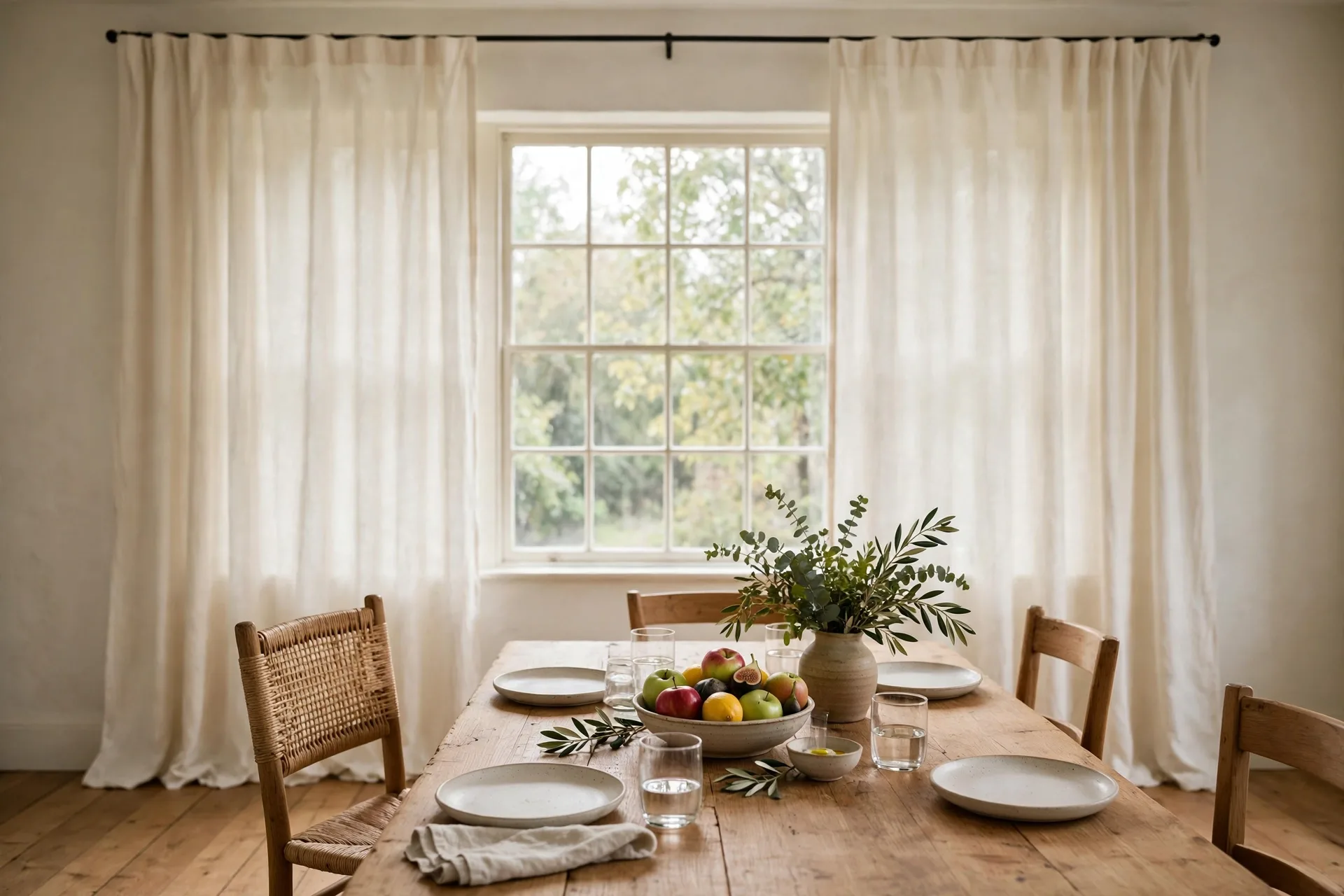
Pattern needs scale and restraint. A large print suits a large room with plain walls and chairs, while a small room with patterned wallpaper or chair fabric suits a plain panel. If you choose a pattern, pull one color from it into the table setting, such as a napkin, so it feels planned. Never match the curtain pattern exactly to the chair fabric, since the same print on two large surfaces reads as a set rather than a room.
Length, fullness and chair clearance in a dining room
Floor length suits most dining rooms, as long as panels end just clear of the floor and clear of chair backs when chairs are pulled out. Short panels suit only a window above a sideboard, radiator or bench seating, where floor length would block heat or bunch behind furniture.
The dining difference is clearance, not just drop. Pull the chairs out as if someone is sitting down, then check where the panel falls against the chair back and floor. Panels that brush chair backs will be pulled and creased every meal, and panels that pool on the floor collect dust and trip feet. A panel that just touches the floor, or stops a fraction above it, stays clean and moves freely.
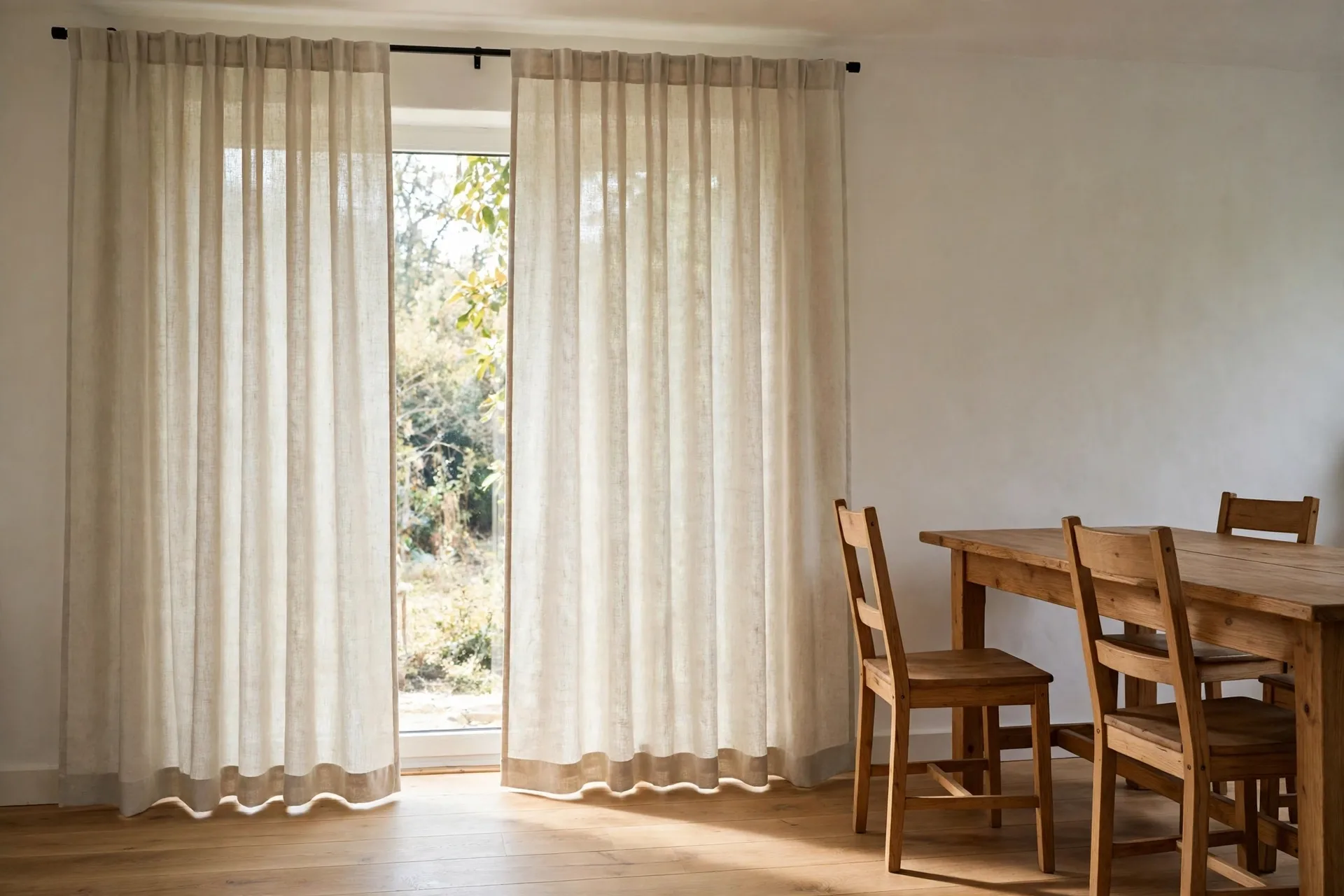
Fullness decides whether closed panels look generous or thin. Total panel width of about 2 times the rod width gives standard fullness, and formal drapes suit the fuller end of that range. Panels that only just meet in the middle look flat and leave a center gap, so order enough width for a slight center overlap. Hang the rod high and wide, above and past the frame, so open panels stack off the glass.
Awkward dining windows have their own answers. Cafe or half curtains suit a small or street-facing nook, since they cover the lower half for privacy while leaving the upper half open to light. Roman shades with side panels suit a narrow window or a wall of windows in different sizes, since the shade handles light and privacy and the panels frame the window without needing matching drops. Motorized operation suits a high or hard-to-reach window, since the panels can be opened and closed without reaching across furniture or climbing to the rod.
Room size and ceiling height in a dining room
Room size and ceiling height change the dining plan more than fabric alone. A small dining room suits light colors, a sheer-first single layer, and a ceiling-mount rod set wider than the frame, so the window reads taller and the wall stays uncluttered. A medium dining room suits the standard plan in this guide, with floor length, fullness of about twice the rod width, and a double layer where wall space allows. A large or open-plan dining room suits fuller panels, a longer drop, and a layered treatment, with the dining curtains coordinated with, not matched to, the neighboring living space.
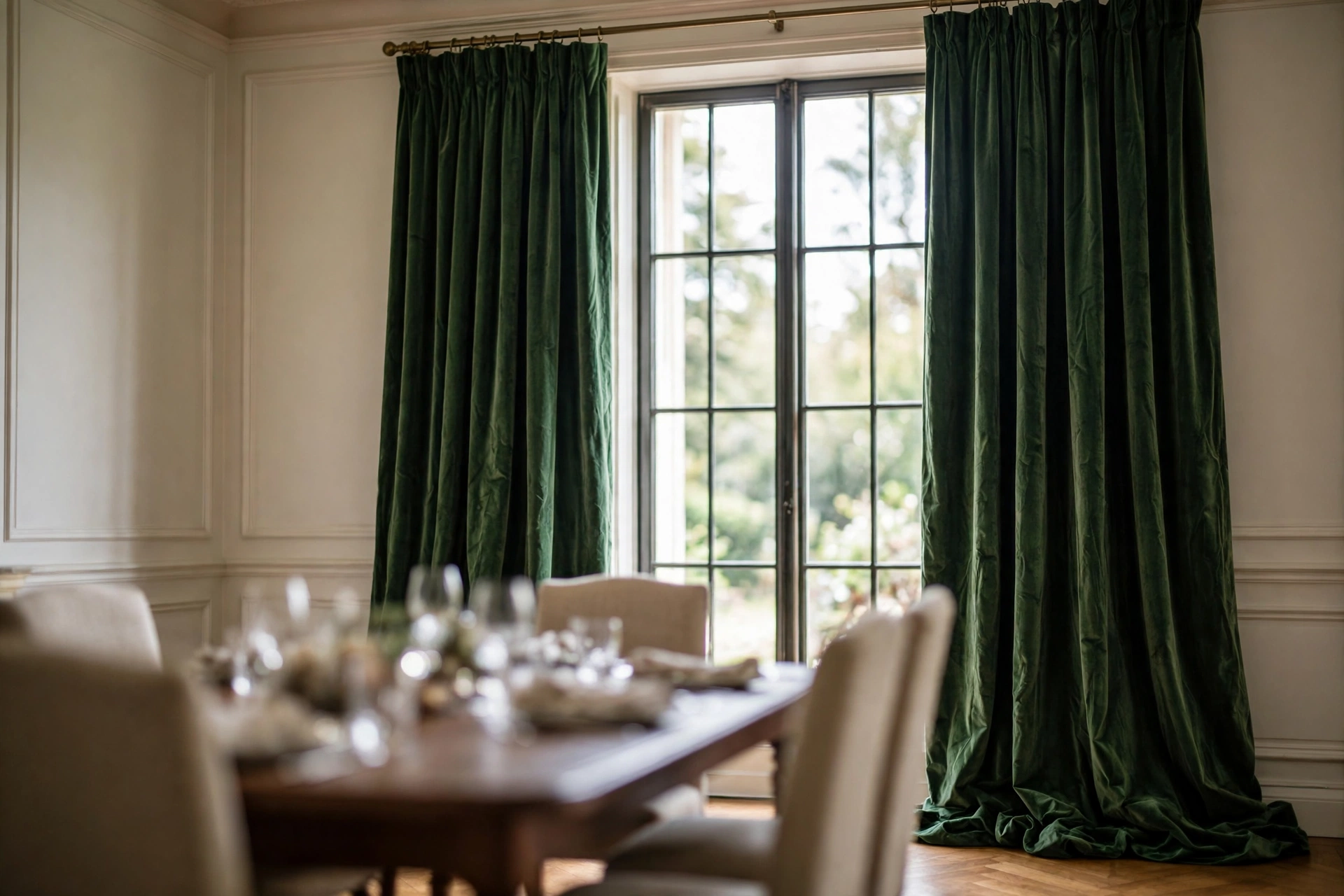
Panel length by ceiling height is a starting point to confirm against your rod to floor measurement, not a fit that suits every room. As a starting point, 102 to 104 inches suits a 9-foot ceiling with a high rod and 114 to 116 inches suits a 10-foot ceiling, when the rod sits high near the ceiling. Measure from your rod to the floor first, then compare the result against those lengths, and adjust for how the hem should finish.
Hem finishes have their own names, and each one needs the chair test. A kiss finish just touches the floor, so check with chairs pulled out that no chair foot catches the hem. A break finish bends slightly at the floor, so check that pulled-out chairs do not crumple or drag the bent hem. A puddle finish pools fabric on the floor, so keep it for a spacious formal room only, and check that chairs never roll or step onto the pooled fabric, since pooled fabric collects dust and trips feet in a busy room.
Layering a sheer with a closing panel for day and evening
Layering gives one dining window two moods: soft daylight and daytime privacy by day, full privacy and warmth at night. The usual order is a sheer closest to the glass and a heavier or room-darkening panel on the room side, on a double rod or track.
By day, close the sheer and open the front panel, so daylight filters through while the view in stays softened. At dinner, close the front panel, so the room feels private and settled.
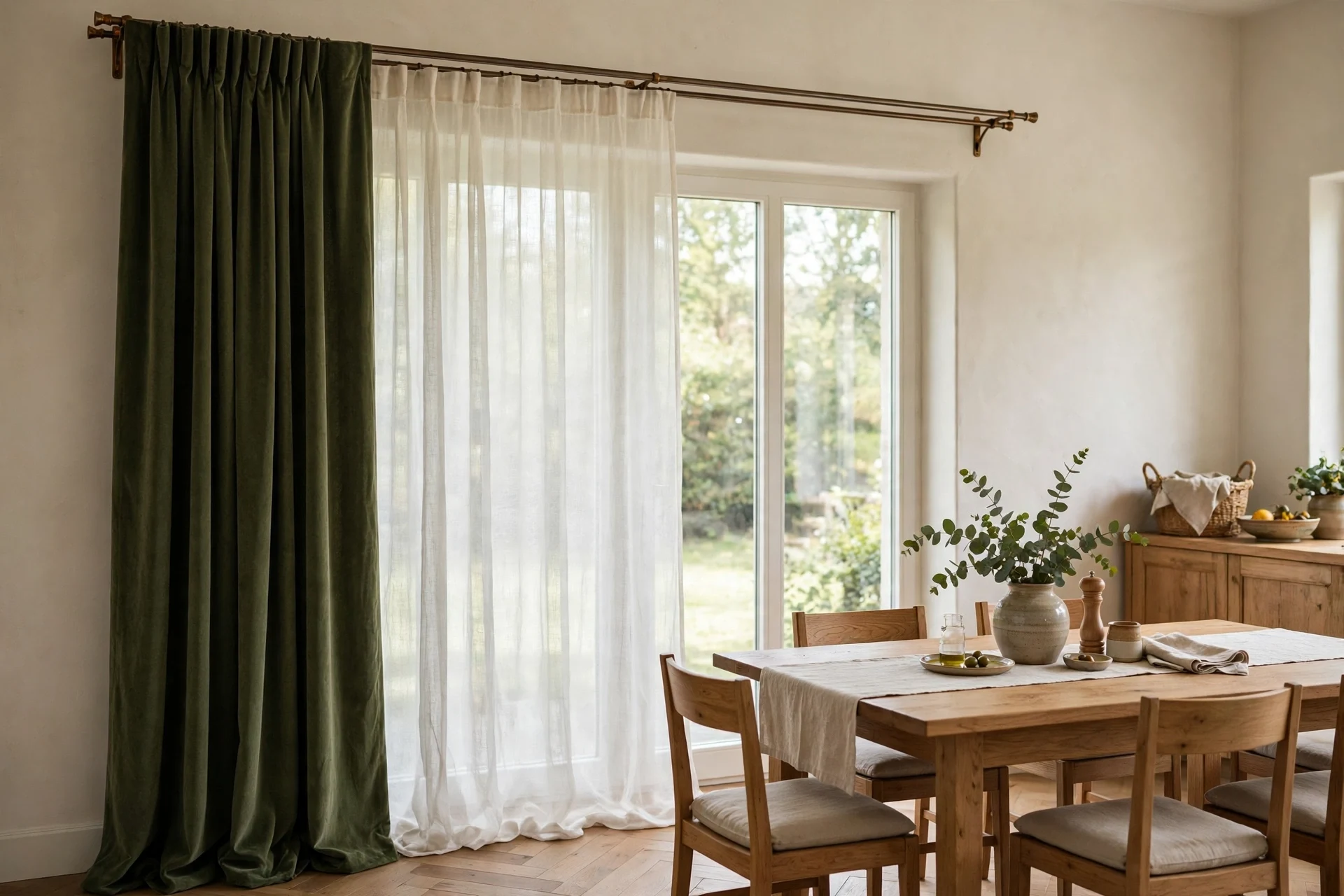
Keep the two layers close in color, with a white or pale sheer and a soft or deep front panel. If one layer carries a pattern, leave the other plain. A single layer can still work in a small room, where two layers can crowd the wall, but choose a light-filtering solid panel rather than a sheer. Layering also softens sound from hard surfaces such as wood, tile and glass. For layering plans in full, see How to Layer Curtains.
Dining rooms echo because hard surfaces dominate them: a bare table, wood or tile floors, glass, and plain walls bounce sound back instead of absorbing it. Heavier, fuller, or lined panels soften that echo more than a single light sheer, since more fabric and more folds break up the reflected sound. In an open-plan room the same sound travels into the living or kitchen space, so a fuller dining layer helps the whole shared room feel calmer at a full table, though curtains soften echo rather than soundproofing a room.
Measuring and hanging in brief for a dining room window
Measuring for a dining room window starts with the rod position, not the glass, since the rod decides how much light and privacy the panels can give. Hang the rod high and wide first, then measure from it.
If a rod is already hung, measure it first. If not, hang it above the frame and wider than the frame, so panels sit past the glass when closed and clear it fully when open. For width, order total panel width of about 2 times the rod width, so closed panels meet and overlap slightly in the center. For length, measure from the rod to the floor and end just clear of the floor, then check chair clearance with chairs pulled out before you order.
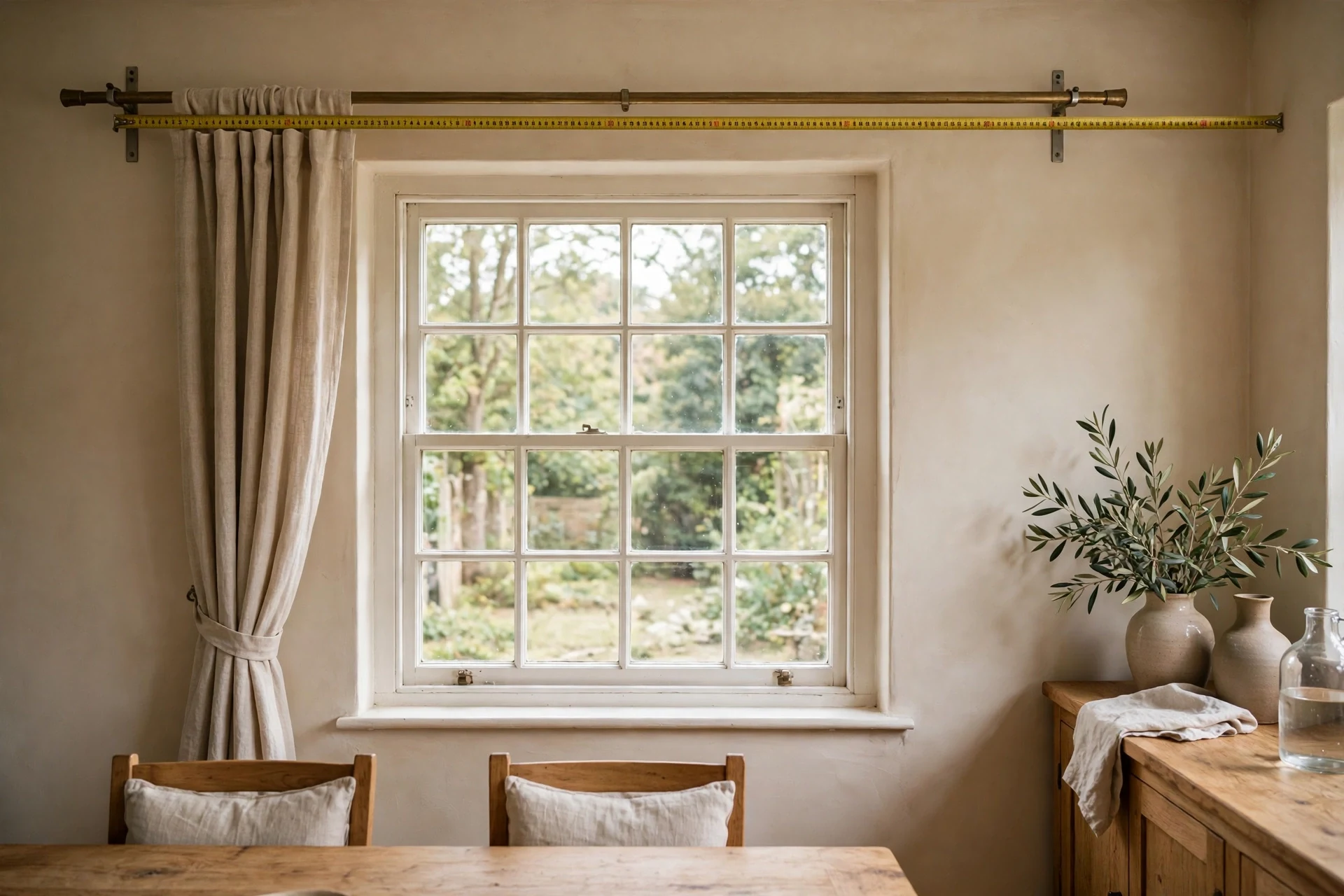
Hardware should match the room style and the panel weight. A warm brass rod suits a traditional room, matte black suits a modern or farmhouse room, and chrome suits a contemporary room, with the finial kept simple so the table stays the focus. Heavy velvet or lined panels need a thicker rod and a mounting plan to match, with a center support on a long span, so check the listing for the weight it suits rather than trusting looks alone. Set a tieback or holdback where the open panel falls in a neat sweep without pulling, lower for a formal long drape and near the middle for an everyday panel, and test the position with chairs pulled out before fixing it in place. For rod types, diameters, and brackets in full, see Best Curtain Rods.
This section is only a brief summary. For measuring detail, see How to Measure for Curtains. For hanging detail, see How to Hang Curtains. After hanging, check closed panels at the time you usually eat, for glare, for a center or side gap after dark, and for any panel that catches a chair back.
Care for food smells, steam and sun in a dining room
Dining room curtains need more washing than curtains in most other rooms, because they sit near food, steam and cooking smells. Washable fabric is the practical choice for an everyday room, and even a formal panel needs a cleaning plan before it goes up.
Food smells settle into fabric, and steam from a nearby kitchen can leave a stale smell in panels that are never washed. Vacuum panels with a soft brush head every few weeks, and wash them when they smell stale. Always follow the care label, since velvet, silk and lined panels often need different care from plain polyester or cotton.
Many polyester, cotton and linen-blend panels can be machine washed on a gentle cold cycle. Put grommet panels in a mesh bag so the rings do not mark the drum, dry on low heat or hang to dry, and rehang while slightly damp so the folds fall back into shape. Steam a hanging panel to remove fold lines, and keep a hot iron away from plastic rings and coated linings. Sun is the other wear factor: a south- or west-facing window can fade fabric, so a lined panel suits a sun-facing room better.
A UV-resistant or blackout lining also shields the face fabric and nearby furniture and wood from fading, so it is worth checking the lining type on the listing for a sun-facing dining window, not only the face fabric.
Mistakes that make dining room curtains look wrong or wear fast
The wrong fabric is rarely the only problem: fit, clearance and care cause most mistakes.
Hanging too low and too narrow is the first mistake: panels inside the frame leave light at the top and sides, so hang higher and wider. Ordering too little width is the second mistake: panels that just meet in the middle leave a center gap, so order enough width for overlap and folds. Leaving a sheer as the only night layer is the third mistake: sheers are for day, so close a solid layer each evening.
Choosing a puddled panel for a busy everyday room is the fourth mistake: pooled fabric collects dust and trips feet, so keep puddling for a spacious formal room. Ignoring chair clearance is the fifth mistake: panels that catch chair backs crease and pull every meal, so check clearance with chairs pulled out before you order. Choosing a high-care fabric near a kitchen is the last mistake: velvet or silk near steam and spills needs a cleaning plan a busy family room rarely keeps, so choose washable fabric there.
Frequently asked questions about dining room curtains
Should dining room curtains be sheer or solid?
Sheer suits daytime dining, while solid suits evening privacy and a formal room. Most rooms used both day and evening need both: a light-filtering layer by day and a solid closing layer at night.
What color curtains are best for a dining room?
Warm neutrals such as ivory, oatmeal, beige and taupe suit most dining rooms, looking soft in daylight and warm under evening light. Deep navy, forest green and burgundy suit formal or larger rooms, while very bright colors suit accents better.
Should dining room curtains touch the floor?
Floor length suits most dining rooms, with panels ending just clear of the floor so chairs and feet move freely. Puddled panels, with fabric pooling on the floor, suit only a spacious formal room, while sill length suits a window above a sideboard, radiator or bench seating.
How do I keep food smells out of dining room curtains?
Vacuum panels with a soft brush head every few weeks and wash them when they smell stale. Washable blends suit rooms near a kitchen best, and airing the room after cooking helps, but washing clears smells settled into the fabric.
Should dining room curtains match the living room curtains in an open plan space?
They should coordinate rather than match exactly. Repeat one element, such as the same fabric family or color, so the zones feel connected without looking identical.
What curtains suit a small dining room?
Light colors, a sheer-first single layer, and a ceiling-mount rod set wider than the frame suit a small dining room best. The light layer keeps the room bright, the single layer leaves wall space free, and the high, wide rod makes the window read taller.
Which heading suits a formal dining room?
A pinch pleat heading suits a formal dining room best, with its structured, even folds and tailored fall. A goblet heading suits a very formal room, where its rounded cups at the top give a fuller, more dressed look.
What length do I need for my ceiling height?
Measure from your rod to the floor first, then compare the result against these starting points: 102 to 104 inches for a 9-foot ceiling and 114 to 116 inches for a 10-foot ceiling, when the rod sits high near the ceiling. Those lengths are starting points to confirm against your measurement, not fits that suit every room, and the hem finish you want changes the final drop.
What is the difference between blackout and room-darkening?
Room-darkening dims the room and gives evening privacy, while true blackout blocks almost all light when closed, with a lining and overlap that leave little light at the edges. Choose room-darkening for a dining room that still needs soft light by day, and blackout for a street-facing evening room where blocking streetlight matters most.
Do dining room curtains help with echo?
Yes, a little. Heavier, fuller, or lined panels soften echo from hard surfaces such as wood, tile, and glass, since more fabric and more folds break up reflected sound. Curtains soften echo rather than soundproofing a room, and a single light sheer helps least.
How often should I wash dining room curtains?
Wash them when they smell stale, rather than on a fixed calendar, and vacuum them with a soft brush head every few weeks in between. Rooms near a kitchen or used for daily family meals need washing more often than a formal room used only for occasions, and the care label decides the washing method for each panel.
This guide is research-based curation: we compared maker specifications, published reviews, and current prices. Read how we choose.